Class 10 Social Science – Minerals and Energy Resources (Geography: Chapter 5) Summary + MCQs + Q&A
CHAPTER SUMMARY-MINERALS AND ENERGY RESOURCES
1. What are Minerals?
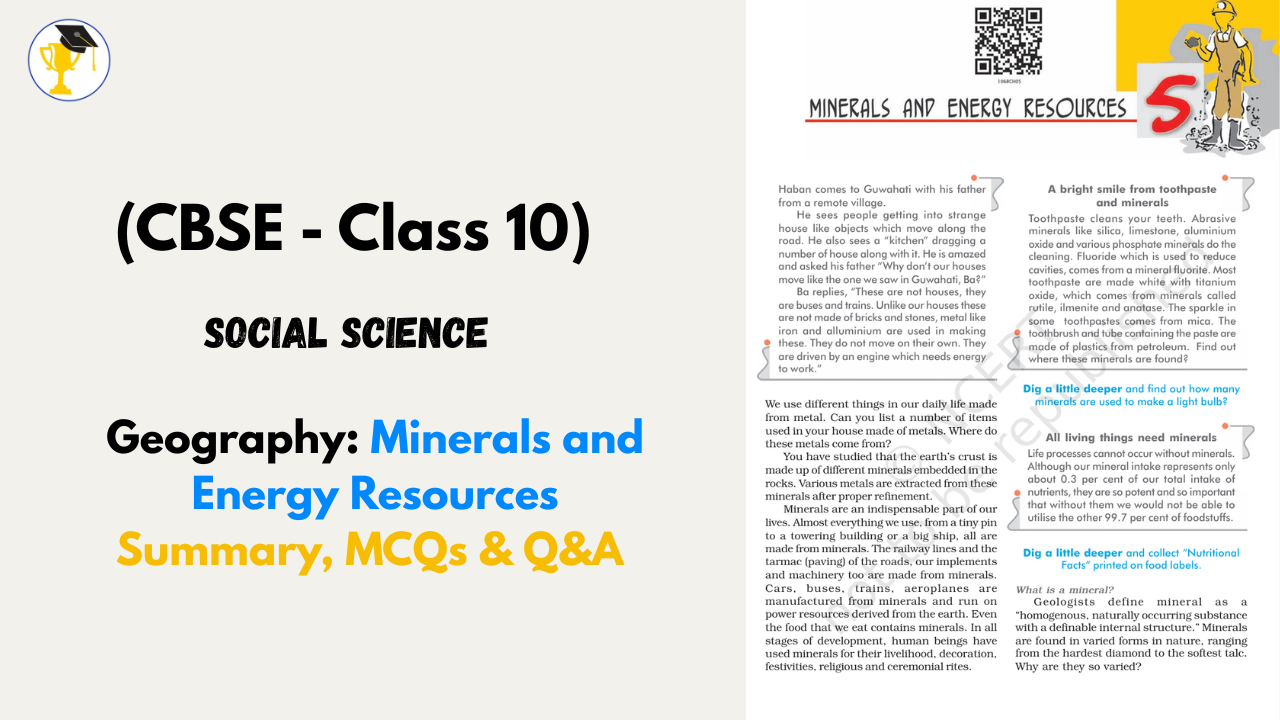
A mineral is a “homogeneous, naturally occurring substance with a definable internal structure.”
They are formed in varied conditions—ranging from hardest diamonds to softest talc.
Minerals are indispensable for human life because:
-
They are used in construction (cement, iron, steel).
-
Used in manufacturing machinery, tools, vehicles.
-
Used in toothpaste, cosmetics, medicines, and even electronics.
2. Mode of Occurrence of Minerals
Minerals occur in different forms:
(a) In Igneous & Metamorphic Rocks
-
Found in veins and lodes.
-
Examples: Tin, Copper, Zinc, Lead.
(b) In Sedimentary Rocks
-
Formed through deposition.
-
Examples: Limestone, Iron ore, Manganese, Gypsum.
(c) Placer Deposits
-
Minerals that can’t be dissolved in water.
-
Example: Gold, Silver, Platinum found in river sands.
(d) Ocean Waters
3. Nature of Mineral Distribution in India
India is rich in mineral deposits, but highly unevenly distributed.
For example:
-
Peninsular rocks → Iron ore, manganese, copper, bauxite
-
Gujarat & Rajasthan → Petroleum
-
Jharkhand, Odisha, Chhattisgarh → Coal & iron ore belts
4. Types of Minerals
(A) Metallic Minerals
-
Iron ore: Hematite, Magnetite
-
Manganese: Used in steel production.
-
Copper: Conductors, electronics
-
Bauxite: Aluminium extraction
(B) Non-Metallic Minerals
5. Energy Resources
Energy is essential for industry, transport, domestic use, and agriculture.
Conventional Sources
-
Found in: Jharia, Raniganj, Bokaro
-
Types: Anthracite, Bituminous, Lignite
-
Found in: Mumbai High, Gujarat, Assam
-
Used for fuels & petrochemicals
-
Environment-friendly
-
Found in: Krishna–Godavari basin, Mumbai High
-
Thermal power (coal)
-
Hydel power (water)
Non-Conventional Sources
-
Solar energy → Gujarat, Rajasthan
-
Wind energy → Tamil Nadu, Gujarat
-
Biogas → Rural households
-
Tidal, Geothermal energy → Experimental stages
-
Nuclear power → Jharkhand, Rajasthan (thorium in Kerala sands)
6. Conservation of Minerals
Minerals are exhaustible and non-renewable. Conservation is essential.
Steps for Conservation:
KEY TERMS
|
Term
|
Meaning
|
|
Mineral
|
Naturally occurring substance with definite structure
|
|
Ore
|
Mineral containing metal that can be extracted profitably
|
|
Ferrous
|
Minerals containing iron
|
|
Non-Ferrous
|
Minerals without iron
|
|
Placer Deposits
|
Minerals found in river sands
|
|
Petroleum
|
Fossil fuel called “Black Gold”
|
|
Hydel Power
|
Electricity generated from water
|
MCQs (10 Important Questions)
1. Which is the finest iron ore?
a) Hematite
b) Magnetite
c) Limonite
d) Siderite
Answer: b) Magnetite
2. Which mineral is used in electrical and electronic industries?
a) Bauxite
b) Mica
c) Copper
d) Limestone
Answer: b) Mica
3. Mumbai High is famous for:
a) Iron ore
b) Coal
c) Petroleum
d) Gold
Answer: c) Petroleum
4. Which is a non-conventional energy source?
a) Coal
b) Petroleum
c) Natural Gas
d) Solar Energy
Answer: d)
5. The largest producer of wind energy in India is:
a) Karnataka
b) Gujarat
c) Tamil Nadu
d) Rajasthan
Answer: c)
6. “Black Gold” refers to:
a) Coal
b) Natural Gas
c) Petroleum
d) Bauxite
Answer: c)
7. The most important ore of aluminium is:
a) Hematite
b) Copper pyrite
c) Bauxite
d) Manganese
Answer: c)
8. Which mineral family is used in cement?
a) Iron
b) Limestone
c) Gold
d) Mica
Answer: b)
9. Tidal energy projects are being developed in:
a) Gujarat
b) Assam
c) Kerala
d) Odisha
Answer: a)
10. Which is a non-metallic mineral?
a) Copper
b) Bauxite
c) Mica
d) Iron ore
Answer: c)
CASE-BASED QUESTIONS
CASE 1: Minerals in Daily Life
PASSAGE:
We use minerals daily — from toothpaste and light bulbs to mobiles, vehicles, roads, and buildings. Toothpaste contains silica, limestone, mica, and phosphates. Roads contain tar and minerals, while vehicles require iron, aluminium, and steel. Even kitchen utensils, wires, and ornaments are made from various minerals. Minerals form an essential part of our lives and industries, and their efficient extraction and use are crucial for economic development.
Questions:
1. Name any two minerals used in toothpaste.
Ans: Silica, Limestone, Mica
2. Which metal is mainly used in vehicles?
Ans: Iron / Aluminium
3. Why are minerals important for industries?
Ans: They provide raw materials for manufacturing goods and machinery.
4. What does this passage reveal about minerals?
Ans: Minerals are essential in daily life and industrial development.
CASE 2: Distribution and Formation of Minerals
PASSAGE:
Minerals occur in different types of rocks—igneous, sedimentary, and metamorphic. They may occur in cracks, crevices, veins, and lodes. Minerals like gold, silver, and platinum are found in placer deposits. Petroleum is found in sedimentary rocks. India’s mineral distribution is uneven, with rich deposits in Jharkhand, Odisha, Chhattisgarh, Karnataka, and Rajasthan, while states like Kerala and Tamil Nadu have beach sands containing thorium.
Questions:
1. Where are minerals like copper and zinc usually found?
Ans: In veins and lodes of igneous and metamorphic rocks
2. What are placer deposits?
Ans: Minerals found in river sands (gold, silver, platinum)
3. Name two states rich in mineral deposits.
Ans: Jharkhand, Odisha
4. Which mineral is found in beach sands of Kerala?
Ans: Thorium
CASE 3: Energy Resources in India
PASSAGE:
Energy resources are vital for agriculture, industry, and household needs. Coal is the most abundant fossil fuel in India and is used for thermal power. Petroleum, known as “Black Gold,” is used for transport and petrochemicals. Natural gas is an eco-friendly fuel. India is also developing non-conventional energy resources such as solar, wind, tidal, geothermal, and biogas. Tamil Nadu leads in wind energy, while Rajasthan and Gujarat have abundant solar energy.
Questions:
1. Why is petroleum called “Black Gold”?
Ans: Because it is valuable and essential like gold.
2. Which state leads in wind power generation?
Ans: Tamil Nadu
3. Name two non-conventional energy sources.
Ans: Solar, Wind
4. Why is natural gas considered eco-friendly?
Ans: It produces less pollution compared to coal and petroleum.
ASSERTION–REASON QUESTIONS
Set 1
A: Minerals are exhaustible natural resources.
R: Minerals take millions of years to form.
Answer: A – Both A and R are true and R explains A.
Set 2
A: Magnetite is of inferior quality compared to hematite.
R: Magnetite contains more iron (up to 70%).
Answer: A is false, R is true.
Set 3
A: Bauxite is the ore of aluminium.
R: Aluminium is extracted from iron ore.
Answer: A is true, R is false.
Set 4
A: Coal is a conventional source of energy.
R: It is used for electricity generation and industrial purposes.
Answer: A
Set 5
A: Non-conventional energy sources are renewable.
R: Solar and wind energy can be replenished naturally.
Answer: A
Set 6
A: Petroleum is mainly found in igneous rocks.
R: Petroleum occurs in sedimentary basins.
Answer: A is false, R is true.
Set 7
A: India has abundant reserves of thorium.
R: Sand deposits of Kerala contain monazite.
Answer: A
Set 8
A: Iron ore is essential for the steel industry.
R: Steel requires iron ore as a basic raw material.
Answer: A
Set 9
A: Wind energy is widely used in India.
R: India has long coastlines favourable for wind farms.
Answer: B – Both statements true, but R is not the correct explanation.
Set 10
A: Limestone is used in cement industry.
R: Limestone has metallic properties.
Answer: A is true, R is false.
VERY SHORT ANSWERS
What is ore? → Mineral with high metal content.
Name one nuclear mineral. → Uranium / Thorium
What is the use of limestone? → Cement manufacturing
Where is mica found in India? → Jharkhand, Andhra Pradesh
What is the most important coal type? → Bituminous
SHORT ANSWERS (3–4 Marks)
1. What are the different modes of occurrence of minerals?
Minerals occur in:
-
Veins and lodes in igneous & metamorphic rocks
-
Layers in sedimentary rocks
-
Placer deposits (river sands)
-
Ocean water
Each mode forms minerals under specific physical and chemical conditions.
2. Why is conservation of minerals important?
Minerals are finite and non-renewable. Their formation takes millions of years. Over-extraction leads to environmental degradation. Conservation ensures sustainable development through recycling, reduced wastage, and use of substitutes.
3. Distinguish between ferrous and non-ferrous minerals.
-
Ferrous minerals contain iron (e.g., iron ore, manganese).
-
Non-ferrous minerals do not contain iron (e.g., bauxite, copper).
Ferrous minerals are used in steel manufacturing, whereas non-ferrous minerals are used for electrical, aircraft, and alloy industries.
LONG ANSWERS
Q1. Describe the classification of minerals in India.
Minerals are broadly classified into metallic and non-metallic minerals. Metallic minerals include ferrous minerals like iron ore and manganese, which contain iron, and non-ferrous minerals like copper, bauxite, and gold, which do not contain iron. Non-metallic minerals include mica, limestone, gypsum, and dolomite; these are used in cement, insulators, and fertilizers. Energy minerals like coal, petroleum, and natural gas play a crucial role in power generation, transportation, and industries. India also has significant deposits of nuclear minerals like uranium and thorium. This varied classification helps in understanding the use and distribution of mineral wealth across the country.
Q2. Explain the importance of non-conventional energy resources in India.
Non-conventional energy sources such as solar, wind, tidal, geothermal, and biogas are renewable, eco-friendly, and sustainable. As India faces increasing pollution and depletion of fossil fuels, these alternatives provide clean energy solutions. Solar energy is abundant in Rajasthan and Gujarat, while Tamil Nadu leads in wind power. Biogas plants support rural households by converting waste into energy. Tidal and geothermal projects are being developed experimentally. Non-conventional sources reduce dependence on coal and petroleum, ensuring energy security and environmental protection for future generations.
Q3. Describe the occurrence, distribution, and importance of iron ore in India.
Iron ore is a ferrous mineral essential for the steel industry. It occurs mainly as hematite and magnetite. Hematite, with high iron content, is the most important ore. Major iron ore belts in India include Odisha–Jharkhand, Durg–Bastar–Chandrapur, Bellary–Chitradurga–Chikmagalur in Karnataka, and Maharashtra–Goa belt. Odisha and Jharkhand are the leading producers. Iron ore is used in manufacturing steel, machinery, vehicles, tools, buildings, and infrastructure. It is the backbone of industrial development in India.
For full chapter click on: Minerals and Energy Resources


 STUDY MATERIALS
 COURSES
 MORE
MORE
 SUCCESS STORY
 ADMISSION
 STORE
STORE