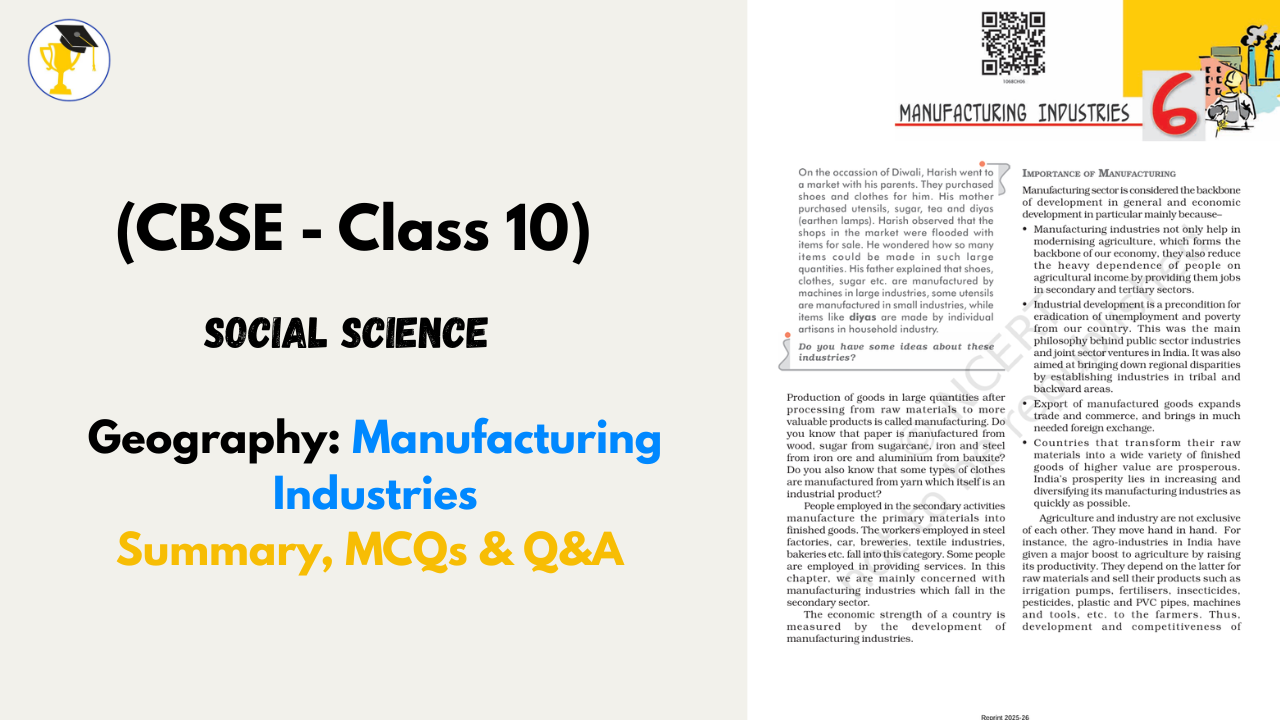
Class 10 Social Science -Manufacturing Industries (Geography: Chapter 6) Summary + MCQs + Q&A
CHAPTER SUMMARY-MANUFACTURING INDUSTRIES
1. Introduction
Manufacturing means production of goods in large quantities after processing raw materials into more valuable products.
Examples:
- Paper from wood
- Sugar from sugarcane
- Iron and steel from iron ore
- Aluminium from bauxite
The manufacturing sector is part of the secondary sector, which converts raw materials from the primary sector (like agriculture and mining) into finished goods.
2. Importance of Manufacturing
The manufacturing sector is called the backbone of economic development because:
- It modernises agriculture by supplying tools, machines, and fertilizers.
- It reduces dependence on agriculture by creating jobs in industry and services.
- It helps eradicate poverty and unemployment.
- It boosts exports and earns foreign exchange.
- Industrial development reduces regional imbalances and promotes self-reliance.
Agriculture and industry move hand in hand — industries need raw materials from agriculture, while agriculture uses industrial goods like machinery and fertilizers.
3. Classification of Industries
Industries are classified based on different criteria:
|
Basis
|
Type
|
Examples
|
| Source of raw material |
Agro-based, Mineral-based |
Sugar, Cotton, Iron & Steel |
| Main role |
Basic, Consumer |
Iron & Steel, Sugar |
| Capital investment |
Small-scale, Large-scale |
Handicrafts, TISCO |
| Ownership |
Public, Private, Joint, Cooperative |
SAIL, Dabur, OIL, Amul |
| Weight of raw materials/products |
Heavy, Light |
Iron & Steel, Electronics |
4. Agro-Based Industries
Textile Industry
- Largest and oldest industry in India.
- Contributes significantly to employment, GDP, and exports.
- Complete value chain: from raw material to finished product.
Cotton Textiles
- First mill: Mumbai (1854).
- Concentrated in Maharashtra, Gujarat, Tamil Nadu.
- Factors: Raw cotton, port access, labour, moist climate.
- Spinning → Centralised; Weaving → Decentralised.
- Khadi and Handloom provide large rural employment.
Jute Textiles
- India: 1st in raw jute production; 2nd in jute goods (after Bangladesh).
- Located mainly along Hugli River (West Bengal).
- Factors: Water transport, port, cheap labour, raw material proximity.
- Used for gunny bags, mats, carpets.
Silk and Woollen Industry
- Silk: Karnataka, Tamil Nadu, Assam, West Bengal.
- Wool: Punjab, Haryana, Rajasthan, Gujarat.
Sugar Industry
- 2nd largest producer after Brazil.
- Concentrated in UP, Bihar, Maharashtra, Karnataka.
- Shifting towards South India due to higher sucrose content and better climate.
5. Mineral-Based Industries
Iron and Steel Industry
- Basic industry — supports all others.
- Major raw materials: Iron ore, Coal, Limestone (ratio 4:2:1).
- Located in Chotanagpur Plateau (Jharkhand, Odisha, WB).
- Public sector plants: Bhilai, Rourkela, Durgapur, Bokaro, Vishakhapatnam.
- Steel = measure of a nation’s development.
Aluminium Smelting
- 2nd most important metallurgical industry.
- Lightweight, corrosion-resistant, and used in aircraft, cables, utensils.
- Raw material: Bauxite → refined using electricity.
- Plants: Odisha, Kerala, Tamil Nadu, Maharashtra.
Chemical Industry
- Fast-growing sector (inorganic + organic).
- Inorganic chemicals: sulphuric acid, soda ash, caustic soda.
- Organic chemicals: petrochemicals, plastics, dyes, synthetic fibres.
- Major centres: Gujarat, Maharashtra, Tamil Nadu, UP, Punjab.
Fertilizer Industry
- Produces nitrogenous (urea), phosphatic (DAP), and complex fertilizers.
- Leading states: Gujarat, Tamil Nadu, UP, Punjab, Kerala.
Cement Industry
- Raw materials: limestone, silica, gypsum, coal.
- First plant: Chennai (1904).
- Major states: MP, Gujarat, Rajasthan, Tamil Nadu, Andhra Pradesh.
- Exported to Africa and the Middle East.
6. Other Important Industries
Automobile Industry
- Produces cars, trucks, buses, scooters.
- Major centres: Delhi, Mumbai, Chennai, Pune, Gurugram, Hyderabad.
- Grew rapidly after liberalisation (1991).
Information Technology & Electronics Industry
- Produces hardware, software, telecom, and computers.
- Bengaluru – electronic capital of India.
- Other centres: Mumbai, Chennai, Delhi, Hyderabad, Pune, Noida.
- Contributes significantly to employment and export revenue.
7. Industrial Pollution and Environmental Degradation
Industries cause four types of pollution:
- Air pollution – from smoke, gases (CO, SO2).
- Water pollution – from dyes, chemicals, oil, heavy metals.
- Land pollution – from toxic waste dumping.
- Noise pollution – from machinery and construction.
Thermal power plants and chemical factories are major polluters.
Steps to Reduce Pollution:
- Treat industrial effluents before discharge.
- Reuse and recycle wastewater.
- Use smokeless fuels, oil, and gas instead of coal.
- Install silencers and filters.
- Create green belts and adopt eco-friendly technologies.
NTPC’s Environmental Initiatives
- NTPC (National Thermal Power Corporation) has ISO 14001 EMS certification.
- Focuses on ash reuse, waste recycling, afforestation, and eco-monitoring systems.
KEY TERMS
| Term |
Meaning |
| Manufacturing |
Converting raw materials into finished goods |
| Basic Industry |
Supplies raw materials to other industries |
| Consumer Industry |
Produces goods for direct consumption |
| Bauxite |
Ore of aluminium |
| Iron & Steel |
Basic and heavy industry |
| Khadi |
Handspun, handwoven cloth |
| Pollution |
Degradation of land, water, air, and noise |
| NTPC |
National Thermal Power Corporation |
MCQs
1. Which of the following is an agro-based industry?
a) Iron & Steel
b) Cement
c) Sugar
d) Aluminium
Answer: c
2. Which mineral is used to make aluminium?
a) Bauxite
b) Iron ore
c) Manganese
d) Copper
Answer: a
3.Which is the electronic capital of India?
a) Mumbai
b) Bengaluru
c) Chennai
d) Delhi
Answer: b
4. Which state has the maximum number of sugar mills?
a) Maharashtra
b) UP
c) Tamil Nadu
d) Bihar
Answer: b
5. Which industry is known as a basic industry?
a) Textile
b) Iron and Steel
c) Sugar
d) Paper
Answer: b
6. Which industry causes the highest air pollution?
a) Cement
b) Chemical
c) Paper
d) Jute
Answer: a
7. The first cotton textile mill in India was set up in:
a) Kolkata
b) Mumbai
c) Ahmedabad
d) Chennai
Answer: b
8. Which public sector company is related to power generation?
a) SAIL
b) NTPC
c) ONGC
d) BHEL
Answer: b
9.Which is the main raw material for cement industry?
a) Limestone
b) Bauxite
c) Coal
d) Gypsum
Answer: a
10. Which city is famous for automobile industry?
a) Pune
b) Durgapur
c) Ranchi
d) Nagpur
Answer: a
CASE-BASED QUESTIONS
Case 1: Iron and Steel Industry
PASSAGE:
The iron and steel industry forms the base of industrial development. It uses iron ore, coal, and limestone in a ratio of 4:2:1. India’s major iron and steel plants are located in the Chotanagpur Plateau region. The sector contributes to infrastructure, machinery, and transport development. However, high costs, outdated technology, and irregular power supply remain challenges.
Questions:
1. Why is iron and steel a basic industry?
Ans: It supplies inputs to all other industries.
2. Name two major steel plants in India.
Ans: Bhilai, Rourkela
3. What are the main raw materials used?
Ans: Iron ore, coal, limestone
4. Mention one problem faced by this industry.
Ans: High cost of production / power shortage
Case 2: Textile Industry
PASSAGE:
India’s textile industry is one of the largest in the world, employing millions. Cotton textile mills are concentrated in Maharashtra, Gujarat, and Tamil Nadu due to humid climate, port facilities, and cheap labour. Decentralised weaving and handloom sectors provide rural employment. However, outdated machinery and competition from synthetic fibres affect productivity.
Questions:
1. Which state has the maximum number of cotton mills?
Ans: Maharashtra
2. What are two advantages of decentralised weaving?
Ans: Employment and flexible production
3. Why is the industry facing challenges?
Ans: Old machinery, competition from synthetics
4. Name one jute-producing state.
Ans: West Bengal
ASSERTION–REASON QUESTIONS
Set 1
A: Manufacturing is the backbone of economic development.
R: It provides jobs and adds value to raw materials.
Answer: A – Both A and R true, R explains A.
Set 2
A: Sugar industry is a mineral-based industry.
R: It uses agricultural raw materials.
Answer: A false, R true.
Set 3
A: Iron and steel industry is a basic industry.
R: It supplies raw materials to other industries.
Answer: A
Set 4
A: The textile industry provides maximum employment in India.
R: It requires highly skilled labour only.
Answer: A true, R false.
Set 5
A: Jute mills are concentrated in West Bengal.
R: Proximity to jute-growing areas and port facilities favour its location.
Answer: A
Set 6
A: Aluminium is extracted from bauxite.
R: Bauxite is the ore of iron.
Answer: A true, R false.
Set 7
A: Automobile industry is a heavy industry.
R: It produces consumer goods like cars and bikes.
Answer: A false, R true.
Set 8
A: Industrial pollution causes land and water contamination.
R: Untreated waste is discharged into rivers and soil.
Answer: A
Set 9
A: Cement industry is located near limestone deposits.
R: Limestone is the main raw material for cement.
Answer: A
Set 10
A: NTPC focuses on eco-friendly power generation.
R: It uses afforestation, ash reuse, and waste recycling.
Answer: A
SHORT ANSWERS (3–4 Marks)
1. What are the main causes of industrial pollution?
Air, water, land, and noise pollution arise from improper waste disposal, burning fossil fuels, chemical effluents, and unplanned industrial growth.
2. Why is iron and steel called a basic industry?
Because it provides raw materials for all other industries-machinery, transport, tools, and construction.
3. Why are industries important for economic development?
Industries modernize agriculture, create employment, increase exports, and promote balanced regional development.
LONG ANSWERS (5–6 Marks)
Q1. Explain the importance of manufacturing industries in India.
Manufacturing industries play a key role in strengthening India’s economy. They reduce dependency on agriculture by creating jobs, modernize farming through machinery, and increase exports. Industrial growth helps eradicate poverty and regional inequality. It earns foreign exchange through the export of manufactured goods and supports other sectors like services and trade. Thus, industrialization is the foundation of national prosperity and development.
Q2. What are the major industrial pollutants, and how can they be controlled?
Industries produce air, water, land, and noise pollution. Smoke from chemical and cement plants pollutes the air, while waste effluents contaminate water bodies. Land becomes barren due to dumping of industrial waste. Noise from machinery causes hearing issues. Pollution can be controlled by treating waste, recycling water, using smokeless fuels, creating green belts, and adopting eco-friendly technologies like NTPC’s environment management system.
Q3. Describe the factors responsible for the localization of the jute industry in the Hugli basin.
The jute industry is concentrated in West Bengal along the Hugli River because of:
- Availability of raw jute in nearby regions.
- Inexpensive water transport.
- Good network of roads and railways.
- Abundant labour from nearby states.
- Urban facilities like banking, insurance, and port for export at Kolkata.
For full chapter click on: Manufacturing Industries


 STUDY MATERIALS
 COURSES
 MORE
MORE
 SUCCESS STORY
 ADMISSION
 STORE
STORE