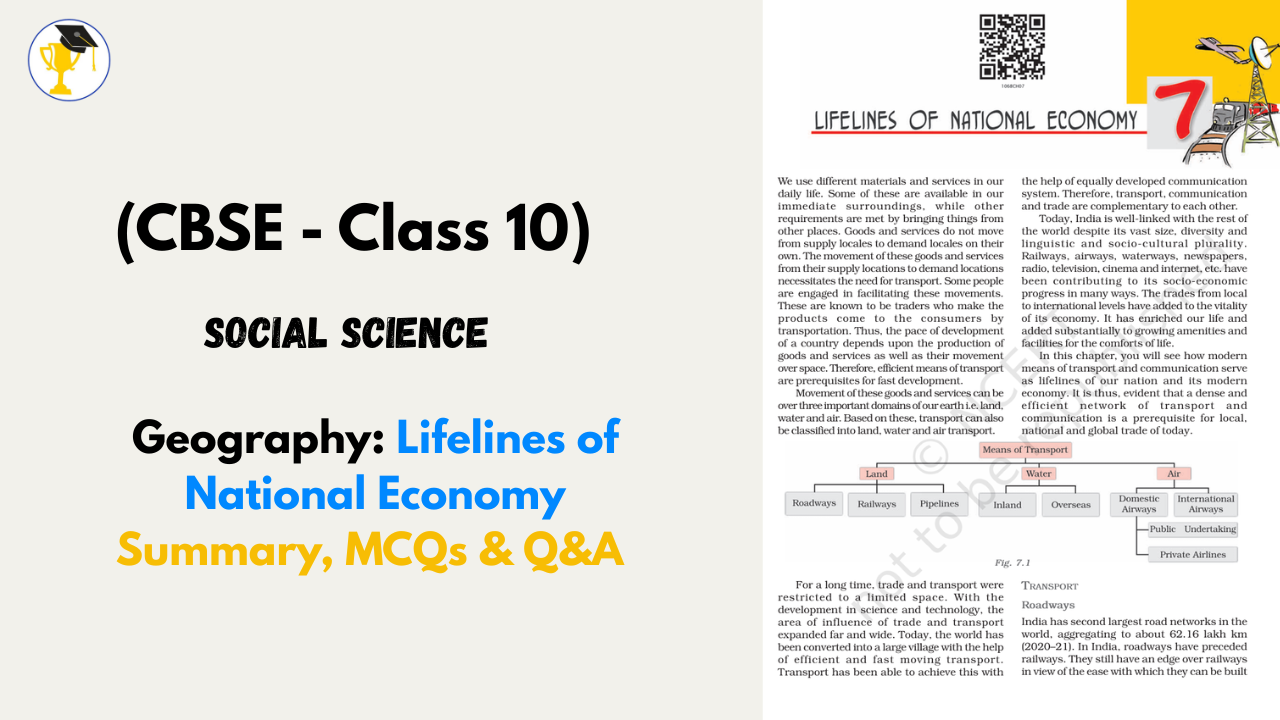
Class 10 Social Science -Lifelines of National Economy (Geography: Chapter 7) Summary + MCQs + Q&A
CHAPTER SUMMARY-LIFELINES OF NATIONAL ECONOMY
1. Introduction
Transport and communication are called the lifelines of the national economy because they connect people, places, and resources across India and with the rest of the world.
- Transport helps move goods and people.
- Communication helps share ideas and information.
Both are vital for economic growth, trade, and national integration.
Efficient transport and communication systems are essential for the fast development of agriculture, industry, and services.
2. Means of Transport
Transport can be divided into three main types:
Land Transport, Water Transport, and Air Transport.
1. Land Transport
(a) Roadways
India has one of the largest road networks in the world — over 6.2 million km (2020–21).
Road transport provides door-to-door service, flexibility, and is most suitable for short distances.
| Type |
Managed By |
Example / Feature |
| National Highways |
Central Government (NHAI) |
Golden Quadrilateral (Delhi–Mumbai–Chennai–Kolkata–Delhi) |
| State Highways |
State Governments |
Connect state capitals to districts |
| District Roads |
Zila Parishads |
Connect rural areas and markets |
| Rural Roads |
Under PMGSY (Pradhan Mantri Gram Sadak Yojana) |
Connect villages to towns |
| Border Roads |
Border Roads Organisation (BRO) |
Build in hilly and border areas like Ladakh, Sikkim |
(b) Railways
- Principal mode of transport for long distances, heavy goods, and passengers.
- Introduced in 1853 (Mumbai to Thane).
- Indian Railways: 4th largest in the world.
- Handles both freight and passenger traffic efficiently.
- Problems: congestion, outdated tracks, accidents, and need for modernization.
(c) Pipelines
- Used for transporting crude oil, petroleum products, and natural gas.
- Cheaper, safer, and eco-friendly.
Major Pipeline Networks
1. Oil Field (Assam) → Barauni → Kanpur → Delhi → Amritsar
2. Hajira (Gujarat) → Jagdishpur (UP) → Haldia (WB)
3. Salaya (Gujarat) → Mathura → Jalandhar
2. Water Transport
- Cheapest means for bulky and heavy goods.
- Environmentally friendly.
- Two types: Inland and Sea (Oceanic) transport.
(a) Inland Waterways
- Rivers, canals, and backwaters.
- Total length: 14,500 km (only 5,000 km navigable).
- Major waterways:
- NW-1: Ganga (Allahabad–Haldia)
- NW-2: Brahmaputra (Sadiya–Dhubri)
- NW-3: Kerala Backwaters
(b) Sea Transport
- Handles about 95% of India’s trade by volume.
- Major ports:
- 12 Major Ports – 6 on west coast, 6 on east coast.
- Largest port: Mumbai Port.
- Kandla Port – tidal port; handles petroleum and fertilizers.
- Kolkata–Haldia, Chennai, Marmagao, Vishakhapatnam are others.
3. Air Transport
- Fastest and most comfortable mode; ideal for long-distance and hilly regions.
- Air India – international services.
- Alliance Air, IndiGo, SpiceJet, Vistara – domestic.
- Pawan Hans provides helicopter services in northeast and Andaman–Nicobar.
- Controlled by Airport Authority of India (AAI) and Pawan Hans Ltd.
4. Communication
(a) Personal Communication
Letters, e-mails, mobile phones, and social media platforms.
(b) Mass Communication
- Radio, television, newspapers, cinema, and the internet.
- India has the largest postal network in the world.
- DD and AIR broadcast in multiple languages.
- Promotes awareness, education, and entertainment.
5. International Trade
- Trade: Exchange of goods and services.
Types:
- Internal Trade: Within the country.
- International Trade: Between nations.
Exports bring in foreign exchange.
Imports meet domestic needs.
India’s main exports: Textiles, machinery, petroleum products, gems, spices.
Imports: Crude oil, gold, fertilizers, machinery.
The balance of trade=Export value - Import value.
6. Tourism as a Trade
- India earns foreign ex.change through tourism.
- Attractions: cultural heritage, natural beauty, yoga, and wellness.
- Provides employment, promotes handicrafts, and supports transport and hospitality industries.
KEY TERMS
| Term |
Definition |
| Transport |
Movement of goods and people from one place to another |
| Communication |
Exchange of information and ideas |
| National Highway |
Main roads connecting major cities across India |
| Inland Waterway |
River/canal route for internal navigation |
| International Trade |
Exchange of goods between nations |
| Tourism |
Movement of people for leisure, education, or business |
MCQs (10 Important Questions)
1. The first railway line in India was opened in:
a) 1850
b) 1853
c) 1860
d) 1873
Answer: b
2. Which is the longest National Waterway?
a) NW-1
b) NW-2
c) NW-3
d) NW-4
Answer: a
3. Which port is known as the tidal port?
a) Mumbai
b) Kandla
c) Vishakhapatnam
d) Kolkata
Answer: b
4. Headquarters of Indian Railways is located at:
Ans: New Delhi
5. Which organisation manages border roads?
Ans: BRO (Border Roads Organisation)
6. Which is India’s largest port?
Ans: Mumbai Port
7. Which authority manages air traffic?
Ans: AAI (Airport Authority of India)
8. Which is the main pipeline transporting gas in India?
Ans: Hajira–Vijaipur–Jagdishpur Pipeline
9. What is India’s main export item?
Ans: Petroleum products and textiles
10. Which sector earns foreign exchange and promotes culture?
Ans: Tourism
CASE-BASED QUESTIONS
Case 1: Development of Transport and Communication
PASSAGE:
Transport and communication have revolutionised India’s connectivity. Roads provide door-to-door service, while railways transport bulk goods and passengers across long distances. Air transport links remote areas like Ladakh and northeast India. Communication through mobile phones, the internet, and television connects people instantly. Together, they form the lifelines of the nation, contributing to unity and progress.
Questions:
1. Why are transport and communication called the lifelines of the economy?
Ans: Because they connect people, goods, and ideas, supporting trade and development.
2. Which regions benefit most from air transport?
Ans: Hilly and remote regions like northeast India and Ladakh.
3. Mention two modern means of communication.
Ans: Internet, Mobile phones
4. How do transport and communication promote national integration?
Ans: They bridge distances, encourage cultural exchange, and unify markets.
Case 2: Ports and Trade
PASSAGE:
Ports play a vital role in India’s international trade, handling about 95% of the trade volume. The Kandla port, developed after partition, serves western India’s petroleum and fertilizer needs. The Kolkata–Haldia port serves eastern states, while Chennai and Vishakhapatnam connect southern India. Ports link India globally and boost its economic strength.
Questions:
1. Which port handles petroleum and fertilizers?
Ans: Kandla Port
2. What percentage of trade is handled by sea routes?
Ans: 95%
3. Which is the oldest artificial port?
Ans: Chennai Port
4. Why are ports important for trade?
Ans: They connect India’s economy to global markets.
ASSERTION–REASON QUESTIONS
Set 1
A: Road transport is more flexible than railways.
R: Roads can be built and maintained easily in varied terrains.
Answer: A
Set 2
A: India has the largest postal network in the world.
R: It connects urban and rural areas efficiently.
Answer: A
Set 3
A: Air transport is preferred in northeastern states.
R: The terrain is difficult and road connectivity is poor.
Answer: A
Set 4
A: Pipelines are used only for water transport.
R: Pipelines also carry petroleum and natural gas.
Answer: A false, R true
Set 5
A: Sea transport is the cheapest mode for bulky goods.
R: Ships can carry large cargo over long distances.
Answer: A
Set 6
A: The Golden Quadrilateral connects four major metros.
R: It links Delhi, Mumbai, Chennai, and Kolkata.
Answer: A
Set 7
A: Communication and trade are independent of each other.
R: Communication promotes trade by linking producers and markets.
Answer: A false, R true
Set 8
A: Kandla port was developed after partition.
R: To serve western India which lost Karachi port.
Answer: A
Set 9
A: Tourism in India has declined in recent years.
R: Improved connectivity and infrastructure increased foreign tourist arrivals.
Answer: A false, R true
Set 10
A: Inland waterways are useful for transportation.
R: They are the most expensive mode of transport.
Answer: A true, R false
Short Question-Answer
1. Longest National Waterway → NW-1 (Ganga)
2. Fastest means of transport → Airways
3. Oldest artificial port → Chennai
4. First train started → 1853 (Mumbai–Thane)
5. Port developed after partition → Kandla
6. Organisation for border roads → BRO
7. International airline → Air India
8. Cheapest transport → Waterways
9. Largest port of India → Mumbai
10. Major inland waterway state → West Bengal
LONG ANSWERS (5–6 MARKS)
Q1. Why are transport and communication called the lifelines of our economy?
Transport and communication connect people, goods, and ideas across the country and the world. Roads, railways, waterways, and airways enable trade and travel, while communication connects minds and markets. Efficient transport systems support industrial and agricultural growth, while modern communication like the internet and mobile phones makes interaction instant. Together, they promote national unity, economic growth, and global integration — making them the true lifelines of our nation.
Q2. Describe major means of transport in India.
India’s transport includes land, water, and air modes. Roads provide flexible door-to-door service. Railways carry heavy goods and passengers over long distances. Pipelines carry oil and gas. Waterways, both inland and oceanic, handle bulk trade cheaply. Air transport provides fast connectivity to remote areas. Together, they create a strong network essential for economic and social growth.
Q3. Explain the importance of international trade.
International trade strengthens India’s economy by connecting it to global markets. Exports earn foreign exchange, while imports bring in necessary goods like oil and machinery. Trade promotes employment, modern technology, and cultural exchange. A favourable balance of trade indicates economic prosperity.
For full chapter click on: Lifelines of National Economy


 STUDY MATERIALS
 COURSES
 MORE
MORE
 SUCCESS STORY
 ADMISSION
 STORE
STORE