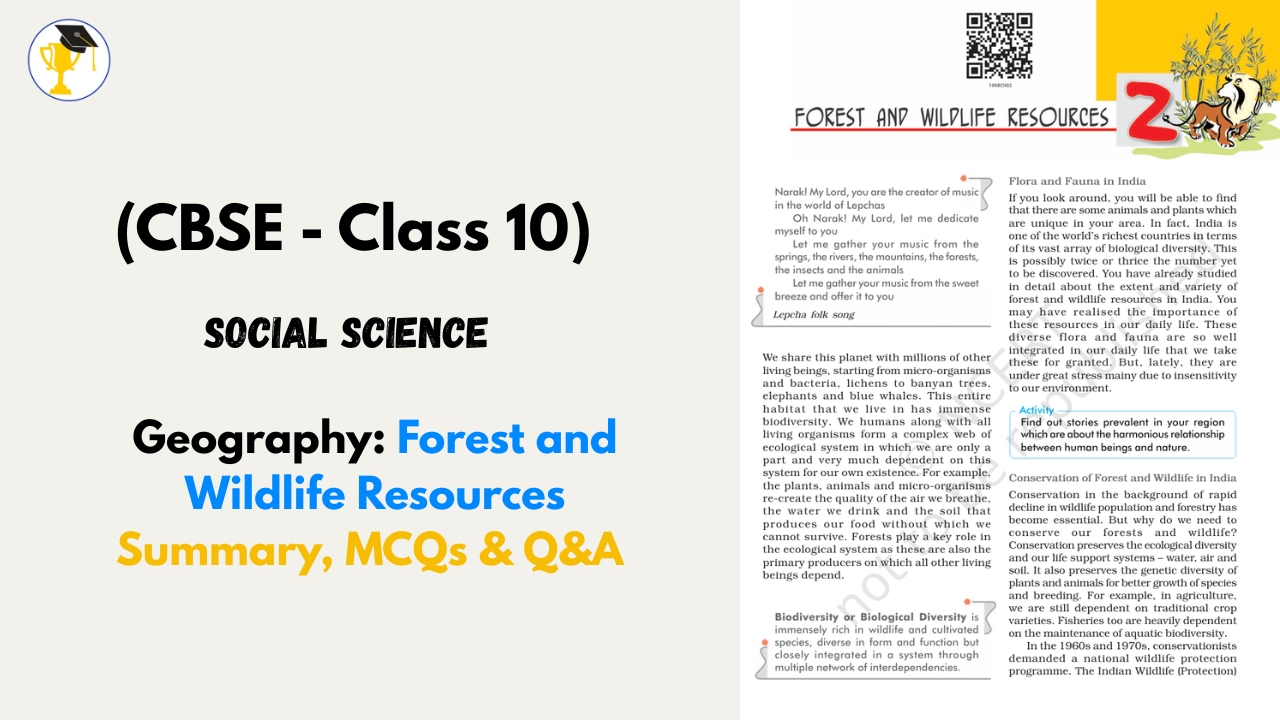
Class 10 Social Science – Forest and Wildlife Resources (Geography: Chapter 2) Summary + MCQs + Q&A
CHAPTER SUMMARY - FOREST AND WILDLIFE RESOURCES
1. Introduction: Our Living Planet
We share this planet with millions of other living organisms — from micro-organisms to massive blue whales. All living beings form an interconnected web of life, depending on air, water, soil, and forests for survival.
Forests play a vital ecological role as primary producers and habitats for numerous species.
India is one of the 12 mega-biodiversity countries in the world, with thousands of unique plants and animals that sustain human life.
2. Flora and Fauna in India
-
India has immense biodiversity, including both cultivated and wild species.
-
This biodiversity supports agriculture, forestry, fisheries, and ecological balance.
-
However, human activities have led to the decline of wildlife and forest cover.
Causes of Depletion:
-
Deforestation and overgrazing
-
Expanding agriculture and mining
-
Industrialization and urbanization
-
Forest fires, poaching, and illegal trade
3. Conservation of Forest and Wildlife in India
Need for Conservation:
Conservation helps preserve:
-
Ecological diversity (air, water, soil)
-
Genetic diversity (crop varieties and animal breeds)
-
Life-support systems for future generations
Legal Measures:
4. Project Tiger (1973)
-
Launched to protect the tiger, an important species in India’s food web.
-
Tiger population dropped to 1,827 by 1973 (from 55,000 a century ago).
-
Main threats: poaching, shrinking habitat, depletion of prey, human pressure.
-
Famous tiger reserves:
Recent focus has expanded from single species to overall biodiversity conservation — including insects and plants (added to the Wildlife Act in 1991).
5. Types and Distribution of Forests in India
India’s forests are classified into three major categories based on ownership and protection level:
|
Type
|
Description
|
Example States
|
|
Reserved Forests
|
Over 50% of total forest area; most valuable for conservation; no commercial use allowed without permission.
|
MP, J&K, Tamil Nadu, Kerala
|
|
Protected Forests
|
About one-third of total forest; protected from depletion but open for local use under control.
|
Bihar, Odisha, Rajasthan
|
|
Unclassed Forests
|
Remaining forests & wastelands; community or private ownership.
|
North-Eastern states, Gujarat
|
(Fig. 2.2 on page 15 shows Kaziranga’s Rhino & Deer — a model of successful habitat protection.)
6. Community and Conservation
Indian communities have practiced conservation for centuries.
Notable Community Efforts:
-
Sariska, Rajasthan: Villagers protested against mining in tiger reserve.
-
Alwar District: Villagers created Bhairodev Dakav “Sonchuri” forest, banning hunting.
-
Chipko Movement (Uttarakhand): Villagers hugged trees to stop deforestation — highlighted the power of eco-friendly community activism.
-
Beej Bachao Andolan (Tehri) & Navdanya Movement: Promoted organic, chemical-free farming and preservation of native seeds.
Joint Forest Management (JFM)
7. Sacred Groves and Traditional Beliefs
These cultural beliefs act as natural sanctuaries for biodiversity.
“The tree offers shade even to the axemen who destroy it.” — Gautama Buddha
8. Good Practices for Conservation
-
Afforestation and forest regeneration
-
Community forest management
-
Eco-friendly farming
-
Protecting sacred groves
-
Avoiding overexploitation of resources
-
Promoting wildlife awareness and eco-tourism
KEY TERMS
|
Term
|
Meaning
|
|
Biodiversity
|
Variety of living organisms in an ecosystem
|
|
Conservation
|
Protection and sustainable use of natural resources
|
|
Wildlife Sanctuary
|
Area reserved for protection of animals
|
|
National Park
|
Area reserved for both flora and fauna
|
|
Biosphere Reserve
|
Large protected area preserving ecosystems
|
|
Reserved Forest
|
Highly protected forest area under government control
|
|
Protected Forest
|
Forest area protected from depletion
|
|
Unclassed Forest
|
Forest under community/private ownership
|
|
JFM
|
Joint Forest Management
|
|
Chipko Movement
|
People’s movement to prevent deforestation
|
MCQs
1. Which of the following conservation strategies does not involve community participation?
a) Joint Forest Management
b) Beej Bachao Andolan
c) Chipko Movement
d) Demarcation of Wildlife Sanctuaries
Answer: d
2. The Wildlife Protection Act was implemented in:
a) 1952
b) 1962
c) 1972
d) 1982
Answer: c
3.Which state has the largest area under permanent forests?
a) Madhya Pradesh
b) Kerala
c) Rajasthan
d) Odisha
Answer: a
4. The first state to pass a JFM resolution:
a) Karnataka
b) Odisha
c) Gujarat
d) Assam
Answer: b
5. The movement where people hugged trees to prevent deforestation:
a) Narmada Bachao
b) Chipko Movement
c) Navdanya
d) Beej Bachao
Answer: b
VERY SHORT ANSWERS
-
What is biodiversity? → The variety of living organisms on earth.
-
When was Project Tiger launched? → 1973.
-
Which Act protects wildlife in India? → Indian Wildlife (Protection) Act, 1972.
-
What are sacred groves? → Virgin forest areas protected for religious beliefs.
-
What is JFM? → Joint Forest Management.
-
Name any two tiger reserves. → Corbett (Uttarakhand), Bandhavgarh (MP).
-
Which movement started in the Himalayas against tree cutting? → Chipko Movement.
-
Who said, “There is enough for everyone’s need but not for anyone’s greed”? → Mahatma Gandhi.
SHORT ANSWERS (3–4 MARKS)
1. Why is biodiversity important for human life?
-
Maintains ecological balance
-
Provides food, fuel, medicine, and raw materials
-
Supports pollination, soil fertility, and climate regulation
2. What are the main types of forests in India?
-
Reserved forests
-
Protected forests
-
Unclassed forests
3. What is the significance of Project Tiger?
-
Protects the tiger population from extinction
-
Conserves habitats and biodiversity
-
Raises public awareness about wildlife
LONG ANSWERS (5–6 MARKS)
Q1. Describe how communities have conserved and protected forests and wildlife in India.
-
Local communities have played a key role through protests and initiatives like:
-
Sariska villagers opposing mining in tiger reserve.
-
Alwar district villages establishing Bhairodev Dakav Sonchuri.
-
Chipko Movement resisting deforestation.
-
Beej Bachao Andolan and Navdanya promoting eco-farming.
-
These community efforts preserve biodiversity, generate awareness, and ensure sustainable livelihoods.
Q2. Write a note on good practices towards conserving forest and wildlife.
-
Afforestation and controlled logging
-
Protection through Wildlife Act (1972)
-
Sacred groves and community rules
-
Joint Forest Management (1988)
-
Awareness campaigns and eco-tourism
-
Use of sustainable farming methods
Such practices ensure ecological stability and balance between development and conservation.
ASSERTION–REASON QUESTIONS
1.A: Biodiversity is essential for ecological balance.
R: It provides raw materials, food, and energy for humans.
Answer: A
2.A: JFM involves local communities in forest management.
R: People share benefits from forest protection.
Answer: A
3. A: Project Tiger was started in 1973.
R: To protect tigers from poaching and habitat loss.
Answer: A
4. A: Sacred groves help conserve biodiversity.
R: Religious beliefs prevent exploitation of these areas.
Answer: A
For full chapter click on: Forest and Wildlife Resources


 STUDY MATERIALS
 COURSES
 MORE
MORE
 SUCCESS STORY
 ADMISSION
 STORE
STORE