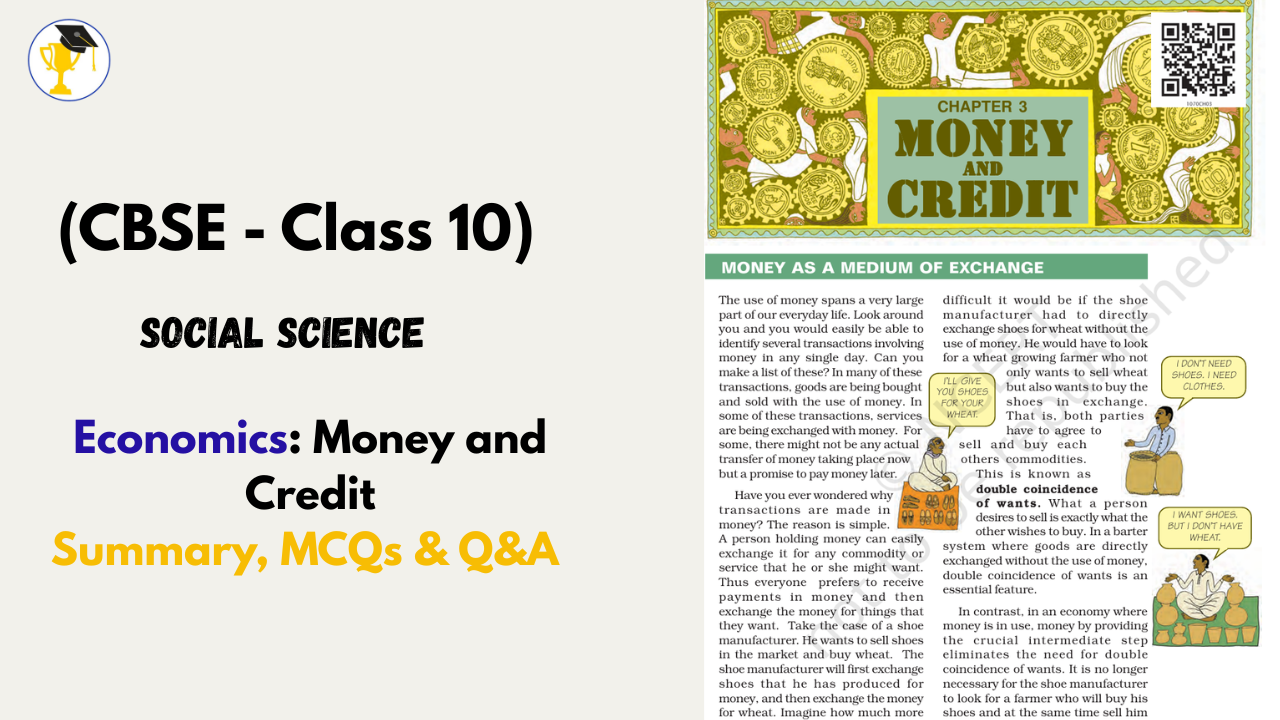
Class 10 Social Science –Money and Credit (Economics: Chapter 3) Summary + MCQs + Q&A
CHAPTER SUMMARY - MONEY and CREDIT
1. Money and the Need for It
-
In ancient times, people used barter system (direct exchange of goods).
-
Barter had problems: double coincidence of wants, difficulty in storing & measuring value.
-
To solve this, money was introduced.
-
Money acts as:
2. Modern Forms of Money
-
Paper currency and coins—issued by RBI.
-
Deposits in bank accounts are also money because they can be withdrawn anytime.
-
Cheques, debit cards, net banking, UPI allow cashless transfers.
3. Loan Activities of Banks
-
People deposit money → banks give a rate of interest on deposits.
-
Banks keep a part of deposits as cash reserves and loan out the rest.
-
Banks charge higher interest on loans than they give on deposits — this is their income.
-
Credit creation: loans lead to more money circulating in the economy.
4. Credit (Loans) and Terms of Credit
Every loan has:
These together are called Terms of Credit.
5. Formal & Informal Credit Sources
Formal Sector
-
Banks & cooperatives.
-
Regulated by RBI.
-
Lower interest rates.
-
Transparent & safer.
Informal Sector
-
Moneylenders, traders, relatives, landlords.
-
Not regulated → Very high interest.
-
Can lead to debt trap for poor people.
6. Self-Help Groups (SHGs)
MCQs
1. Money acts as a medium of exchange because:
a) It has high value
b) It is authorized by government
c) It eliminates double coincidence of wants
d) It can be stored
Answer: c
2. Which institution regulates the credit activities of formal sector?
a) SBI
b) IMF
c) RBI
d) World Bank
Answer: c
3. What is collateral?
a) Loan taken from bank
b) Security against a loan
c) Documentation work
d) Interest rate
Answer: b
4. Which of the following is an informal source of credit?
a) Commercial banks
b) Cooperatives
c) Moneylenders
d) Regional rural banks
Answer: c
5. The main source of income for banks is:
a) Interest on loans
b) Deposits
c) Taxes
d) Charges on withdrawals
Answer: a
6. SHGs help wome
a) Providing free food
b) Giving training for exams
c) Providing loan at low interest
d) Giving charity
Answer: c
ASSERTION – REASON QUESTIONS (WITH ANSWERS)
Choose the correct option:
A. Both Assertion (A) and Reason (R) are true and R is the correct explanation of A.
B. Both A and R are true, but R is NOT the correct explanation of A.
C. A is true but R is false.
D. A is false but R is true.
1. Assertion (A): Money eliminates the problem of double coincidence of wants.
Reason (R): Money acts as a medium of exchange.
Answer: A
(Both are true and R explains A.)
2. Assertion (A): Demand deposits are considered money.
Reason (R): Demand deposits can be withdrawn by cheque, making payments easy.
Answer: A
(True and correctly explains.)
3. Assertion (A): Banks keep 100% of their deposits as cash.
Reason (R): Banks need to keep some cash to meet daily withdrawal demands.
Answer: C
(Assertion is false; banks keep only a fraction, not 100%. Reason is true.)
4. Assertion (A): Formal sector loans are preferred over informal loans.
Reason (R): Formal sector loans always charge lower interest rates and are regulated by RBI.
Answer: A
(Both are true, and R explains A.)
5. Assertion (A): Informal lenders can trap poor borrowers in a cycle of debt.
Reason (R): Informal lenders charge very high rates of interest without any regulation.
Answer: A
(True and reason explains.)
6. Assertion (A): Collateral is necessary for most formal loans.
Reason (R): Collateral serves as a security for the bank if the borrower fails to repay.
Answer: A
7. Assertion (A): Self-Help Groups (SHGs) help in reducing the dependence on moneylenders.
Reason (R): SHGs provide loans to members at reasonable interest rates.
Answer: A
8. Assertion (A): Credit always increases the income of the borrower.
Reason (R): Credit helps people to expand their business.
Answer: C
(Assertion is false → credit can also push borrowers into a debt trap; reason is true.)
9. Assertion (A): Banks use the major portion of deposits to give loans.
Reason (R): Interest charged on loans is the main source of income for banks.
Answer: B
(Both are true, but R is not the only explanation for giving loans—it states bank’s income, not the reason they use deposits.)
10. Assertion (A): Rich households mostly depend on formal credit sources.
Reason (R): They have documents and collateral required by banks.
Answer: A
(Both true and well linked.)
CASE-BASED QUESTION – 1
Passage: Credit in Rural Areas
Ramesh is a small farmer in a village. He wants to grow paddy on his 2-acre land but does not have enough money to buy seeds, fertilizers, and pesticides. He goes to the village moneylender who agrees to give him a loan of INR 20,000. However, the moneylender charges a high rate of interest and asks Ramesh to keep his land documents as collateral. Unfortunately, the crop fails due to irregular rainfall, and Ramesh is unable to repay the loan on time. The moneylender adds more interest to the loan amount, and Ramesh falls into a debt trap.
Questions:
-
Why did Ramesh need credit?
To buy seeds, fertilizers, and other inputs for paddy cultivation.
-
Who gave him the loan and what was the collateral?
The village moneylender gave the loan; collateral was Ramesh’s land documents.
-
What type of credit source is the moneylender—formal or informal? Why?
Informal, because moneylenders are unregulated and often charge high interest.
-
What happened when Ramesh could not repay the loan?
More interest was added, pushing him into a debt trap.
-
Suggest one way Ramesh could avoid falling into the debt trap next time.
Borrow from a formal sector bank or join a Self-Help Group (SHG).
CASE-BASED QUESTION – 2
Passage: Loans from Banks
Sita runs a small tailoring shop in a town. She plans to buy a new sewing machine to expand her business. She approaches a commercial bank for a loan of INR 25,000. The bank asks her to submit identity proof, address proof, and income details. The bank gives her the loan at 8% interest per year, repayable in monthly installments over two years. With the new machine, Sita increases her production and income, and easily repays the loan.
Questions:
-
Why did Sita apply for a loan?
To buy a new sewing machine and expand her business.
-
Name any two documents the bank asked for.
Identity proof, address proof, income details.
-
What interest rate did the bank charge?
8% per year.
-
Why was Sita able to repay the loan easily?
Increased production and income from the new machine.
-
What kind of loan source is this—formal or informal? Give a reason.
Formal, because commercial banks follow RBI rules and have fixed interest rates.
CASE-BASED QUESTION – 3
Passage: Formal vs Informal Credit
A survey was conducted in a village to study the pattern of credit. It was found that 30% of the credit needs were met by cooperative societies and commercial banks, while 70% of the loans came from moneylenders, shopkeepers, and landlords. The informal lenders charged very high interest rates and often used unfair means to recover money. Poor households depended more on informal loans because they lacked proper documents and collateral.
Questions:
-
What percentage of loans came from informal sources?
70%.
-
Why do poor people depend more on informal lenders?
Because they lack documents and collateral required by banks.
-
What is one major drawback of informal credit?
Very high interest rates/unfair practices.
-
Which credit source is safer—formal or informal? Why?
Formal, because it is regulated by RBI and interest rates are fixed.
-
How can formal sector reach more poor households?
Simplify loan procedures, open more rural bank branches, support SHGs.
CASE-BASED QUESTION – 4
Passage: Self-Help Groups (SHGs)
In a small village in Maharashtra, 15 women formed a Self-Help Group. Each member saves ?100 per month. After six months, the group has enough savings to give small loans to the members. Meena, a member, takes a loan of ?2,000 to buy raw materials for making papad. She repays the loan at a low interest rate within four months. Later, the SHG gets linked to a bank and receives a large loan to start a small-scale papad-making unit, providing employment to several women.
Questions:
-
How much does each member save per month?
INR 100.
-
Why did Meena take a loan?
To buy raw materials for making papad.
-
How do SHGs help women?
Provide low-interest loans, encourage savings, and create employment.
-
What happened after the SHG got linked to a bank?
They received a large loan to start a small business.
-
Mention one advantage that SHGs have over individual borrowers.
Easier access to bank loans due to group guarantee.
Short Answer Questions (3–4 Marks)
1. What is the barter system? Why was it replaced by money?
2. What are demand deposits?
3. What are the differences between formal and informal sources of credit?
|
Formal Credit
|
Informal Credit
|
|
Regulated by RBI
|
Not regulated
|
|
Low interest
|
Very high interest
|
|
Transparency
|
Often unfair practices
|
|
Banks, cooperatives
|
Moneylenders, traders
|
4. What is a debt trap?
-
When borrowers cannot repay loans and take a new loan to repay old ones.
-
Due to high interest from informal lenders.
-
Leads to continuous cycle of debt.
5. Why are SHGs becoming popular?
-
Provide loans at low interest.
-
Encourage saving habits.
-
Allow women to start small businesses.
-
Reduce dependence on moneylenders.
Long Answer Questions (5–6 Marks)
1. Explain the role of banks in the economic development of a country.
-
Banks accept deposits → provide safety and interest.
-
Provide loans to farmers, small businesses, industries, students.
-
Help in capital formation.
-
Through credit creation, increase money supply.
-
Encourage investment and production.
-
Promote digital payments.
2. How does credit play both a positive and a negative role? (Very Important)
Positive Role
-
Helps farmers buy seeds, fertilizers.
-
Helps businesses expand.
-
Helps consumers buy homes, vehicles, education.
-
Can increase income and production.
Negative Role
-
If not used carefully, leads to losses.
-
High-interest loans → debt trap.
-
Crop failure can lead farmers into distress.
-
Heavy burden of repayment.
Thus, credit is useful but risky.
3. Describe the functions and significance of Self-Help Groups.
-
10–20 women form a group.
-
Members save a small amount every month.
-
Provide loans to members at low interest.
-
Help women become financially independent.
-
Promote literacy, health awareness, and social unity.
-
Banks lend to SHGs → reduces paperwork.
-
Effective tool for poverty reduction and women empowerment.
For full chapter click on: Money and Credit


 STUDY MATERIALS
 COURSES
 MORE
MORE
 SUCCESS STORY
 ADMISSION
 STORE
STORE