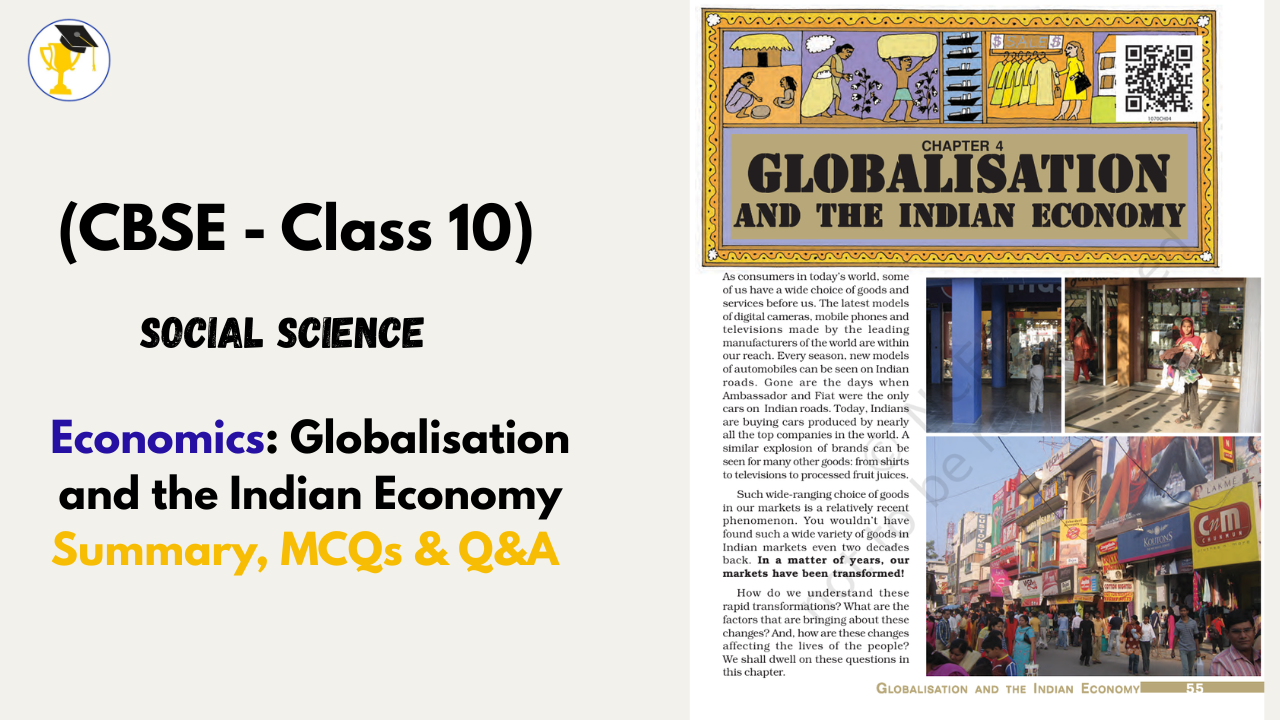
Class 10 Social Science – Globalisation and the Indian Economy (Economics: Chapter 4) Summary + MCQs + Q&A
Chapter Summary - Globalisation and the Indian Economy
1. Meaning of Globalisation
Globalisation = integration of markets, production and economies across countries.
Happens through foreign trade, foreign investment, movement of goods, services, technology and sometimes people.
2. Role of MNCs
-
Set up offices/factories in many countries.
-
Choose countries with cheap labour, good resources, favourable government policies.
-
Spread production across countries by:
3. Interlinking of Production
Production is now divided into parts and spread globally.
4. Foreign Trade
Foreign trade connects markets by:
5. Meaning of Globalisation
Globalisation = rapid integration/interconnection between countries.
6. Factors Enabling Globalisation
7. Liberalisation
Removing government restrictions on import/export and foreign investment.
8. WTO
9. Impact of Globalisation in India
Positive for:
-
Consumers (more choice, better quality)
-
Skilled workers
-
Some Indian companies (Infosys, Tata Motors)
-
Growth of services like BPO
Negative for:
-
Small producers
-
Unorganised workers (page 69–70)
-
Industries facing competition (toys, plastics, tyres, etc.)
10. Fair Globalisation
Requires government support, fair rules, worker protection, and support to small producers.
KEY TERMS
-
MNC – company with production in many countries
-
Foreign investment – money invested by MNCs
-
Trade barriers – restrictions on imports (tax, quotas)
-
Liberalisation – removing trade restrictions
-
WTO – regulates international trade
-
SEZ – Special Economic Zone
-
Globalisation – increasing interconnectedness of economies
MCQs (Most Important)
-
Globalisation refers to:
a) Closing of world markets
b) Integration of economies across the world
c) Only increase in exports
d) Only movement of people
Answer: b
-
The organisation responsible for promoting free trade is:
a) IMF
b) WTO
c) WHO
d) UNESCO
Answer: b
-
The most common route for MNCs to enter other countries is:
a) Building new markets
b) Buying existing local companies
c) Selling online
d) Government control
Answer: b
-
Removing restrictions on trade is called:
a) Privatisation
b) Nationalisation
c) Liberalisation
d) Globalisation
Answer: c
-
Transporting goods in large sealed containers reduces:
a) Labour
b) Communication
c) Port-handling cost
d) Advertisement
Answer: c
-
The example of Chinese toys shows:
a) Increase in domestic production
b) Increase in prices
c) Integration of markets
d) Decrease in competition
Answer: c
-
SEZs are set up to:
a) Increase food production
b) Attract foreign companies
c) Train workers
d) Improve agriculture
Answer: b
-
Which group is most negatively affected by globalisation?
a) Skilled workers
b) Foreign companies
c) Small producers
d) Consumers
Answer: c
-
Which factor has helped globalisation the most?
a) Increase in tax
b) Rapid improvement in technology
c) Increase in gold prices
d) Migration restrictions
Answer: b
-
Which of the following is NOT an informal sector effect of globalisation on workers?
a) Job insecurity
b) Long working hours
c) Higher wages
d) Temporary contracts
Answer: c
CASE-BASED QUESTION
PASSAGE
With the opening of foreign trade and investment since 1991, India has experienced rapid globalisation. Many MNCs have set up factories in India to take advantage of cheaper labour and a large market. The growth of Special Economic Zones (SEZs) has also encouraged foreign investment by offering tax exemptions and efficient infrastructure. However, globalisation has not benefited all sections equally. While consumers now enjoy more choice and better quality at lower prices, many small producers face intense competition from cheaper imported goods. Workers in the unorganised sector also experience job insecurity, long working hours, and low wages due to flexible labour policies.
Questions:
1. Why did many MNCs set up factories in India?
Because labour is cheaper and India offers a large market for goods.
2. What is the purpose of setting up SEZs in India?
To attract foreign companies by offering tax benefits and better infrastructure.
3. How has globalisation benefited consumers?
They get more choices, better quality, and lower prices.
4. Which two groups are negatively affected by globalisation?
Small producers and unorganised sector workers.
5. Mention one reason why unorganised workers face job insecurity.
Because companies prefer temporary and flexible labour to reduce costs.
VERY SHORT ANSWERS (1–2 Marks)
-
What is foreign investment?
Investment made by MNCs to buy or set up businesses in another country.
-
What is meant by trade barrier?
Government-imposed restriction on imports/exports.
-
Give one example of an MNC operating in India.
Coca-Cola / Tata Motors / Infosys / Ford Motors.
-
What is the full form of WTO?
World Trade Organisation.
-
What is the main aim of WTO?
To promote free and fair international trade.
-
Define SEZ.
Industrial zones with special facilities and tax benefits for foreign investment.
-
What does the term "global market" mean?
A market where products are sold worldwide.
-
What is the effect of liberalisation?
Reduction of government restrictions on trade and investment.
-
Name one factor that has facilitated globalisation.
Technology/Internet/Transport improvements.
-
Why do MNCs prefer to set up production in developing countries?
Because labour and resources are cheaper.
ASSERTION–REASON QUESTIONS
Choose the correct option:
A. Both A and R are true and R is the correct explanation of A
B. Both A and R are true but R is NOT the correct explanation
C. A is true but R is false
D. A is false but R is true
Assertion (A): Globalisation has increased competition among producers in India.
Reason (R): Foreign trade allows producers to reach global markets easily.
Answer: B
(Both are true, but R does not explain increased competition.)
2. Assertion (A): MNCs establish production units in developing countries.
Reason (R): Developing countries provide cheaper labour and larger markets.
Answer: A
3. Assertion (A): SEZs are set up to encourage foreign investment.
Reason (R): SEZs provide tax exemptions and world-class facilities.
Answer: A
4. Assertion (A): Small producers often suffer due to globalisation.
Reason (R): They cannot compete with the high-quality and low-cost goods of MNCs.
Answer: A
5. Assertion (A): Liberalisation means removing restrictions on foreign trade and investment.
Reason (R): Liberalisation encourages companies to freely import and export goods.
Answer: A
6. Assertion (A): Developed countries want developing countries to remove trade barriers.
Reason (R): This allows developed countries to access new markets for selling their goods.
Answer: A
7. Assertion (A): Globalisation has benefited all sections of society equally.
Reason (R): All producers have improved their performance due to global competition.
Answer: D
(Both are false.)
8. Assertion (A): Information technology has supported globalisation.
Reason (R): IT enables quick communication between countries for business activities.
Answer: A
9. Assertion (A): Workers in unorganised sectors face job insecurity due to globalisation.
Reason (R): Companies prefer hiring temporary workers to reduce production costs.
Answer: A
10. Assertion (A): Foreign trade integrates markets across countries.
Reason (R): Goods produced in one country can be sold in another country easily.
Answer: A
SHORT ANSWERS (3–4 Marks)
1. Explain how foreign trade leads to integration of markets.
Using example of Chinese toys :
-
Imports bring goods from foreign markets
-
Buyers get more choices
-
Local and foreign producers compete
-
Prices become similar
Thus, markets of different countries get integrated.
2. What are the advantages of globalisation for consumers?
3. How do MNCs spread their production?
4. What steps has the Indian government taken to attract foreign investment?
-
Set up SEZs
-
Tax exemptions
-
Flexible labour laws
-
Improved infrastructure
LONG QUESTIONS
Q1. Explain how globalisation has impacted India.
Globalisation has had a mixed impact on India. On the positive side, consumers enjoy a greater variety of goods at reasonable prices due to foreign competition. Many Indian companies like Infosys, Tata Motors, and Asian Paints have benefited by adopting modern technology and expanding their global presence. MNCs have invested heavily in sectors like automobiles, electronics, and fast food, creating employment for skilled workers. However, the negative impacts cannot be ignored. Small and medium producers face intense competition from cheaper imported goods, forcing many to shut down their businesses. Workers in the unorganised sector face job insecurity, lower wages, and longer working hours due to flexible labour policies. Thus, while globalisation has helped India integrate with the world economy, its benefits have not been evenly distributed.
Q2. Describe any five steps the government can take to ensure fair globalisation.
To ensure fair globalisation, the government must take strong steps to protect vulnerable groups. First, it should strictly implement labour laws so that workers enjoy fair wages, job security, and safe working conditions. Second, small producers must be supported through credit facilities, better infrastructure, and access to modern technology so that they can compete with large industries. Third, the government should negotiate at the WTO to secure fair rules that protect developing countries from unfair trade practices of developed nations. Fourth, SEZs and industrial zones must ensure that local communities are not displaced without compensation. Finally, the government should work with other developing nations to resist pressure from powerful countries and MNCs. These steps will help ensure that globalisation benefits everyone, not just the rich and powerful.
Q3. What are the factors that have enabled globalisation in India? Explain.
Several factors have contributed to globalisation in India. Rapid improvements in transportation, such as modern ships and air cargo systems, have made the movement of goods across countries faster and cheaper. Developments in information and communication technologies—mobile phones, internet, emails, and satellite communication—have allowed instant contact between producers, suppliers, and customers worldwide. Another major factor is liberalisation of trade and investment policies in 1991, which removed many restrictions on imports and allowed foreign companies to invest in India freely. Additionally, the role of global organisations like WTO has pushed countries to adopt policies favouring global trade. Together, these factors have integrated India more closely with the world market and boosted foreign investment.
For full chapter click on: Globalisation and the Indian Economy


 STUDY MATERIALS
 COURSES
 MORE
MORE
 SUCCESS STORY
 ADMISSION
 STORE
STORE