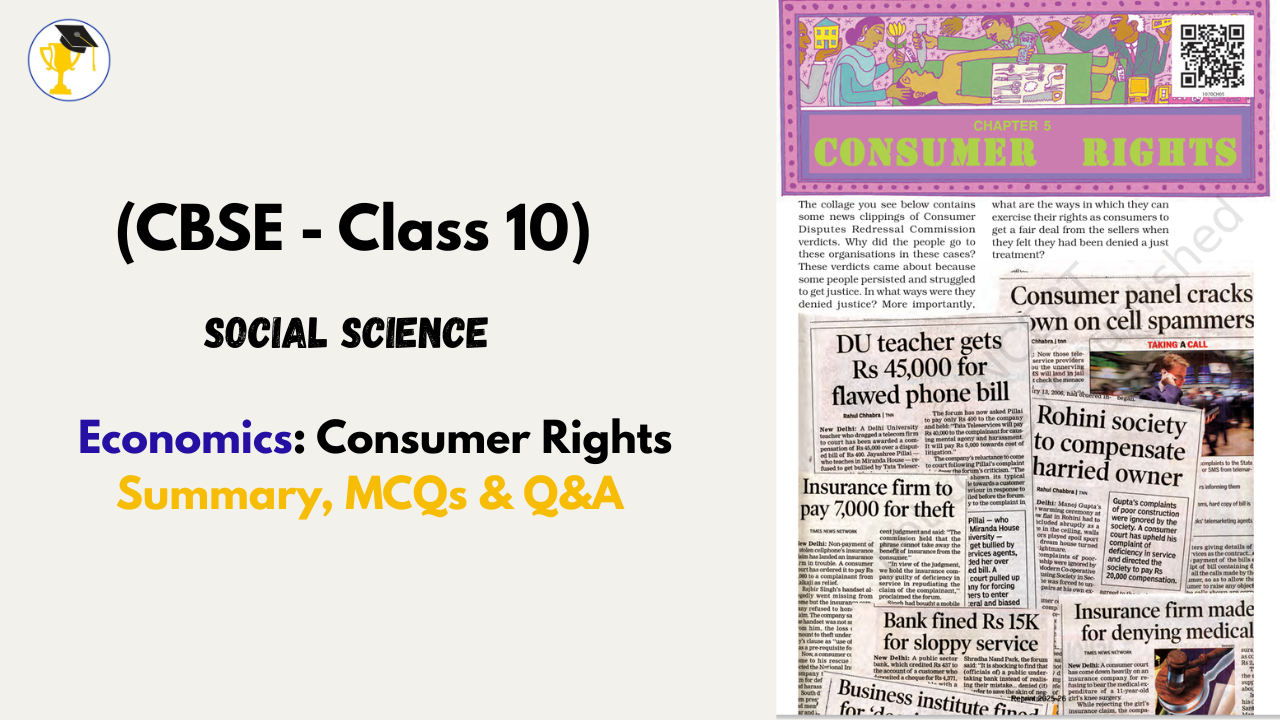
Class 10 Social Science – Consumer Rights (Economics: Chapter 5) Summary + MCQs + Q&A
CHAPTER SUMMARY - CONSUMER RIGHTS
1. The Consumer in the Marketplace
Consumers often face exploitation—examples include underweight goods, adulteration, defective products, misleading advertisements, and unfair pricing.
Big companies with huge wealth and marketing power can mislead consumers (e.g., unsafe baby milk powder; cigarette companies hiding cancer risks).
2. Consumer Movement in India
The consumer movement began due to:
It grew stronger with COPRA (Consumer Protection Act), 1986—a major milestone.
3. Rights of Consumers
NCERT mentions several rights:
-
Right to Safety (Reji’s case on p. 79—defective anaesthesia caused lifelong injury)
-
Right to be Informed (labels, MRP, expiry date)
-
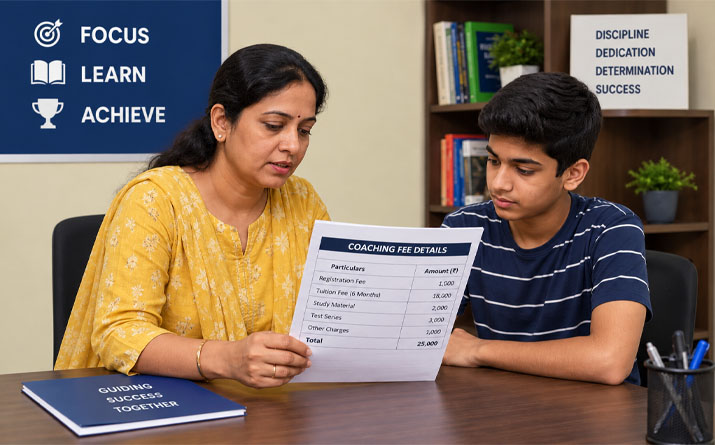
Right to Choose (Abirami’s case—refund from coaching institute, p. 81–82)
-
Right to Seek Redressal
-
Right to Consumer Education
-
Right to Representation
RTI (Right to Information Act, 2005) also supports transparency (example on p. 80).
4. Consumer Redressal System
COPRA created a three-tier system:
-
District Commission – up to INR 1 crore
-
State Commission – INR 1 crore to INR 10 crore
-
National Commission – above INR 10 crore
Diagram on pages 82–83 shows how Prakash filed a complaint for delayed money order.
5. ISI, Agmark, Hallmark, FSSAI
Logos ensure safety & quality.
Mandatory for goods like LPG cylinders, packaged water, cement, food colours.
6. Progress and Challenges of Consumer Movement
Achievements:
Problems:
-
Redressal is slow & expensive
-
Many people unaware
-
Rules not strictly followed
-
Evidence hard to produce (no bills)
KEY TERMS
-
Consumer – anyone who buys goods/services for personal use
-
Consumer Movement – collective struggle against unfair practices
-
COPRA – Consumer Protection Act
-
MRP – Maximum Retail Price
-
ISI/Agmark/Hallmark/FSSAI – quality certification marks
-
District/State/National Commissions – redressal bodies
-
Right to Safety/Choice/Redressal/Information/Education
MCQs
1. COPRA was enacted in the year:
a) 1986
b) 1976
c) 1991
d) 2010
Answer: a
2. Which logo ensures the quality of electrical appliances?
a) Agmark
b) ISI
c) Hallmark
d) FSSAI
Answer: b
3. The right violated when shopkeepers force consumers to buy unnecessary products:
a) Right to Safety
b) Right to Choose
c) Right to Education
d) Right to Represent
Answer: b
4. National Consumer Day is celebrated on:
a) 24 December
b) 15 August
c) 5 June
d) 2 October
Answer: a
5. Which mark is used for gold jewellery?
a) ISI
b) Hallmark
c) Agmark
d) ISO
Answer: b
6. COPRA provides a three-tier redressal system. Which is NOT a tier?
a) Panchayat
b) District
c) State
d) National
Answer: a
7. Which organisation issues Agmark?
a) BIS
b) RBI
c) FSSAI
d) Ministry of Agriculture
Answer: d
8. Filing a complaint in consumer court requires:
a) A lawyer must be hired
b) A bill/warranty (if available)
c) A huge fee
d) Permission from police
Answer: b
9. Which right ensures that manufacturers print MRP and expiry date?
a) Right to Education
b) Right to Information
c) Right to Safety
d) Right to Redressal
Answer: b
10. A consumer club in schools helps to:
a) Sell goods
b) Exploit buyers
c) Create awareness
d) Fix prices
Answer: c
VERY SHORT ANSWERS
-
What is the full form of COPRA?
Consumer Protection Act.
-
What does MRP mean?
Maximum Retail Price.
-
Name the quality mark for agricultural products.
Agmark.
-
Which body certifies gold jewellery?
Hallmark.
-
Which act helps citizens obtain information from govt?
RTI Act, 2005.
-
National Consumer Day is observed on?
24 December.
-
Claim limit of District Commission?
Up to INR 1 crore.
-
What does the Right to Safety protect consumers from?
Hazardous goods and services.
-
Who issues the ISI mark?
Bureau of Indian Standards (BIS).
-
What is the main goal of consumer movement?
Protect consumer interests & fair trade.
CASE-BASED QUESTION (WITH PASSAGE)
PASSAGE
Reji, a Class IX student, became permanently disabled due to improper anaesthesia during a tonsil operation in Kerala. His father filed a case in the State Consumer Commission, but it was dismissed due to lack of evidence. He then appealed to the National Consumer Commission in New Delhi. After reviewing medical negligence and poor service delivery, the National Commission ordered the hospital to pay compensation.
(Referenced from NCERT, Page 79–80)
Questions:
-
Which consumer right was violated in Reji’s case?
Right to Safety.
-
Why did the National Commission compensate Reji?
Due to medical negligence and deficiency in service.
-
What does this case show about the consumer movement?
Consumers have the right to seek redressal through commissions.
-
Name the three-tier consumer redressal system.
District, State, National Commissions.
-
What lesson does this case teach consumers?
Always demand quality & fight for rights through legal mechanisms.
ASSERTION–REASON QUESTIONS (10 SETS)
1.
Assertion (A): Consumers have the right to be informed.
Reason (R): Manufacturers must print MRP, expiry date and ingredients.
Answer: A
2.
A: Hallmark certifies gold purity.
R: It is issued by FSSAI.
Answer: C (R is false)
3.
A: Consumer courts often take time to settle disputes.
R: Cases require evidence, attendance, and procedures.
Answer: A
4.
A: Right to Safety is essential for consumers.
R: Some products can be life-threatening if faulty.
Answer: A
5.
A: The consumer movement began due to exploitation and unfair trade.
R: Black marketing and adulteration were common earlier.
Answer: A
6.
A: Consumers should keep bills and receipts.
R: Bills serve as proof for filing complaints.
Answer: A
7.
A: COPRA introduced the three-tier system.
R: This system helps settle disputes at different levels.
Answer: A
8.
A: Right to Choose is violated when sellers force unnecessary purchases.
R: Consumers must buy only what the seller chooses.
Answer: C
9.
A: MRP is the maximum price a seller can charge.
R: Consumers can also bargain for a lower price.
Answer: A
10.
A: Only expensive goods need quality certification.
R: Certification is mandatory for essential and safety-related products.
Answer: D
SHORT ANSWERS (3–4 MARKS)
1. Why are rules and regulations required in the marketplace?
-
Prevent exploitation
-
Ensure safe and quality goods
-
Stop misleading advertisements
-
Protect consumers from unfair trade practices
2. What rights are ensured under COPRA?
-
Right to Safety
-
Right to Information
-
Right to Choice
-
Right to Redressal
-
Right to Education
-
Right to Representation
3. Explain why consumer awareness is needed.
-
Consumers are scattered
-
Lack of knowledge makes them vulnerable
-
Sellers may cheat with defective goods, false ads
-
Helps buyers make informed choices
LONG ANSWERS (5–6 MARKS)
Q1. Why are rules and regulations required in the marketplace?
Rules and regulations are essential in the marketplace to protect consumers from exploitation and unfair practices. As shown in the chapter, consumers often find themselves in a weak position because sellers have more power, information, and control over products. Traders may use unfair methods such as selling underweight goods, adulterating food items, charging more than the printed MRP, or providing defective products. Large companies also influence consumers through misleading advertisements—for example, baby milk powder or cigarette companies once made false claims until legal action was taken. Without clear rules, the responsibility shifts unfairly onto the buyer. Therefore, regulations ensure quality, safety, transparency, and fair pricing while also holding producers accountable. These rules help create a fair marketplace where consumers can trust the goods and services they purchase.
Q2. Trace the evolution of the consumer movement in India.
The consumer movement in India began as a response to widespread exploitation of consumers and unfair practices by traders. During the 1960s, problems like food shortages, hoarding, black marketing, and adulteration led people to raise their voices for protection. In the 1970s, consumer organisations became more active by writing articles, conducting investigations, and forming groups to expose malpractices in ration shops and transport services. The movement gained momentum in the 1980s, putting pressure on the government to take strong action. As a result, the Consumer Protection Act (COPRA) was passed in 1986, marking a milestone. This Act provided legal backing, established consumer courts, and recognised consumer rights. Today, India observes National Consumer Day on 24 December, though challenges like slow redressal and low awareness still remain.
Q3. Explain the rights of consumers and write a few sentences on each.
The Consumer Protection Act grants several important rights to consumers
-
Right to Safety: Consumers must be protected from hazardous goods and services. Faulty medical treatment or unsafe appliances can cause serious harm.
-
Right to be Informed: Manufacturers must provide details like MRP, expiry date, ingredients, and usage instructions. This helps consumers make informed choices.
-
Right to Choose: Buyers should be able to select products freely without being forced into unwanted purchases, as seen in cases where sellers bundle unnecessary goods.
-
Right to Redressal: Consumers can seek compensation against defective goods or poor services through consumer commissions.
-
Right to Consumer Education: People must be aware of their rights and responsibilities.
-
Right to Representation: Consumers have the power to be heard and take part in decision-making bodies.
Q4. Critically examine the progress of the consumer movement in India.
The consumer movement in India has achieved significant progress but still faces many challenges. Since the enactment of COPRA in 1986, thousands of consumer organisations and forums have emerged across the country, guiding people and helping them file complaints. The establishment of District, State, and National Consumer Commissions has given consumers a legal platform for justice. Various quality marks like ISI, Agmark, and Hallmark assure product reliability. However, the redressal process remains slow, expensive, and time-consuming. Many consumers lack awareness and do not keep bills, making complaints difficult. Enforcement of laws is often weak, especially in unorganised sectors. Despite these issues, consumer awareness is gradually increasing, and the movement continues to grow. Its success ultimately depends on the active participation of consumers themselves.
Q5. What legal measures were taken by the government to protect consumers in India?
The government has introduced several legal measures to safeguard consumers from exploitation. The most significant step was the Consumer Protection Act (COPRA) of 1986, later strengthened by the 2019 amendment. COPRA established a three-tier consumer redressal system—District, State, and National Commissions—making it easier for consumers to file complaints. The law ensures compensation for defective goods, poor services, or unfair practices. The government also made quality certification marks compulsory for essential and safety-related products. These include ISI for electrical goods, Agmark for agricultural items, Hallmark for jewellery, and FSSAI for food items. Additionally, the Right to Information Act (2005) empowers people to access details about government functioning. Departments of Consumer Affairs at the state and central levels conduct awareness campaigns and support consumer organisations.
Q6. Describe the need for consumer consciousness with suitable examples.
Consumer consciousness is crucial because an unaware consumer is the easiest target for exploitation. The NCERT chapter gives many examples where consumers suffered due to lack of awareness—such as Reji, who became disabled due to medical negligence, and Abirami, who was denied a refund by her coaching institute. In markets, sellers may cheat by giving underweight goods, charging extra, selling expired items, or providing defective appliances. Misleading advertisements often trick people into buying unsafe or low-quality products. When consumers know their rights—like checking the MRP, expiry date, certification marks, and demanding bills—they can avoid such exploitation. Conscious consumers also help society by reporting unfair practices, filing complaints, and spreading awareness. Thus, consumer awareness ensures fairness, quality, and safety in the marketplace.
For full chapter click on: Consumer Rights


 STUDY MATERIALS
 COURSES
 MORE
MORE
 SUCCESS STORY
 ADMISSION
 STORE
STORE