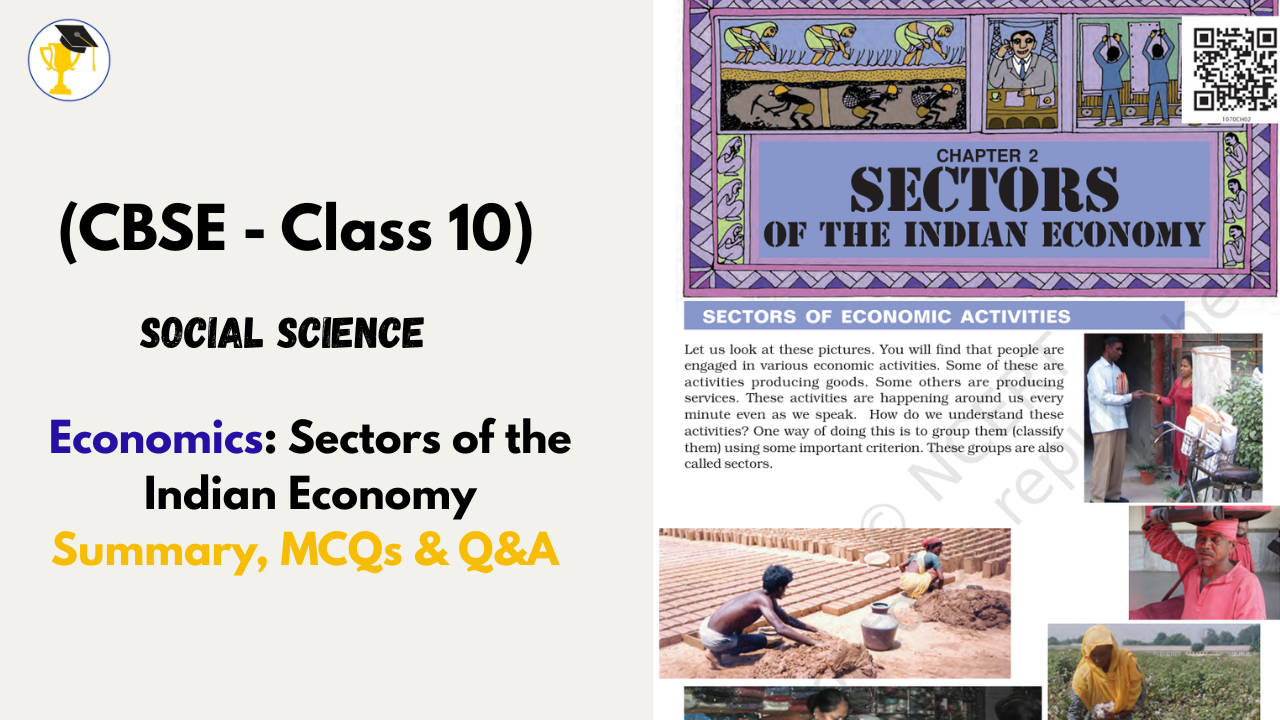
Class 10 Social Science –Sectors of the Indian Economy (Economics: Chapter 2) Summary + MCQs + Q&A
CHAPTER SUMMARY - Sectors of the Indian Economy
1. Classification of Sectors Based on Nature of Activities
A. Primary Sector (Agriculture-Based Activities)
This sector deals with the extraction and production of natural resources.
Examples:
-
Farming
-
Fishing
-
Mining
-
Dairy
-
Forestry
It forms the foundation of all other sectors.
B. Secondary Sector (Industrial & Manufacturing Activities)
This sector converts raw materials into finished products.
Examples:
-
Textile mills
-
Food processing
-
Steel production
-
Furniture manufacturing
It represents industrial growth.
C. Tertiary Sector (Services)
This is the service sector, essential for supporting primary & secondary activities.
Examples:
-
Banking
-
Education
-
Transport
-
IT services
-
Retail
Today, the tertiary sector contributes the most to India’s GDP.
2. Comparing Sectors by GDP and Employment
-
Earlier: Primary sector = highest employment.
-
Today: Tertiary sector = highest GDP contributor.
-
Manufacturing & services are growing faster than agriculture.
However, agriculture still provides the largest employment, which creates mismatches in growth.
3. Types of Unemployment
A. Disguised Unemployment (Agriculture)
More people working than needed – extra workers have zero contribution.
B. Seasonal Unemployment
Common in farming where work is available only during certain months.
4. Organized and Unorganized Sector
A. Organized Sector
-
Registered by government
-
Fixed working hours
-
Job security
-
Paid leave and holidays
Examples:
Banks, schools, large companies.
B. Unorganized Sector
-
No fixed hours
-
Low wages
-
No job security
-
No benefits
Examples:
Small shops, daily-wage labourers, street vendors.
5. Public and Private Sector
Public Sector
Owned and funded by the government.
Examples:
-
Railways
-
Post office
-
Government hospitals
Private Sector
Owned by private individuals or companies.
Examples:
-
Reliance
-
TCS
-
Private banks
6. MGNREGA — Employment Guarantee Scheme
The Mahatma Gandhi National Rural Employment Guarantee Act (2005) provides:
This scheme helps reduce unemployment and poverty.
MCQs – Sectors of the Indian Economy
-
Primary sector includes:
a) Banking
b) Dairy
c) Transport
d) IT services
Ans: b
-
Secondary sector is also known as:
a) Service sector
b) Manufacturing sector
c) Agriculture sector
d) IT sector
Ans: b
-
Teaching is part of which sector?
a) Primary
b) Secondary
c) Tertiary
d) None
Ans: c
-
MGNREGA guarantees how many days of work?
a) 60
b) 80
c) 100
d) 120
Ans: c
-
Today, which sector contributes most to India’s GDP?
a) Primary
b) Secondary
c) Tertiary
d) Mining
Ans: c
-
Disguised unemployment is common in:
a) IT
b) Agriculture
c) Banking
d) Construction
Ans: b
-
Organized sector includes:
a) Street vendors
b) IT company employees
c) Tailor in a village
d) Domestic workers
Ans: b
-
Retail shops belong to the:
a) Primary sector
b) Secondary sector
c) Tertiary sector
d) Public sector
Ans: c
-
Which is a manufacturing activity?
a) Teaching
b) Making bread
c) Poultry farming
d) Selling fruits
Ans: b
-
Public sector example is:
a) Reliance Jio
b) Indian Railways
c) Maruti Suzuki
d) Infosys
Ans: b
-
Which is NOT an unorganized sector job?
a) Daily wage labour
b) Street seller
c) Government clerk
d) Small shop worker
Ans: c
-
GDP is the total:
a) Profit of all companies
b) Production of only factories
c) Value of all final goods & services
d) Export earnings
Ans: c
-
Seasonal unemployment mainly occurs in:
a) Industries
b) Agriculture
c) IT companies
d) Transport
Ans: b
-
Which sector includes activities that help production grow?
a) Primary
b) Secondary
c) Tertiary
d) All of these
Ans: c
-
Public sector aims to promote:
a) Profit
b) Welfare
c) Luxury goods
d) Foreign companies
Ans: b
Assertion–Reason Questions
Q1.
A: Tertiary sector has grown rapidly in India.
R: Demand for services such as IT, banking, and education has increased.
Ans: A and R both true; R explains A
Q2.
A: Disguised unemployment means extra people working without increasing output.
R: It occurs mostly in agriculture.
Ans: A and R both true; R explains A
Q3.
A: Organized sector gives job security.
R: It is registered and follows government rules.
Ans: A and R both true; R explains A
Q4.
A: Public sector is owned by private companies.
R: Its main aim is to provide services.
Ans: A false, R true
CASE-BASED QUESTIONS
CASE 1 — Disguised Unemployment
Passage:
A farmer’s family of six works on their small piece of land. The land is very small and requires only three workers to cultivate it efficiently. However, all six family members work on the farm because they have no other source of income. Even if three family members stop working, the total output of the field remains the same. The family wants to improve their income but has limited opportunities other than farming.
Questions
-
Which type of unemployment is shown in this case?
-
In which sector is this type of unemployment most common?
-
How can the extra workers improve their income?
Answers
-
Disguised unemployment
-
Primary sector (agriculture)
-
By taking up non-farm jobs such as dairy, poultry, small shops, etc.
CASE 2 — Growth of Tertiary Sector
Passage:
In the last twenty years, services such as banking, education, transport, communication, and IT have grown rapidly in India. People increasingly rely on services for everyday activities like online payments, schooling, shopping, and healthcare. As income levels rise and technology spreads, more people demand high-quality services. The government too invests heavily in transport networks, schools, and hospitals, boosting the service sector even further.
Questions
-
Which sector is growing the fastest in India?
-
Give one reason for the growth of this sector.
-
Name any one service included in this sector.
Answers
-
Tertiary sector
-
Rising demand for modern services
-
Banking / transport / IT / education (any one)
CASE 3 — Organized vs Unorganized Sector
Passage:
Ravi works in a government office where he receives a fixed salary, regular working hours, paid leave, and job security. His job is registered under labour laws and provides benefits like pension and medical insurance. His cousin Suresh, on the other hand, works at a small roadside tea stall. He has no fixed working hours, no job security, no paid holidays, and can be removed from work at any time. His wages are very low and irregular.
Questions
-
In which sector does Ravi work?
-
Why is Suresh’s workplace considered unorganized?
-
Suggest one measure to improve conditions for unorganized-sector workers.
Answers
-
Organized sector
-
No job security, no fixed wages, no benefits
-
Minimum wage laws, social security schemes, working hour regulations
CASE 4 — Public vs Private Sector
Passage:
Aman suffers from high fever and is taken to a government hospital. The doctors treat him free of cost because the hospital is run by the government for public welfare. After treatment, Aman’s father buys medicines from a private medical store, where he pays the full price for the medicines. While the government hospital focuses on providing essential services at low cost, the private medical shop runs mainly for profit.
Questions
-
Which sector does the hospital belong to?
-
Why are private services usually costlier?
-
What is the main aim of the public sector?
Answers
-
Public sector
-
Private businesses aim to earn profit
-
To provide essential services and public welfare
CASE 5 — MGNREGA and Employment
Passage:
The Mahatma Gandhi National Rural Employment Guarantee Act (MGNREGA) was launched in 2005 to provide guaranteed wage employment to rural households. Under this scheme, each rural family is entitled to get 100 days of work in a year at minimum wages. Many villagers work under MGNREGA for building roads, ponds, wells, and canals. This scheme helps reduce rural unemployment and provides livelihood security to the poorest households.
Questions
-
How many days of employment does MGNREGA guarantee?
-
Name one type of work provided under the scheme.
-
Why was this scheme introduced?
Answers
-
100 days
-
Construction of roads / ponds / canals / wells (any one)
-
To reduce unemployment and provide income security
CASE 6 — Seasonal Unemployment
Passage:
Ramesh works as a farm labourer during the sowing and harvesting seasons. For several months of the year, he has no work because agricultural jobs are not available all year round. During this period, he travels to nearby towns to find small daily-wage jobs but does not always succeed. His income remains unstable and low due to the lack of permanent employment.
Questions
-
What type of unemployment is described in the passage?
-
Why does this type of unemployment occur?
-
Suggest one way to reduce such unemployment.
Answers
-
Seasonal unemployment
-
Agriculture provides work only during certain months
-
Promote non-farm activities like dairy, poultry, fisheries, and small industries
CASE 7 — Manufacturing Sector
Passage:
A sugar mill buys sugarcane from farmers and converts it into sugar. Hundreds of workers are employed for cleaning, processing, packing, and transporting the sugar. The product is then sold to wholesalers and retailers across the country. The mill helps create jobs and adds value to the raw material produced by farmers.
Questions
- Which sector does the sugar mill belong to?
- What activity is the mill performing?
- Give one more example of a secondary-sector industry.
Answers
- Secondary sector
- Manufacturing or processing
- Textile industry / steel industry / cement industry (any one)
Short Answer Questions (3 Marks)
1. What is disguised unemployment?
More people are employed than required; removing extra workers does not reduce output. Common in agriculture.
2. Why is the tertiary sector growing rapidly in India?
-
Rising demand for services
-
Increase in trade, transport, banking
-
Expansion of IT and telecom
-
Growing education and health needs
3. Differentiate between public and private sector.
-
Public Sector: Government owned (Railways)
-
Private Sector: Individually owned (Reliance)
-
Public aims at welfare; Private aims at profit
Long Answer Questions (5–6 Marks)
1. Explain the three sectors of the Indian economy with examples.
The primary sector involves activities that directly use natural resources such as agriculture, fishing, mining and forestry. It forms the base of all economic activities. The secondary sector consists of manufacturing and industrial processes where raw materials from the primary sector are converted into finished goods; for example, textile mills, steel factories, food processing and automobile manufacturing. The tertiary sector, also called the service sector, includes activities that support production like banking, education, communication, transport, retail and IT services. It does not produce goods directly but helps in the smooth functioning of the economy. Today, the tertiary sector is the largest contributor to India’s GDP.
2. Describe the difference between organized and unorganized sectors.
The organized sector includes establishments registered with the government that follow labour laws, provide regular salaries, fixed working hours, paid leave, pensions and job security. Examples include banks, government offices and large industries. In contrast, the unorganized sector consists of small units that do not follow rules and regulations. Workers here face low wages, no job security, no paid holidays, and poor working conditions. Examples are street vendors, small shops, construction workers and domestic workers. The government needs to support the unorganized sector to improve worker welfare.
3. What steps can be taken to create more employment in rural areas?
-
Promote small-scale industries like food processing, pottery, handicrafts
-
Expand rural infrastructure (roads, electricity, irrigation)
-
Provide cheap credit for starting businesses
-
Increase investment in agriculture (HYV seeds, irrigation, storage facilities)
-
Strengthen government schemes like MGNREGA
-
Create non-farm jobs like dairy farming, poultry, fisheries
For full chapter click on: Sectors of the Indian Economy


 STUDY MATERIALS
 COURSES
 MORE
MORE
 SUCCESS STORY
 ADMISSION
 STORE
STORE