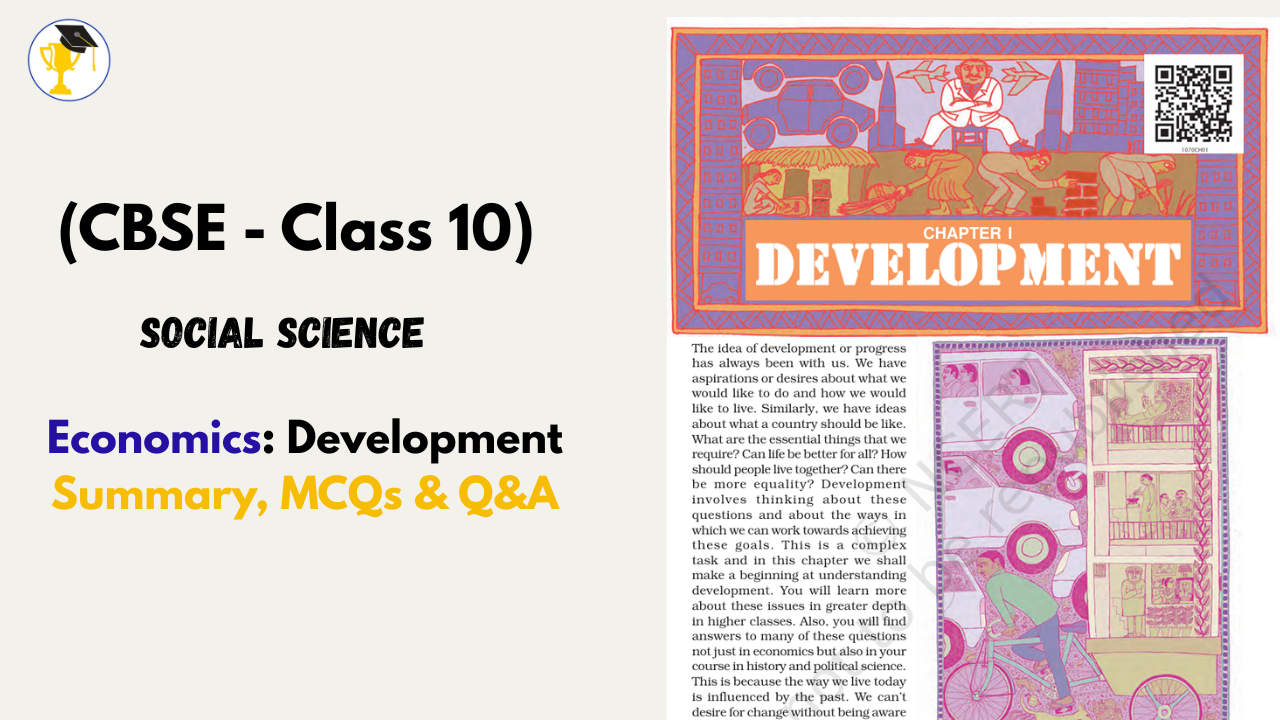
Class 10 Social Science –Development (Economics: Chapter 1) Summary + MCQs + Q&A
CHAPTER SUMMARY - DEVELOPMENT
1. What Development Means
Development means progress or improvement in life. People have different goals because their life situations differ.
-
Some want more income, jobs, better wages.
-
Others want respect, equality, security, freedom.
-
Development for one group may be harmful for another (e.g., big dams vs. displaced tribals).
2. Income and Other Goals
Most people do seek more income, but non-material things like dignity, security, freedom are equally important.
Examples:
3. National Development
Different people have different ideas of national development.
A good development plan must:
-
Be just and fair
-
Benefit majority
-
Not harm weaker sections
4. How to Compare Countries?
World Bank uses Per Capita Income as the main criterion.
-
Countries above US$ 63,400 → Rich
-
Below US$ 2400 → Low-income
India = Low-middle income (US$ 10030)
But average income hides inequalities.
(Example table on page 9 shows equal average income but unequal distribution.)
5. Income & Other Criteria
Per capita income alone is not enough.
Other important indicators:
6. Public Facilities
Development requires collective provision:
7. Human Development Report (UNDP)
UNDP uses:
8. Sustainability of Development
Current development patterns may harm future generations.
Examples from textbook:
MCQs — DEVELOPMENT
-
Development of a country can be measured through:
a) Per capita income
b) Literacy rate
c) Health status
d) All of the above
Ans: d
-
Per capita income =
a) Total income × population
b) Total income ÷ population
c) Income of richest 10%
d) Monthly expenditure
Ans: b
-
Which state has highest literacy in Table 1.4?
a) Haryana
b) Kerala
c) Bihar
d) Punjab
Ans: b
-
Which neighbouring country ranks highest in HDI?
a) Pakistan
b) Nepal
c) Sri Lanka
d) Myanmar
Ans: c
-
Which resource is non-renewable?
a) Groundwater
b) Forests
c) Crude oil
d) Solar energy
Ans: c
ASSERTION–REASON (A–R)
Q1
A: People have conflicting development goals.
R: Different groups have different life situations.
Ans: A and R both true; R explains A
Q2
A: Average income hides inequalities.
R: It distributes total income equally across all persons.
Ans: A true, R false
Q3
A: Kerala performs better in health indicators than Haryana.
R: Kerala provides better public facilities.
Ans: A and R true; R explains A
Q4
A: Sustainable development protects future generations.
R: Overuse of resources leads to depletion.
Ans: A and R true; R explains A
CASE-BASED QUESTIONS
CASE 1 — Toxic Waste Dump
A multinational company dumped toxic waste in Ivory Coast…
Q1. Who benefited?
→ The foreign company (cheap disposal).
Q2. Who suffered?
→ Local residents (health issues, death).
Q3. What developmental goal is needed?
→ Safe environment & strict environmental regulation.
CASE 2 — Comparing States
Kerala has lower infant mortality & higher literacy vs. Haryana.
Q1. Why is Kerala better despite lower income?
→ Better public health & education facilities.
Q2. What does it show?
→ Income alone is not enough to measure development.
CASE 3 — Groundwater Overuse
300 districts show 4m decline in groundwater.
Q1. Why overuse?
→ Over-irrigation, tube wells, cash crops.
Q2. Can development continue like this?
→ No, it is unsustainable.
SHORT ANSWERS (3 MARKS)
Q1. Why do people have different development goals?
-
Different life situations and needs
-
What benefits one may harm another
-
Priorities vary (income, security, equality, dignity)
Q2. Why is per capita income not sufficient?
Q3. What is Human Development Report?
LONG ANSWERS (5–6 MARKS)
1. Explain different types of development goals.
Different people have different development goals because their needs, situations and aspirations differ. A landless labourer wants more days of work and higher wages, while a prosperous farmer wants high crop prices and cheap labour. Women often seek dignity, freedom and safety, which may matter more than income. A girl may want equal opportunities as her brother, creating conflicting goals within the same family. Similarly, while industrialists want big dams for electricity, displaced communities want security and protection of their homes. Thus, development is multi-dimensional: it includes material goals (income, jobs), social goals (equality, respect), and non-material goals (freedom, security). These goals vary widely across individuals and groups.
2. Compare Kerala and Haryana using the indicators in Table 1.3 & 1.4.
Though Haryana has the highest per capita income among the three states, Kerala performs much better in health and education indicators. Kerala’s Infant Mortality Rate is only 6 per 1000 births, while Haryana’s is 28. Kerala’s literacy rate is 94%, compared to Haryana’s 82%. Net attendance ratio is also significantly higher in Kerala. This proves that income alone cannot measure development. Kerala’s better human development is due to strong public facilities like schools, healthcare, and social welfare, which improve overall quality of life.
3. What is sustainable development? Why is it important?
Sustainable development means using resources in a way that meets present needs without compromising the ability of future generations to meet their own needs. Groundwater depletion in 300 Indian districts and crude oil reserves lasting only 50 years show the danger of overuse. Environmental degradation affects everyone and does not respect boundaries. If current patterns continue, future generations will face scarcity, high costs, and ecological damage. Therefore, development must include conservation, renewable resources, pollution control, and careful use of natural assets.
For Full Chaper Click on: Development


 STUDY MATERIALS
 COURSES
 MORE
MORE
 SUCCESS STORY
 ADMISSION
 STORE
STORE