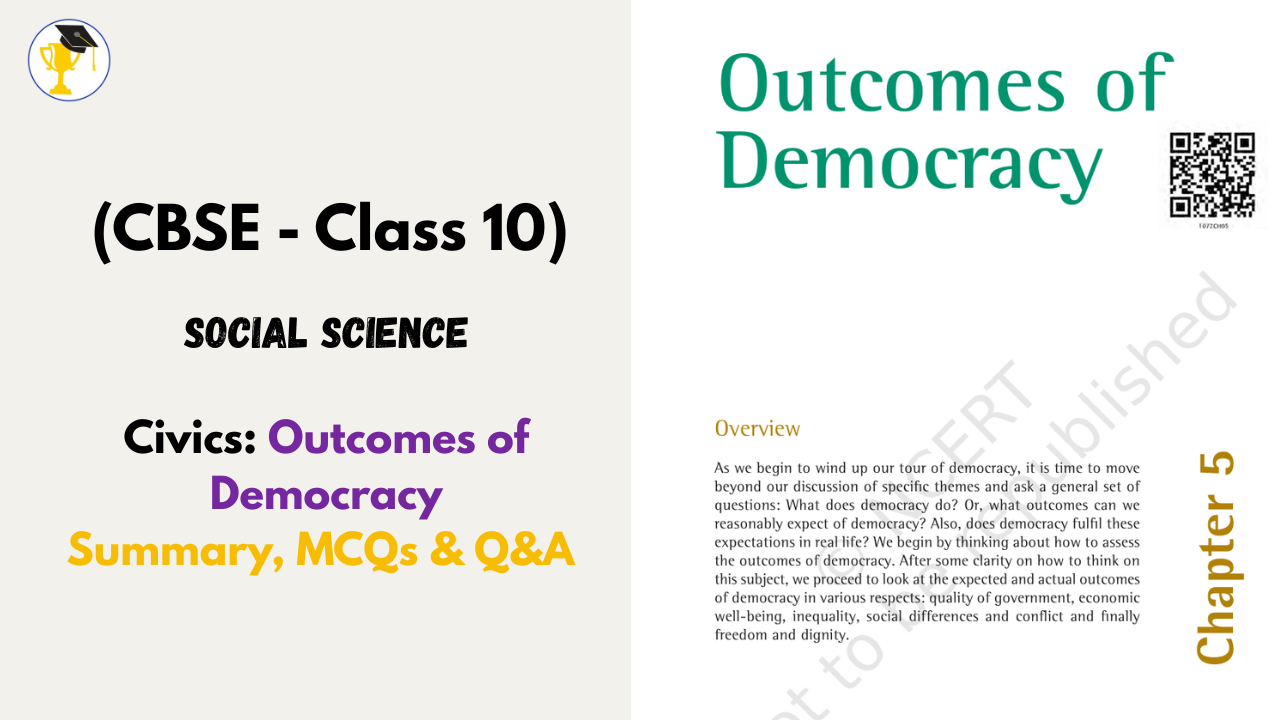
Class 10 Social Science-Outcomes of Democracy (Civics: Chapter 5) Summary + MCQs + Q&A
CHAPTER SUMMARY-OUTCOMES OF DEMOCRACY
Introduction: What Does Democracy Deliver?
The chapter starts by asking two key questions:
Democracy is not perfect, but it is better than any other form of government because it allows:
-
Participation
-
Accountability
-
Equality
-
Transparency
The NCERT overview (page 72) explains that the outcomes must be judged through:
1. Outcome: Accountable, Responsive & Legitimate Government
A democratic government:
-
Is accountable because leaders can be voted out.
-
Is responsive because people can question policies.
-
Has legitimacy because it follows laws and procedures.
However, democracies may be slow because they involve consultation and debate, but this makes decisions more acceptable.
2. Outcome: Economic Growth & Development
Do democracies achieve higher economic growth?
Democracy ensures fairness, not just faster growth.
3. Outcome: Reduction of Inequality & Poverty
Democracy promises equality, but:
-
Rich–poor gap is often very high.
-
Socio-economic inequalities persist.
-
Disadvantaged groups still struggle for equal opportunities.
Democracy creates awareness and space for movements, even if results are slow.
4. Outcome: Accommodation of Social Diversity
Democracy handles diversity better because:
-
Conflicts are resolved through dialogue, not violence.
-
All groups get representation.
-
Majority must work with minority (majority rule + minority rights).
Purpose: Unity in diversity without suppression.
5. Outcome: Enhancement of Dignity & Freedom of Citizens
This is the most important outcome.
-
Every individual’s dignity is protected.
-
Women, minorities, and vulnerable groups gain more respect.
-
Citizens enjoy rights like freedom of speech, religion, expression, and voting.
Democracy gives people power to correct their government.
KEY TERMS
|
Term
|
Meaning
|
|
Legitimacy
|
Public acceptance of government’s right to rule
|
|
Accountability
|
Responsibility to citizens and laws
|
|
Transparency
|
Open decision-making
|
|
Social Diversity
|
Differences of caste, religion, language
|
|
Dignity
|
Respect and value of each individual
|
|
Equality
|
Equal rights and opportunities for all
|
ONE-WORD / ONE-LINE ANSWERS
1. What ensures government stability? → Legitimacy
2. What is the essence of democracy? → Accountability
3. Which form of government grows faster? → Dictatorship
4. What does democracy promote? → Dignity & freedom
5. What reduces conflicts? → Accommodation
6. What gap remains in democracies? → Economic inequality
7. Who can question the government? → Citizens
8. Essential feature of democracy → Free & fair elections
9. Outcome related to decision-making → Transparency
10. What protects minority rights? → Democracy
MCQs (10 Important Questions)
1. A major outcome of democracy is:
a) Quick decisions
b) Accountability
c) Dictatorship
d) Inequality
Answer: b
2. Democracies are better because they promote:
Dignity of citizens
3. Economic growth is usually higher in:
Dictatorships
4. Which of the following is not guaranteed in democracy?
Fast decision-making
5. Democracy ensures:
Political equality
6. Which outcome addresses diversity?
Accommodation
7. Which is a major challenge in democracy?
Economic inequality
8. Legitimacy in democracy comes from:
Elections
9. Women’s dignity improves in:
Democracy
10. Best indicator of government quality:
Transparency
CASE-BASED QUESTIONS
Case 1: Slow but Correct Decisions
PASSAGE:
Democracy involves consultation and debate, which makes decisions slower. But this ensures that decisions are accepted and respected by the public.
Questions:
1. Why are democratic decisions slow?
→ Consultation with people
2. What advantage does this provide?
→ Better, more acceptable decisions
3. What value does this highlight?
→ Transparency
Case 2: Economic Inequality in Democracies
PASSAGE:
Even in democracies, large sections of the population remain poor. While wealth is concentrated among a few, democracy allows awareness and movements against inequality.
Questions:
1. Does democracy remove economic inequality?
→ No
2. What does democracy provide instead?
→ Platform for raising demands
3. Who benefits the most from democratic rights?
→ Poor & disadvantaged groups
ASSERTION-REASON QUESTIONS
1. A: Democracy promotes dignity of citizens.
R: Every individual has equal political rights.
Answer: A
2. A: Dictatorships make decisions faster.
R: They do not need to consult people.
Answer: A
3. A: Democracy guarantees economic equality.
R: All citizens earn the same income.
Answer: (A false, R false)
4. A: Democracy reduces the chance of conflicts.
R: It accommodates social diversity.
Answer: A
5. A: People have control over their rulers in democracy.
R: Elections allow voters to change government.
Answer: A
6. A: Democracies always eliminate poverty.
R: Equal voting rights reduce inequality.
Answer: A false, R true
7. A: Transparency is a strong feature of democracy.
R: Decisions are taken secretly.
Answer: A true, R false
8. A: Democracy provides methods to resolve conflicts.
R: It engages people in dialogue.
Answer: A
9. A: Democracy ensures dignity for women.
R: Women participate equally in decision-making.
Answer: A
10. A: Democracy is always efficient.
R: All decisions are taken quickly.
Answer: Both A and R are false
LONG ANSWERS (5–6 MARKS)
Q1. Explain the major outcomes of democracy.
Democracy ensures accountability by allowing citizens to elect and replace leaders. It strengthens dignity and freedom, especially for women and marginalized groups. Although economic growth may not be very high, democracy is better at handling social diversity, reducing conflicts through negotiation. The system promotes transparency and legitimacy, which makes governments more stable and trusted by the people.
Q2. How does democracy promote dignity and freedom of citizens?
Democracy treats every citizen as equal, regardless of caste, gender, religion, or class. It gives freedom of expression, right to vote, and right to protest, which empower individuals. Women and minorities gain dignity through representation and constitutional protection. This outcome of democracy is its greatest strength.
Q3. Why is democracy better than dictatorship?
Democracy promotes equality, protects human rights, and ensures transparency. Dictatorships may grow faster but often suppress citizens, violate rights, and take harsh decisions. Democracy involves public consultation, which makes decisions more acceptable and just.
For full chapter click on: Outcomes of Democracy


 STUDY MATERIALS
 COURSES
 MORE
MORE
 SUCCESS STORY
 ADMISSION
 STORE
STORE