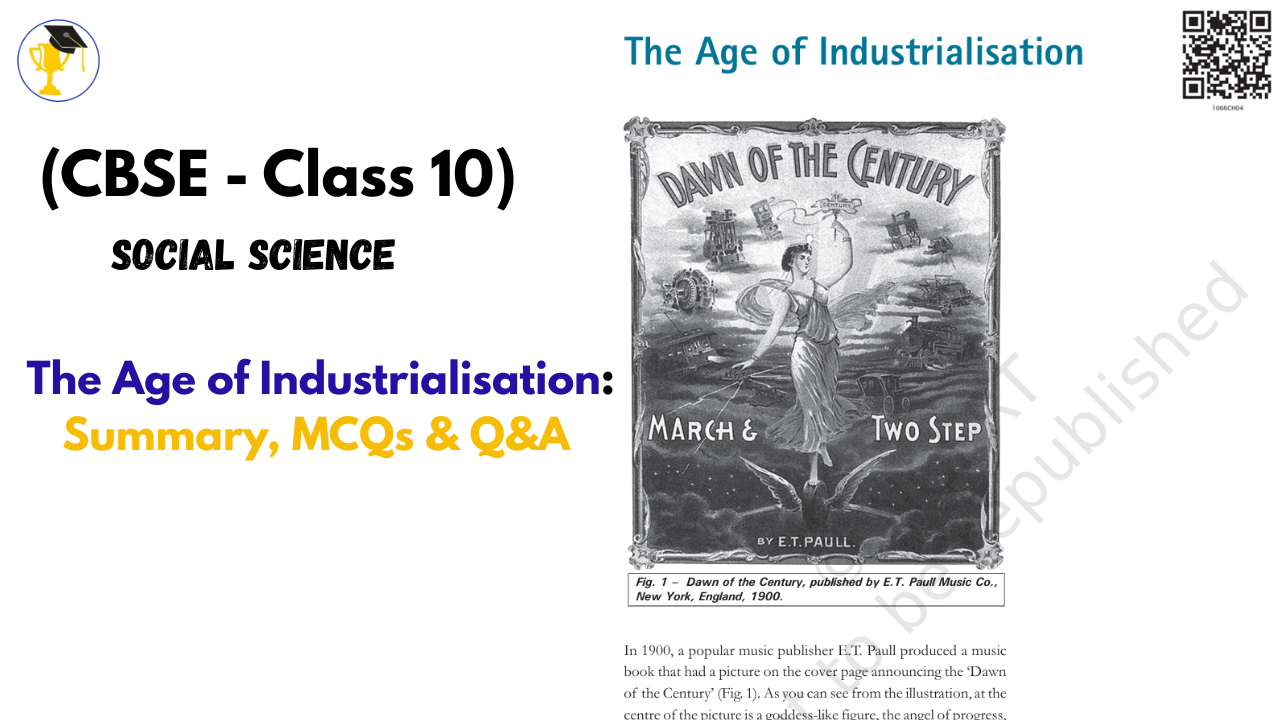
Class 10 Social Science – The Age of Industrialsation (History: Chapter 4) Summary + MCQs + Q&A
Chapter Summary - The Age of Industrilsation
1. Before the Industrial Revolution
Before factories, Europe had proto-industrialisation, a phase where:
-
Merchants moved to villages to get goods produced.
-
Powerful guilds in towns restricted new merchants.
-
Peasants did spinning & weaving as a family-based cottage industry.
-
Merchants supplied money + raw materials → peasants produced goods → merchants exported them.
• This created a vast rural industrial network long before factories.
2. The Coming of the Factory
-
First factories came up in 1730s.
-
Cotton industry expanded rapidly.
-
Inventions like the spinning jenny, water frame, and Arkwright’s cotton mill boosted production.
-
Mills brought all processes under one roof, allowing better supervision.
-
By 19th century, factories symbolised industrial England.
3. Pace of Industrial Change
Important points:
-
Cotton & iron–steel were major sectors.
-
Traditional industries continued; fewer than 20% workers were in modern industries.
-
Technology spread slowly because new machines were costly, unreliable.
-
Even in 19th century, most workers were craftspeople, not machine operators.
4. Hand Labour vs Steam Power
-
Britain had large surplus labour, so machines were not always needed.
-
Demand in many industries was seasonal, so hand labour was cheaper.
-
Elite families preferred hand-made goods → sign of class & refinement.
-
In contrast, America (labour shortage) mechanised faster.
Life of the Workers
-
Workers migrated from rural areas, often jobless for months.
-
Wages fluctuated ↑↓; unemployment was common.
-
New machines like Spinning Jenny threatened jobs → workers attacked machines.
5. Industrialisation in the Colonies – India
(A) Age of Indian Textiles
-
India was famous for fine silk & cotton textiles.
-
Trade via Surat, Hoogly, Masulipatam.
-
Indian merchants, bankers, supply merchants operated the export network.
But decline began when:
(B) What Happened to Weavers?
Initially:
-
East India Company wanted more Indian textiles for Europe.
-
Appointed gomasthas to control weavers.
-
Introduced advances that tied weavers to the Company.
Problems:
-
Gomasthas acted harshly → weavers revolted.
-
Low prices + forced contracts.
-
Weavers migrated or shifted to agriculture.
(C) Manchester Comes to India
-
By 19th century, British machine-made cloth flooded Indian markets.
-
Import duties supported British textiles.
-
Indian export markets collapsed.
-
American Civil War (1861) → shortage of cotton in Britain → raw cotton exported from India → price rise → Indian weavers suffered.
6. Factories Come Up in India
-
First cotton mill: Bombay, 1854.
-
First jute mill: Bengal, 1855.
-
Entrepreneurs: Dwarkanath Tagore, Tata, Birla, Hukumchand, Parsis.
-
European Managing Agencies controlled major sectors.
Workers
7. Peculiarities of Industrial Growth
-
British invested mostly in tea, coffee, mining, and jute (for exports).
-
Indian mills produced coarse yarn → safe from Manchester competition.
-
Swadeshi movement helped Indian mills grow.
-
WWI boosted Indian industries due to fall in British imports.
Small-Scale Industries
8. Market for Goods – Advertising
MCQs – Chapter 4
1. Proto-industrialisation refers to:
a) Growth of factories
b) Pre-factory large-scale production
c) Increase in machine-made goods
d) Expansion of modern industries
Ans: b)
2. Who invented the cotton mill?
a) James Watt
b) Arkwright
c) Henry Ford
d) Samuel Crompton
Ans: b)
3. Who were gomasthas?
a) Jobbers in mills
b) Company supervisors over weavers
c) Agents of zamindars
d) Tax collectors for British officials
Ans: b)
4. Which city had the first cotton mill in India?
a) Calcutta
b) Bombay
c) Ahmedabad
d) Madras
Ans: b)
5. Which industry was the first to experience modern industrialisation in Britain?
a) Iron and Steel
b) Textile Industry
c) Automobile Industry
d) Shipbuilding
Ans: b)
6. Who were jobbers in Indian mills?
a) Supervisors who maintained machines
b) Agents who recruited workers
c) Owners of factories
d) Workers who packed finished goods
Ans: b)
7. Which of the following was a major feature of early industrialisation?
a) Use of robots in factories
b) Heavy dependence on handmade goods
c) Mass production in large factories
d) Introduction of electricity in industries
Ans: c)
8. Which country became the leading industrial nation after Britain?
a) France
b) Germany
c) USA
d) Japan
Ans: c)
9. The term Stapler in the wool industry referred to:
a) A person who sorted wool
b) A machine that spun yarn
c) A device used to weave cloth
d) A worker who dyed fabric
Ans: a)
10. Which invention revolutionised cotton spinning?
a) Flying Shuttle
b) Spinning Jenny
c) Water Frame
d) Power Loom
Ans: b)
11. When did the first jute mill start in India?
a) 1854
b) 1860
c) 1874
d) 1885
Ans: a)
12. Who set up the first cotton mill in Bombay?
a) Dinshaw Petit
b) Jamsetjee Jejeebhoy
c) Dadabhai Naoroji
d) Cowasjee Nanabhai Davar
Ans: d)
ASSERTION–REASON QUESTIONS
Q1.
Assertion (A): Indian handloom survived even during mill competition.
Reason (R): Mills could not imitate fine weaves like Banarasi and Baluchari.
Ans: a) A and R both true, and R explains A
Q2.
A: Gomasthas were unpopular among weavers.
R: They were village relatives who helped weavers.
Ans: c) A true, R false
Q3.
A: British mills faced a shortage of cotton in 1860s.
R: Because of the American Civil War.
Ans: a)
Q4.
A: Jobbers held great power.
R: They controlled worker recruitment.
Ans: a)
CASE-BASED QUESTIONS
CASE 1: Proto-Industrialisation
PASSAGE
Even before factories began to dominate the landscape, European merchants in the seventeenth and eighteenth centuries moved to the countryside to get goods produced for international markets. Guild restrictions in towns prevented them from expanding locally. Poor peasants and artisans welcomed this work because common lands were disappearing and cultivation income was shrinking. By working for merchants, families could remain in villages and still earn. Yarn, cloth, and other goods travelled from spinners to weavers to fullers, and finally to London—the great finishing centre. This vast network of rural producers and town-based merchants is known as proto-industrialisation.
Q1. What prevented merchants from producing in towns?
Ans: Powerful guilds restricted production.
Q2. Why did peasants accept merchant advances?
Ans: To supplement declining agricultural income.
Q3. Which city became the finishing centre?
Ans: London.
CASE 2: Life of Workers
PASSAGE
In Victorian Britain, labour was abundant and workers migrated to cities hoping to find employment. Many job-seekers spent nights under bridges or in night shelters because work was uncertain. Wages were low and fluctuated. The fear of unemployment was constant. During the Napoleonic Wars, prices rose sharply and real wages fell. Many were jobless during off-seasons. Workers often opposed new machines like the Spinning Jenny, fearing that mechanisation would take away their jobs. Attacks on machines and protests were common as workers struggled for secure livelihoods.
Q1. Why were wages unstable?
Ans: Seasonal demand and frequent unemployment.
Q2. What did workers fear about new machines?
Ans: Machines would replace manual labour.
Q3. During which war did prices rise sharply?
Ans: Napoleonic Wars.
CASE 3: Gomasthas & Weavers
PASSAGE
After establishing political control, the East India Company wanted to control Indian textile production. They appointed gomasthas—paid officials—to supervise weavers, collect cloth, and ensure quality. Weavers were forced to accept advances, making them tied to Company orders. Unlike old supply merchants, gomasthas were outsiders with no social connection to villages. They arrived with sepoys, punished weavers, and forced them to accept low prices. This led to clashes, desertion of villages, and widespread distress among weavers.
Q1. Who were gomasthas?
Ans: Company-appointed supervisors.
Q2. Why were they disliked?
Ans: Because they acted harshly and imposed low prices.
Q3. What system tied weavers to Company orders?
Ans: The advance payment system.
CASE 4: Manchester Imports
PASSAGE
By the early nineteenth century, British industries expanded and demanded protection from foreign competitors. The British government imposed import duties on Indian textiles and promoted Manchester cloth in Indian markets. As a result, Indian exports fell sharply—from 33% in 1811 to only 3% by mid-century. Machine-made British cloth was cheap, and local markets were flooded. When the American Civil War disrupted cotton supply, Britain turned to India for raw cotton, causing prices to rise and creating severe shortages for Indian weavers who could not afford raw material. The decline of weaving became widespread.
Q1. Why did Manchester goods flood India?
Ans: Import duties protected British goods.
Q2. Why did raw cotton prices rise?
Ans: American Civil War stopped US cotton supply.
Q3. What was the impact on Indian weaving?
Ans: Market collapsed; weavers faced ruin.
CASE 5: Indian Industrialists
PASSAGE
Indian entrepreneurs like Dwarkanath Tagore, Jamsetjee Jeejeebhoy, and later G.D. Birla and Hukumchand accumulated early wealth through trade—especially the China trade involving opium and tea. Many then set up industries like cotton mills, jute mills, and iron and steel factories. Yet, colonial policies restricted Indian capitalists: they were excluded from European Chambers of Commerce and barred from trading manufactured goods with Europe. Despite these challenges, Indian industrialists built major business empires.
Q1. Which trade helped early Indian entrepreneurs gain wealth?
Ans: China trade (opium–tea).
Q2. Why were Indian businessmen limited under colonial rule?
Ans: European agencies controlled trade and excluded Indians.
Q3. Name one Indian industrialist from this period.
Ans: Dwarkanath Tagore / J.N. Tata / G.D. Birla.
CASE 6: Advertisements & Markets
PASSAGE
As industries grew, manufacturers needed to persuade people to buy new products. Advertisements played a huge role in shaping consumer culture. Manchester cloth labels used images of Indian gods like Lakshmi, Saraswati, and Krishna to gain trust of buyers. Later, calendars became a powerful advertising tool because even the illiterate used them at home and shops. Nationalist advertisers used symbols like Bharat Mata and swadeshi messages, urging Indians to buy Indian goods and reject foreign cloth.
Q1. Why were gods used in advertisements?
Ans: To gain trust and familiarity.
Q2. Why were calendars effective?
Ans: They reached even illiterate households.
Q3. What message did Indian mills promote?
Ans: Swadeshi — buy Indian goods.
VERY SHORT ANSWERS (1 Marks)
-
Who created the first cotton mill?
Ans: Richard Arkwright.
-
What is proto-industrialisation?
Ans: Pre-factory, large-scale rural industrial production.
-
Why did Surat decline?
Ans: European companies gained monopoly; trade shifted to Bombay & Calcutta.
-
Who were jobbers?
Ans: Agents who recruited workers for mills.
-
Name the first jute mill in India.
Ans: Set up in Bengal in 1855.
SHORT ANSWERS (3 MARKS)
Q1. Why did handloom survive?
-
Fly shuttle increased productivity.
-
Mills couldn’t imitate fine weaves.
-
Rich buyers continued buying expensive cloth.
Q2. Why did weavers face problems in the 19th century?
-
Manchester imports flooded India.
-
Raw cotton shortage due to American Civil War.
-
Company’s harsh control & low prices.
Q3. Give three features of proto-industrialisation.
-
Rural production for international markets.
-
Merchant–peasant relationship.
-
Decline of guilds and rise of merchant networks.
LONG ANSWERS (5–6 MARKS)
Q1. Explain the life of workers during early industrialisation.
Workers in industrial Britain lived extremely harsh lives. Millions of poor peasants migrated to towns in search of work, but employment was uncertain and seasonal. Many workers slept under bridges, in shelters, or on streets. Wages fluctuated widely, and although nominal wages sometimes rose, real wages fell during wars due to rising prices. Workers frequently faced unemployment, and the fear of losing livelihood made them hostile towards new machines. The introduction of the Spinning Jenny was bitterly opposed because it threatened the jobs of women spinners. Even when work was available, conditions were terrible: long hours, low pay, and unhealthy surroundings. Thus the early period of industrialisation brought insecurity rather than improvement in workers’ lives.
Q2. Describe the system through which the East India Company controlled Indian weavers.
The East India Company established strict control over Indian textile production after gaining political power. It appointed gomasthas, salaried officials who supervised weavers, ensured quality, and collected finished cloth. The Company also introduced a system of advances, giving money to weavers to buy raw material, but making them contractually bound to sell only to the Company at low prices. Old supply merchants were removed, and gomasthas, who were outsiders, treated weavers harshly—using sepoys, enforcing deadlines, and punishing delays. This destroyed local bargaining power, reduced weavers’ independence, and pushed many into poverty and migration.
Q3. Why did industrial production increase in India during the First World War?
During WWI, British mills were occupied with war production and could not export goods to India. This created a vacuum in the Indian market, allowing Indian mills to expand. Indian factories were also asked to supply goods for the war—such as cloth for uniforms, tents, jute bags, boots, and saddles. As demand grew, factories introduced multiple shifts, hired more workers, and increased output. British imports declined permanently after the war because Britain’s economy weakened, enabling Indian industries to consolidate their control over the home market.
For Full Chaper Click on: The Age of Industrialisation


 STUDY MATERIALS
 COURSES
 MORE
MORE
 SUCCESS STORY
 ADMISSION
 STORE
STORE