

Q 31 :

A monoatomic gas having γ=53 is stored in a thermally insulated container and the gas is suddenly compressed to (18)th of its initial volume. The ratio of final pressure and initial pressure is: (γ is the ratio of specific heats of the gas at constant pressure and at constant volume)          [2025]

  • 16


  • 40


  • 32


  • 28


(3)

PiViγ=PfVfγ

 PfPi=(ViVf)γ=(8)5/3=32


Q 32 :

An ideal gas initially at 0°C temperature, is compressed suddenly to one fourth of its volume. If the ratio of specific heat at constant pressure to that at constant volume is 3/2, the change in temperature due to the thermodynamics process is ________ K.          [2025]


(273)

        TVγ1 = constant

                    γ=32

273×V0.5=T(V4)0.5

                    T=546 K  T=273 K


Q 33 :

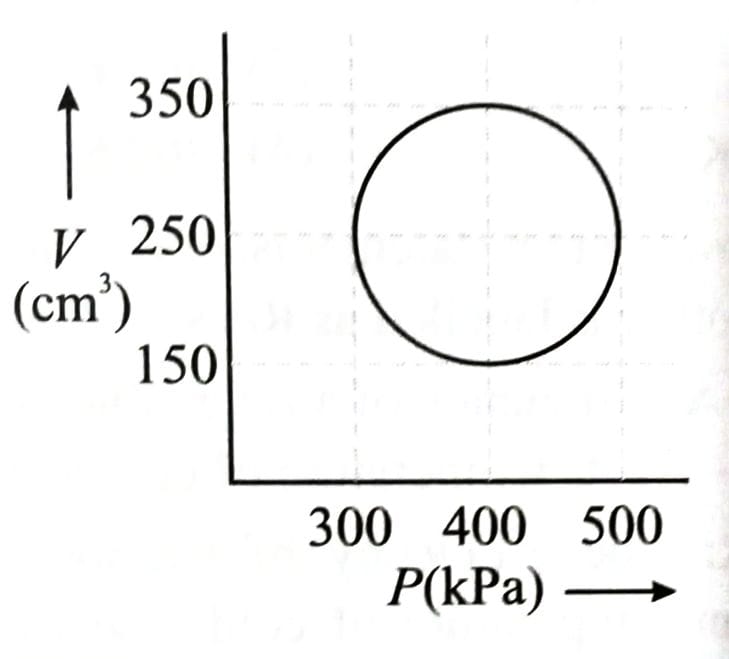
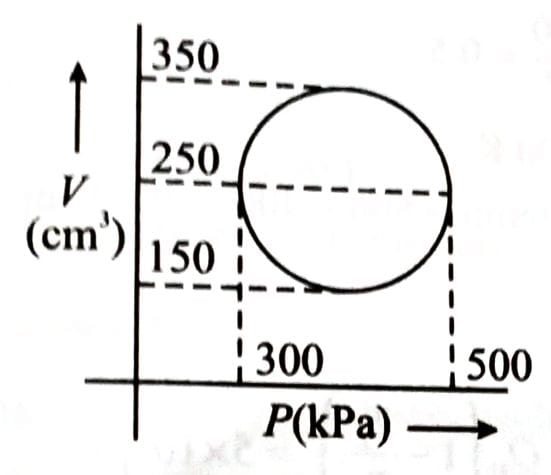
An ideal gas has undergone through the cyclic process as shown in the figure. Work done by the gas in the entire cycle is ________ ×101 J. (Take π = 3.14)          [2025]


(314)

Area of circle, W=π(V2)·(P2)

W=π4(500300)×103(350150)×106

W=31.4 Joule

W=314×101 Joule


Q 34 :

In an isothermal change, the change in pressure and volume of a gas can be represented for three different temperatures; T3>T2>T1 as           [2023]

  •  

  •  

  •  

  •  

(1)

For isothermal process, P-V graph is a rectangular hyperbola.

As the dotted line is an isobaric line, which implies T3>T2>T1 as the volume is increasing.


Q 35 :

Match List I with List II :              [2023]

  List I   List II
A. Isothermal Process I. Work done by the gas decreases internal energy
B. Adiabatic Process II. No change in internal energy
C. Isochoric Process III. The heat absorbed goes partly to increase internal energy and partly to do work
D. Isobaric Process IV. No work is done on or by the gas


Choose the correct answer from the options given below :

  • A-I, B-II, C-IV, D-III


  • A-II, B-I, C-IV, D-III


  • A-I, B-II, C-III, D-IV


  • A-II, B-I, C-III, D-IV


(2)

ΔU=nCVΔT

For isothermal process, T is constant.  

So, ΔU=0

AII

Adiabatic process

ΔQ=0

ΔQ=ΔU+ΔW

ΔU=-ΔW

Work done by gas is positive,  

so ΔU is negative.

BI

For isochoric process, ΔW=0

CIV

For isobaric process, 

ΔW=PΔV0

ΔU=nCVΔT0

Heat absorbed goes partly to increase internal energy and partly to do work.


Q 36 :

Given below are two statements. One is labelled as Assertion A and the other is labelled as Reason R.     [2023]

Assertion A: If dQ and dW represent the heat supplied to the system and the work done on the system respectively, then according to the first law of thermodynamics dQ=dUdW.

Reason R: First law of thermodynamics is based on law of conservation of energy.

In the light of the above statements, choose the correct answer from the option given below:

  • A is correct but R is not correct


  • A is not correct but R is correct


  • Both A and R are correct and R is the correct explanation of A


  • Both A and R are correct but R is not the correct explanation of A


(3)

First law of thermodynamics is based on the law of conservation of energy and it can be written as

dQ=dU-dW

where dW is the work done on the system.


Q 37 :

The pressure (P) and temperature (T) relationship of an ideal gas obeys the equation PT2=constant. The volume expansion coefficient of the gas will be         [2023]

  • 3T2


  • 3T2


  • 3T3


  • 3T


(4)

PT2=constant,   Using PV = nRT

P=nRTV

PT2=nRTV×T2=constant=K

 T3=KV

So, ddT(KV)=3T2

KdVdT=3T2

 dV=3T2KdT=VγdT

dV=VγdT

 γV=3T2K

 γ=3T2KV=3T2T3=3T


Q 38 :

Heat is given to an ideal gas in an isothermal process.

A. Internal energy of the gas will decrease.
B. Internal energy of the gas will increase.
C. Internal energy of the gas will not change.
D. The gas will do positive work.
E. The gas will do negative work.  

Choose the correct answer from the options given below:              [2023]

  • A and E only


  • B and D only


  • C and E only


  • C and D only


(4)

dQ=dU+dW

 dU=nCVdT

dU=0 (For isothermal)

 U=constant

Also, dQ>0 (supplied).

Hence dW>0


Q 39 :

The pressure of a gas changes linearly with volume from A to B as shown in the figure. If no heat is supplied to or extracted from the gas, then the change in the internal energy of the gas will be                [2023]

  • 6 J


  • Zero


  • −4.5 J


  • 4.5 J


(4)

As Δq=0

Δu=-W

W=PdV

Δu=-W=30×103×150×10-6

       =4500×10-3=4.5 J


Q 40 :

A sample of gas at temperature T is adiabatically expanded to double its volume. The work done by the gas in the process is (given, γ=32)               [2023]

  • W=TR[2-2]


  • W=TR[2-2]


  • W=RT[2-2]


  • W=TR[2-2]


(4)

T1V1γ-1=T2V2γ-1

TV1/2=T2(2V)1/2T2=T2

W=R(T1-T2)γ-1=R(T-T2)1/2=RT(2-2)