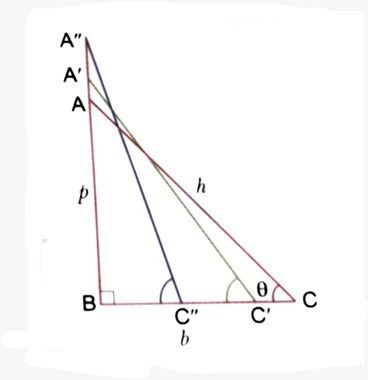


Assertion (A): If then the value of cos A is
Reason (R): For every angle
Both Assertion (A) and Reason (R) are true and Reason (R) is the correct explanation of Assertion (A)
Both assertion (A) and reason (R) are true and reason (R) is not the correct explanation of Assertion (A)
Assertion (A) is true but reason(R) is false.
Assertion (A) is false but reason(R) is true.
(1) Both Assertion (A) and Reason (R) are true and Reason (R) is the correct explanation of Assertion (A)
Assertion (A): The value of is possible.
Reason (R): The length of hypotenuse in a right-angled triangle is always greater than opposite side (perpendicular).
Both A and R are true, and R is the correct explanation of A.
Both A and R are true, but R is not the correct explanation of A
A is true, but R is false
A is false, but R is true
(4)
is defined as ratio of hypotenuse and opposite side (perpendicular). As hypotenuse is the largest side in any right-angled triangle, the value of cannot be less than 1. However, reason is true
Assertion (A): The secant of an angle is the reciprocal of the cosine of that angle.
Reason (R): Secant is defined as the ratio of the hypotenuse to the base of the triangle.
Both A and R are true, and R is the correct explanation of A
Both A and R are true, but R is not the correct explanation of A.
A is true, but R is false
A is false, but R is true
(1)
Both the assertion and the reason are correct. The secant of an angle is indeed the reciprocal of the cosine, and the definition provided in the reason accurately reflects this relationship.
Assertion (A):
Reason (R): Cotangent of an angle is the reciprocal of the tangent of that angle
Both A and R are true, and R is the correct explanation of A
Both A and R are true, but R is not the correct explanation of A
A is true, but R is false
A is false, but R is true
(1)
We know,
Assertion (A): The value of cosine decreases as the angle increases from
Reason (R): Cosine is defined as the ratio of the adjacent side to the angle under consideration and the hypotenuse, and as the angle increases, the length of the adjacent side decreases relative to the constant hypotenuse
Both A and R are true, and R is the correct explanation of A
Both A and R are true, but R is not the correct explanation of A
A is true, but R is false
A is false, but R is true
(1)
[where b stands for base (adjacent side) and h stands for hypotenuse]
Obviously, by keeping hypotenuse constant
As increases ⇒ b decreases
Hence, Assertion (A) is true. Also Reason (R) represents the same facts and supports the Assertion (A). Therefore, Reason (R) is true and correctly explains the Assertion (A).

Both A and R are true, and R is the correct explanation of A.
Both A and R are true, but R is not the correct explanation of A.
A is true, but R is false.
A is false, but R is true
(1)
The assertion is correct as the sine of is indeed 1.
The reason is also true and correctly explains why this is the case because at , the right triangle’s opposite side becomes the hypotenuse.
Both A and R are true, and R is the correct explanation of A
Both A and R are true, but R is not the correct explanation of A
A is true, but R is false
A is false, but R is true
(1)
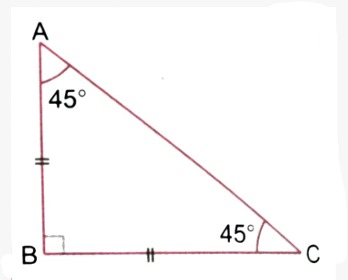
⇒ ∠A = ∠C
⇒ AB = BC = x (say)
[? In a triangle, sides opposite to equal angles are equal]
[where AB is perpendicular (opposite side) and BC is base (adjacent side)]
Hence, assertion A is true.

Also reason (R) is true and represents a fact (that for an angle of 45° in a right triangle, the opposite side equals the adjacent side), supporting assertion (A), so it correctly explains the assertion (A).
Assertion (A): The sum of the sine of two acute angles A and B is less than or equal to
Reason (R): The maximum value of the sine function is 1.
Both A and R are true, and R is the correct explanation of A.
Both A and R are true, but R is not the correct explanation of A.
A is true, but R is false
A is false, but R is true.
(2)
Both statements are true, but the reason does not correctly explain the assertion. The assertion’s truth relies on the fact that the maximum value of sum of sine of A and B occur when A and B are each
Assertion (A): If two acute angles add up to , their sines are equal.
Reason (R): The sum of angles in a right triangle is , and one of the angles is.
Both A and R are true, and R is the correct explanation of A.
Both A and R are true, but R is not the correct explanation of A.
A is true, but R is false.
A is false, but R is true.
(4)
The assertion is false because the sine of angles that add up to are equal to its cosine and vice-versa. The reason is true, as it describes the fundamental property of angle sums in a right triangle.
Assertion (A): The tangent of is 1.
Reason (R): For an angle of in a right triangle, the opposite side equals the adjacent side.
Both A and R are true, and R is the correct explanation of A.
Both A and R are true, but R is not the correct explanation of A.
A is true, but R is false.
A is false, but R is true.
(1)
Hence, assertion A is true.
Also reason (R) is true and represents a fact (that for an angle of 45° in a right triangle, the opposite side equals the adjacent side), supporting assertion (A), so it correctly explains the assertion (A).