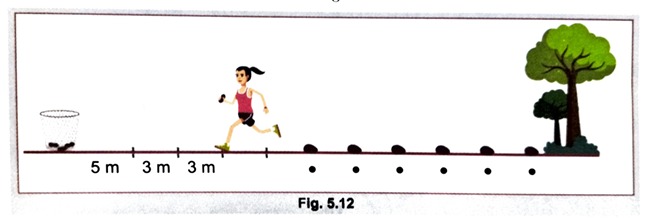


In a potato race, a bucket is placed at the starting point, which is 5 m from the first potato.
The other potatoes are arranged 3 m apart in a straight line, with a total of ten potatoes, as shown in the figure.

A competitor starts from the bucket, picks up the nearest potato, runs back to the bucket to drop it in, then returns to pick up the next potato.
This process continues until all the potatoes are in the bucket
Based on the above information answer the following questions:
(i) What is the distance covered to pick up the 7th potato?
46 m
44 m
45 m
41 m
(1)
Distance covered to pick up the 1st potato =2(5 m) = 10 m
Distance between two successive potatoes = 3 m
Distance covered to pick up the 2nd potato =2(5+3)=16 m
Distance covered to pick up the 3rd potato =2(5+3+3)=22 m
So the distances are: 10, 16, 22, …
This forms an AP where:
Distance covered to pick up 7?? potato
In a potato race, a bucket is placed at the starting point, which is 5 m from the first potato.
The other potatoes are arranged 3 m apart in a straight line, with a total of ten potatoes, as shown in the figure.

A competitor starts from the bucket, picks up the nearest potato, runs back to the bucket to drop it in, then returns to pick up the next potato.
This process continues until all the potatoes are in the bucket
Based on the above information answer the following questions:
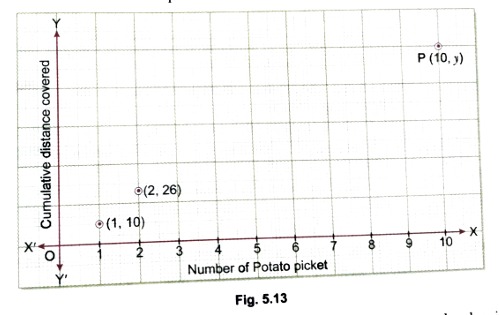
(ii) If the X-axis represents the complete trip from bucket to nth potato and Y-axis represents the cumulative distance covered by the girl, then find the Y-coordinates of the 10th potato.

350
370
330
340
(2)
So the y-coordinate of the 10th potato is 370
and the point will be (10, 370).
In a potato race, a bucket is placed at the starting point, which is 5 m from the first potato.
The other potatoes are arranged 3 m apart in a straight line, with a total of ten potatoes, as shown in the figure.

A competitor starts from the bucket, picks up the nearest potato, runs back to the bucket to drop it in, then returns to pick up the next potato.
This process continues until all the potatoes are in the bucket
Based on the above information answer the following questions:
(iii) (a) If the average speed of girl is 5 m/s then find the average time taken by girl to put all the potatoes in the bucket?
74 Second
72 Second
75 Second
70 Second
(1)
Average speed of the girl = 5 m/s
Total distance covered = 370 m
In a potato race, a bucket is placed at the starting point, which is 5 m from the first potato.
The other potatoes are arranged 3 m apart in a straight line, with a total of ten potatoes, as shown in the figure.

A competitor starts from the bucket, picks up the nearest potato, runs back to the bucket to drop it in, then returns to pick up the next potato.
This process continues until all the potatoes are in the bucket
Based on the above information answer the following questions:
(iii) (b) What is the total distance the competitor has to run?
370 m
350 m
360 m
330 m
(1)
Computer Animations: The animation on a new computer game initially allows the hero of the game to jump a (screen) distance of 10 inch over booby traps and obstacles. Each successive jump is limited to 3/4 inch less than the previous one.

Based on the above information, answer the following questions:
(i) Find the length of the seventh jump
(1)
Find the length of the thirteenth jump.
As the hero of the game initially jumps 10 inch and each successive jump is limited to 3/4 inch less than the previous one.
Therefore, we have
Distance covered in first jump = 10 inch
Distance covered in second jump = 10 − 3/4 = 37/4 inch
Distance covered in third jump = 37/4 − 3/4 = 34/4 inch and so on.
Clearly, these distances form an AP with a = 10 and d = −3/4
Computer Animations: The animation on a new computer game initially allows the hero of the game to jump a (screen) distance of 10 inch over booby traps and obstacles. Each successive jump is limited to 3/4 inch less than the previous one.

Based on the above information, answer the following questions:
(ii) Find the total distance covered after seven jumps.
(2)
Total distance covered after seven jumps is given by
Computer Animations: The animation on a new computer game initially allows the hero of the game to jump a (screen) distance of 10 inch over booby traps and obstacles. Each successive jump is limited to 3/4 inch less than the previous one.

Based on the above information, answer the following questions:
(iii) (a) Find the length of the ninth jump
2 inch
1 inch
4 inch
5 inch
(3)
Length of 9th jump
Computer Animations: The animation on a new computer game initially allows the hero of the game to jump a (screen) distance of 10 inch over booby traps and obstacles. Each successive jump is limited to 3/4 inch less than the previous one.

Based on the above information, answer the following questions:
(iii) (b) Find the length of the thirteenth jump.
2 inch
4 inch
3 inch
1 inch
(4)
Length of 13th jump
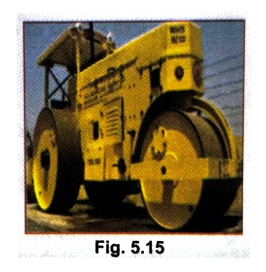
A road roller, often called a roller compactor or just a roller, is an engineering vehicle used to compact soil, gravel, concrete, or asphalt in the construction of roads and foundations. Similar machines are also used in landfills or agriculture. Past records of a road roller manufacturing company show that the number of products produced forms an arithmetic progression (AP).
The company produced 270 road rollers in the 4th year and 510 in the 10th year.

Based on the above information, answer the following questions
(i) What was the company’s production in first year?
150
140
120
110
(1)
Let a and d be the first term and common difference of the AP formed by the number of products produced by the company every year.
We have:
A road roller, often called a roller compactor or just a roller, is an engineering vehicle used to compact soil, gravel, concrete, or asphalt in the construction of roads and foundations. Similar machines are also used in landfills or agriculture. Past records of a road roller manufacturing company show that the number of products produced forms an arithmetic progression (AP).
The company produced 270 road rollers in the 4th year and 510 in the 10th year.

Based on the above information, answer the following questions
(ii) What was the company’s production in the 8th year?
430
420
415
410
(1)
Company’s production in 8th year is given by: