Q 1 :

Ananya saves Rs. 24 during the first month Rs. 30 in the second month and Rs. 36 in the third month. She continues to save in this manner.

On the basis of above information answer the following questions.

Q. Whether the monthly savings of Ananya form an AP or not ? If yes then write the first term and common difference.


(6)

Savings of Ananya are Rs. 24, Rs. 30, Rs. 36, ...

Since it is uniformly increasing by Rs. 6, therefore it forms an AP.

Here, a = 24, d = 30 – 24 = 6


Q 2 :

Ananya saves Rs. 24 during the first month Rs. 30 in the second month and Rs. 36 in the third month. She continues to save in this manner.

On the basis of above information answer the following questions.

Q. What is the amount that she will save in 15th month?


(108)

a15=a+14d=24+14×6=24+84=Rs. 108


Q 3 :

Ananya saves Rs. 24 during the first month Rs. 30 in the second month and Rs. 36 in the third month. She continues to save in this manner.

On the basis of above information answer the following questions.

Q. In which month, will she save Rs. 66?


(8)

an=66a+(n-1)d=66

24+(n-1)6=66n-1=426=7n=8


Q 4 :

Ananya saves Rs. 24 during the first month Rs. 30 in the second month and Rs. 36 in the third month. She continues to save in this manner.

On the basis of above information answer the following questions.

Q.  What is the common difference of an AP whose nth term is 8 – 5n?


(-5)

an=8-5n

a1=8-5=3

a2=8-10=-2d=a2-a1=-2-3=-5


Q 5 :

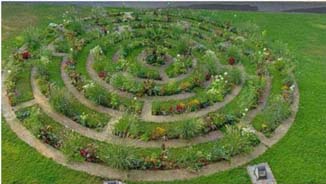
A school has decided to plant some endangered trees on 51st World Environment Day in the nearest park. They have decided to plant those trees in few concentric circular rows such that each succeeding row has 20 more trees than the previous one. The first circular row has 50 trees.

Based on the above given information, answer the question :

Q.  How many trees will be planted in the 10th row ?


(230)

Here a= 50 and d= 20

Number of trees planted in 10th row = a10 = 50 + 9 × 20 = 230


Q 6 :

A school has decided to plant some endangered trees on 51st World Environment Day in the nearest park. They have decided to plant those trees in few concentric circular rows such that each succeeding row has 20 more trees than the previous one. The first circular row has 50 trees.

Based on the above given information, answer the questions :

Q.   How many more trees will be planted in the 8th row than in the 5th row ?


(60)

Here a=50 and d=20

a8-a5=3×20=60


Q 7 :

A school has decided to plant some endangered trees on 51st World Environment Day in the nearest park. They have decided to plant those trees in few concentric circular rows such that each succeeding row has 20 more trees than the previous one. The first circular row has 50 trees.

Based on the above given information, answer the question :

Q.   If 3200 trees are to be planted in the park, then how many rows are required ? 


(16)

Here a=50 and d=20

Let Sn=3200

Sn=n2[2a+(n-1)d]=3200

Sn=n2[2×50+(n-1)×20]=3200

n2+4n-320=0

(n+20)(n-16)=0

Since, n-20

  n=16

Hence, required number of rows are 16


Q 8 :

A school has decided to plant some endangered trees on 51st World Environment Day in the nearest park. They have decided to plant those trees in few concentric circular rows such that each succeeding row has 20 more trees than the previous one. The first circular row has 50 trees.

Based on the above given information, answer the question :

Q.  If 3200 trees are to be planted in the park, then how many trees are still left to be planted after the 11th row ?


(1550)

Required number of trees = Sn-S11

=3200-112[2×50+10×20]=3200-1650=1550

Hence, number of trees left are 1550


Q 9 :

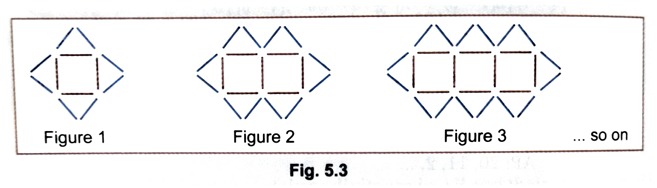
In Mathematics, relations can be expressed in various ways. Matchstick patterns are an example of linear relations. Different strategies can be used to calculate the number of matchsticks used in different figures.

Based on the above information, answer the following questions:


(i) Write the AP for the number of triangles used in the figures. Also, write the nth term of this AP.

  • an=2(n+1)


  • an=1(n+2)


  • an=1(2+2)


  • an=3(n+2)


(1)

The AP formed by the number of triangles in each figure is: 4, 6, 8, …

Here, a=4,??d=6-4=8-6=2 

The nth term of an AP is an=a+(n-1)dan=4+(n-1)×2=4+2n-2=2n+2=2(n+1)So, an=2(n+1)


Q 10 :

In Mathematics, relations can be expressed in various ways. Matchstick patterns are an example of linear relations. Different strategies can be used to calculate the number of matchsticks used in different figures.

Based on the above information, answer the following questions:


(ii) Which figure has 61 matchsticks?

  • 8th figure


  • 7th figure


  • 5th figure


  • 4th figure


(1)

The AP formed by the number of matchsticks in the figure is:
12, 19, 26, …

Here, a=12, d=19-12=26-19=7

Let the ntfigure have 61 matchsticks. Then:

an=6112+(n-1)7=61(n-1)7=49n-1=7n=8

The 8th figure has 61 matchsticks.


Q 11 :

In Mathematics, relations can be expressed in various ways. Matchstick patterns are an example of linear relations. Different strategies can be used to calculate the number of matchsticks used in different figures.

Based on the above information, answer the following questions:


(iii) (a) If 2 more matchsticks are added in each figure, then will the number of matchsticks in each figure still form an AP? If yes, find the number of matchsticks used in the 10th figure.

  • 77


  • 74


  • 73


  • 70


(1)

If two more matchsticks are added to each figure, the new sequence is:
12 + 2, 19 + 2, 26 + 2, … i.e., 14, 21, 28, …

24-14=7=28-21

Hence, the sequence is an AP where a=14,??d=7 

We need to find a10: an=a+(n-1)da10=14+9×7=14+63=77

The number of matchsticks used in the 10th figure is 77


Q 12 :

In Mathematics, relations can be expressed in various ways. Matchstick patterns are an example of linear relations. Different strategies can be used to calculate the number of matchsticks used in different figures.

Based on the above information, answer the following questions:


(iii) (b) If from each figure 5 matchsticks are removed, then will the number of matchsticks in each figure still form an AP? If yes, find which figure will have 91 matchsticks.

  • 13th figure


  • 14th figure


  • 12th figure


  • 11th figure


(1)

If 5 matchsticks are removed from each figure, the new sequence formed is:
12 – 5, 19 – 5, 26 – 5, … i.e., 7, 14, 21, …

14-7=7, 21-14=7

Hence, the sequence is an AP where a=7, d=7

Let the nth figure have 91 matchsticks:

an=917+(n-1)7=91(n-1)7=84n-1=12n=13


Q 13 :

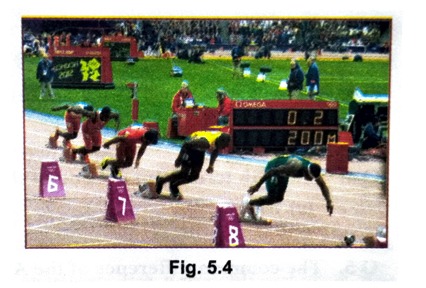
Your friend Veer wants to participate in a 200 m race. He can currently run that distance in 51 seconds and with each day of practice it takes him 2 seconds less. He wants to complete the race in 31 seconds.

Based on the above information answer the following question:


(i) Write AP for the given situation

  • 51, 49, 47


  • 52, 49, 47


  • 51, 53, 47


  • 51, 50, 74


(1)

The general form of an AP is a, a + d, a + 2d, ...., where a is the first term and d is the common difference.

Here a = 51, d = –2 ∴ The required AP is: 51, (51 – 2), (51 – 4), .... 51, 49, 47, ....


Q 14 :

Your friend Veer wants to participate in a 200 m race. He can currently run that distance in 51 seconds and with each day of practice it takes him 2 seconds less. He wants to complete the race in 31 seconds.

Based on the above information answer the following question:


(ii) What is the minimum number of days he needs to practice till his goal is achieved?

  • 11


  • 12


  • 13


  • 15


(1)

Let he has to practice for n days

a = 31  a + (n  1)d = 31,  a = 51, d = -2  51 + (n  1)(-2) = 31  -2(n  1) = 31  51 = -20 n  1 = 10  n = 11

Minimum number of days = 11


Q 15 :

Your friend Veer wants to participate in a 200 m race. He can currently run that distance in 51 seconds and with each day of practice it takes him 2 seconds less. He wants to complete the race in 31 seconds.

Based on the above information answer the following question:


(iii) (a) If nth term of an AP is given by a = 2n + 3, then find the common difference of the AP.

  • 1


  • 2


  • 5


  • 4


(2)

Given, a = 2n + 3 a = 2(n  1) + 3 = 2n + 1 d = a  a = (2n + 3)  (2n + 1) = 2


Q 16 :

Your friend Veer wants to participate in a 200 m race. He can currently run that distance in 51 seconds and with each day of practice it takes him 2 seconds less. He wants to complete the race in 31 seconds.

Based on the above information answer the following question:


(iii) (b) Find the value of n, for which 2n, n + 10, 3n + 2 are three consecutive terms of an AP.

  • 5


  • 4


  • 6


  • 3


(3)

Since, 2n, n + 10, 3n + 2 are in AP.2(n + 10) = 2n + 3n + 2 [ if a, b, c are in AP then 2b = a + c] 2n + 20 = 5n + 2 18 = 3n n = 6


Q 17 :

Your elder brother wants to buy a car and plans to take loan from a bank for his car. He repays his total loan of Rs 1,18,000 by paying every month starting with the first instalment of Rs 1000. If he increases the instalment by Rs 100 every month, answer the following:

Based on the above information answer the following questions:


(i) Find the amount paid by him in the 30th instalment

  • 3900


  • 3700


  • 3600


  • 3500


(1)

We have an AP of monthly instalments 1000, 1100, 1200, ...
Here  a=1000 ,d=100

(i) Amount paid in 30th instalment

a30=a+(30-1)da30=a+29d=1000+29×100=1000+2900=3900


Q 18 :

Your elder brother wants to buy a car and plans to take loan from a bank for his car. He repays his total loan of Rs 1,18,000 by paying every month starting with the first instalment of Rs 1000. If he increases the instalment by Rs 100 every month, answer the following:

Based on the above information answer the following questions:


(ii) What amount does he still have to pay after the 30th instalment?

  • 45500


  • 44500


  • 42500


  • 43000


(2)

Now, total amount paid in 30 instalment = S30

S30=30/2(2×1000+(30-1)×100)[Sn=n/2(2a+(n-1)d)]S30=30(1000+29×50)=30×2450= 73,500 Amount still he has to pay= 1,18,000- 73,500=44,500


Q 19 :

Your elder brother wants to buy a car and plans to take loan from a bank for his car. He repays his total loan of Rs 1,18,000 by paying every month starting with the first instalment of Rs 1000. If he increases the instalment by Rs 100 every month, answer the following

Based on the above information answer the following questions:


(iii) (a) If the total number of installments is 40, what is the amount paid in the last installment?

  • 4400


  • 4700


  • 4900


  • 4100


(3)

(a) As total number of instalment is 40, therefore amount paid in last instalment =a40

a40=a+(40-1)d=a+39d=1000+39×100=1000+3900=4900


Q 20 :

Your elder brother wants to buy a car and plans to take loan from a bank for his car. He repays his total loan of Rs 1,18,000 by paying every month starting with the first instalment of Rs 1000. If he increases the instalment by Rs 100 every month, answer the following

Based on the above information answer the following questions:


(iii) (b) Find the ratio of the 1st instalment to the last instalment.

  • 10:49


  • 10:45


  • 11:49


  • 10:19


(1)

(b) We have, first instalment = Rs 1000
and last instalment = Rs 4900

∴ Required ratio =1000/4900=10/49=10:49


Q 21 :

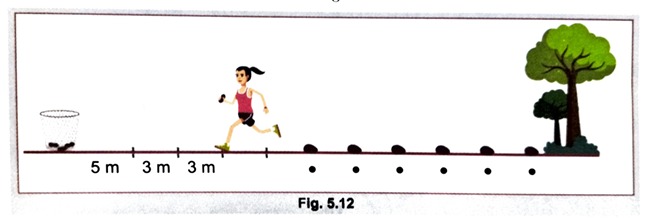
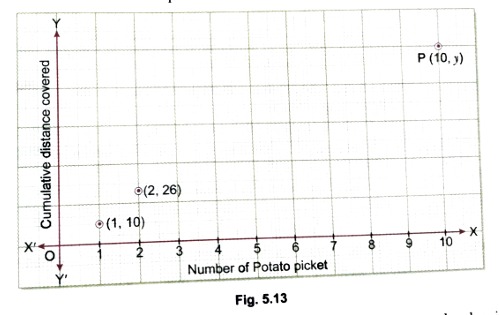
In a potato race, a bucket is placed at the starting point, which is 5 m from the first potato.
The other potatoes are arranged 3 m apart in a straight line, with a total of ten potatoes, as shown in the figure.

A competitor starts from the bucket, picks up the nearest potato, runs back to the bucket to drop it in, then returns to pick up the next potato.
This process continues until all the potatoes are in the bucket


Based on the above information answer the following questions:


(i) What is the distance covered to pick up the 7th potato?

  • 46 m


  • 44 m


  • 45 m


  • 41 m


(1)

Distance covered to pick up the 1st potato  =2(5m) = 10m

Distance between two successive potatoes = 3 m

Distance covered to pick up the 2nd potato =2(5+3)=16m

Distance covered to pick up the 3rd potato =2(5+3+3)=22m

So the distances are: 10, 16, 22, …

This forms an AP where: a=a1=10,a2=16,d=16-10=6

Distance covered to pick up 7?? potato  =2(5+6×3)=2×23=46 m


Q 22 :

In a potato race, a bucket is placed at the starting point, which is 5 m from the first potato.
The other potatoes are arranged 3 m apart in a straight line, with a total of ten potatoes, as shown in the figure.

A competitor starts from the bucket, picks up the nearest potato, runs back to the bucket to drop it in, then returns to pick up the next potato.
This process continues until all the potatoes are in the bucket


Based on the above information answer the following questions:


(ii) If the X-axis represents the complete trip from bucket to nth potato and  Y-axis represents the cumulative distance covered by the girl, then find the Y-coordinates of the 10th potato.

  • 350


  • 370


  • 330


  • 340


(2)

Sn=n/2[2a+(n-1)d]S10=10/2[2(10)+(10-1)6]=5[20+54]=5×74=370 m


So the y-coordinate of the 10th potato is 370
and the point will be (10, 370).


Q 23 :

In a potato race, a bucket is placed at the starting point, which is 5 m from the first potato.
The other potatoes are arranged 3 m apart in a straight line, with a total of ten potatoes, as shown in the figure.

A competitor starts from the bucket, picks up the nearest potato, runs back to the bucket to drop it in, then returns to pick up the next potato.
This process continues until all the potatoes are in the bucket


Based on the above information answer the following questions:


(iii) (a) If the average speed of girl is 5 m/s then find the average time taken by girl to put all the potatoes in the bucket?

  • 74 Second 


  • 72 Second 


  • 75 Second 


  • 70 Second 


(1)

Average speed of the girl = 5 m/s
Total distance covered = 370 m

Speed=Distance /TimeTime=Distance/Speed =370/5=74 seconds  


Q 24 :

In a potato race, a bucket is placed at the starting point, which is 5 m from the first potato.
The other potatoes are arranged 3 m apart in a straight line, with a total of ten potatoes, as shown in the figure.

A competitor starts from the bucket, picks up the nearest potato, runs back to the bucket to drop it in, then returns to pick up the next potato.
This process continues until all the potatoes are in the bucket


Based on the above information answer the following questions:


(iii) (b) What is the total distance the competitor has to run?

  • 370 m


  • 350 m


  • 360 m


  • 330 m


(1)

Let the total distance run by competitor be S.So S = 10/2 [2a + (101)d]= 5 [2a + 9d]= 5 [2 × 10 + 9 × 6]= 5 (20 + 54)            = 370 m The competitor has to run 370 m.


Q 25 :

Computer Animations: The animation on a new computer game initially allows the hero of the game to jump a (screen) distance of 10 inch over booby traps and obstacles. Each successive jump is limited to 3/4 inch less than the previous one.

Based on the above information, answer the following questions:


(i) Find the length of the seventh jump

  • 512inch


  • 412inch


  • -512inch


  • 432inch


(1)

Find the length of the thirteenth jump.

As the hero of the game initially jumps 10 inch and each successive jump is limited to 3/4 inch less than the previous one.

Therefore, we have

Distance covered in first jump = 10 inch

Distance covered in second jump = 10 − 3/4 = 37/4 inch

Distance covered in third jump = 37/4 − 3/4 = 34/4 inch and so on.

Clearly, these distances form an AP with a = 10 and d = −3/4

Length of 7th jump, a = a + 6d= 10 + 6 × (3/4)     = 10  9/2     = (20  9)/2= 11/2 inch = 512 inch.


Q 26 :

Computer Animations: The animation on a new computer game initially allows the hero of the game to jump a (screen) distance of 10 inch over booby traps and obstacles. Each successive jump is limited to 3/4 inch less than the previous one.

Based on the above information, answer the following questions:


(ii) Find the total distance covered after seven jumps.

  • 5412 inch


  • 5414 inch


  • 5421 inch


  • -5412 inch


(2)

Total distance covered after seven jumps is given by

S7=7/22×10+(7-1)×(-3/4)[Sn=n/2(2a+(n-1)d)]S7=7/2(20-6×3/4)=7/2(20-9/2)=7/2×31/2=217/4=54 1/4 inch."


Q 27 :

Computer Animations: The animation on a new computer game initially allows the hero of the game to jump a (screen) distance of 10 inch over booby traps and obstacles. Each successive jump is limited to 3/4 inch less than the previous one.

Based on the above information, answer the following questions:


(iii) (a) Find the length of the ninth jump

  • 2 inch


  • 1 inch


  • 4 inch


  • 5 inch


(3)

Length of 9th jump a9=a+8d=10+8(-3/4)=10-6=4 inch 


Q 28 :

Computer Animations: The animation on a new computer game initially allows the hero of the game to jump a (screen) distance of 10 inch over booby traps and obstacles. Each successive jump is limited to 3/4 inch less than the previous one.

Based on the above information, answer the following questions:


(iii) (b) Find the length of the thirteenth jump.

  • 2 inch


  • 4 inch


  • 3 inch


  • 1 inch


(4)

Length of 13th jump a13=a+12d=10+12(-3/4)=10-9=1" inch" 


Q 29 :

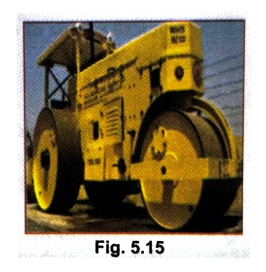
A road roller, often called a roller compactor or just a roller, is an engineering vehicle used to compact soil, gravel, concrete, or asphalt in the construction of roads and foundations. Similar machines are also used in landfills or agriculture. Past records of a road roller manufacturing company show that the number of products produced forms an arithmetic progression (AP).
The company produced 270 road rollers in the 4th year and 510 in the 10th year.

Based on the above information, answer the following questions


(i) What was the company’s production in first year?

  • 150


  • 140


  • 120


  • 110


(1)

Let a and d be the first term and common difference of the AP formed by the number of products produced by the company every year.

We have:

 a4=270a+3d=270 ...(i)"Also, a10=510a+9d=510...(ii)"Subtracting (i) from (ii): 6d=240d=240/6=40Substituting d=40in (i):a+3×40=270 a=270-120=150Production in first year = 150.


Q 30 :

A road roller, often called a roller compactor or just a roller, is an engineering vehicle used to compact soil, gravel, concrete, or asphalt in the construction of roads and foundations. Similar machines are also used in landfills or agriculture. Past records of a road roller manufacturing company show that the number of products produced forms an arithmetic progression (AP).
The company produced 270 road rollers in the 4th year and 510 in the 10th year.

Based on the above information, answer the following questions


(ii) What was the company’s production in the 8th year?

  • 430


  • 420


  • 415


  • 410


(1)

Company’s production in 8th year is given by:

a8=a+7d=150+7×40=150+280=430