

Q 1 :

For the given reaction, choose the correct expression of KC from the following:

Fe(aq)3++SCN(aq)-(FeSCN)(aq)2+                      [2024]

  • KC=[FeSCN2+]2[Fe3+][SCN-]


  • KC=[FeSCN2+][Fe3+]2[SCN-]2


  • KC=[Fe3+][SCN-][FeSCN2+]


  • KC=[FeSCN2+][Fe3+][SCN-]


(4)     

          Fe3+(aq)+SCN-(aq)(FeSCN)2+(aq)  

               Kc=[FeSCN2+][Fe3+][SCN-]


Q 2 :

The equilibrium constant for the reaction SO3(g)SO2(g)+12O2(g) is KC=4.9×10⁻². The value of KC for the reaction given below is

2SO2(g)+O2(g)2SO3(g) is :                        [2024]

  • 4.9


  • 49


  • 41.6


  • 416


(4)     

               SO3(g)SO2(g)+12O2(g),Kc=4.9×10⁻² - I

                Reverse the above equation. On reversing a chemical equation, equilibrium constant gets inversed.

                 SO2(g)+12O2(g)SO3(g),Kc1=14.9×10⁻² - II

                Multiply II by 2. On multiplying an equation by n, equilibrium constant gets raised by a power n.

                 2SO2(g)+O2(g)2SO3(g),Kc11=(14.9×10⁻²)2=416.49


Q 3 :

At –20°C and 1 atm pressure, a cylinder is filled with equal number of H2I2 and HI molecules for the reaction H2(g)+I2(g)2HI(g), the Kp for the process is x×10-1x= _______ . [Given : R = 0.082 L atm K-1 mol-1]                      [2024]

  • 1


  • 2


  • 10


  • 0.01


(3)       

               nHI=nH2=nI2=x

                H2(g)+I2(g)2HI(g)

                Kp=Kc=[HI]2[H2][I2]=(nHI/V)2(nH2/V)(nI2/V)=(nHI)2nH2×nI2=(x)2x×x=10×10-1


Q 4 :

The ratio KPKC for the reaction:

CO(g)+12O2(g)CO2(g) is :                       [2024]

  • RT


  • (RT)1/2


  • 1RT


  • 1


(3)           

                  CO(g)+12O2(g)CO2(g)

                    Δng=Gaseous mol of product-gaseous mol of reactant

                              =1-(1+0.5)=-0.5

                     Kp=Kc(RT)Δng

                     KpKc=(RT)-0.5=1RT


Q 5 :

For the given hypothetical reactions, the equilibrium constants are as follows:

XY; K1=1.0

YZ;K2=2.0

ZW;K3=4.0

The equilibrium constant for the reaction XW is                                        [2024]

  • 12.0


  • 6.0


  • 8.0


  • 7.0


(3)          

              On adding reactions, equilibrium constants are multiplied

                XY,K1=[Y][X]

                YZ,K2=[Z][Y]

                ZW,K3=[W][Z]

            ___________________

            Adding all three:

           XW,K=[W][X]=[W][Z][Y][Z][Y][X]=K1K2K3=1×2×4=8


Q 6 :

For the reaction  N2O4(g)2NO2(g), Kp=0.492 atm at 300 K. Kc for the reaction at same temperature is _______ ×10-2. (Given: R = 0.082 L atm mol-1 K-1)                     [2024]


(2)  

N2O4(g)2NO2(g)

Δng= gaseous moles of products - gaseous moles of reactants

         =2-1=1

Kp=Kc(RT)Δng

0.492atm=Kc×(0.082atm L mol-1K-1×300K)1

Kc=0.4920.082×300mol L-1

      =0.02mol L-1=2×10⁻²mol L-1


Q 7 :

The following concentrations were observed at 500 K for the formation of NH3 from N2 and H2. At equilibrium; [N2]=2×10⁻²M,[H2]=3×10⁻²Mand[NH3]=1.5×10⁻²M. Equilibrium constant for the reaction is _____________ .          [2024]


(417)

N2(g)+3H2(g)2NH3(g)

Kc=[NH3]2[N2][H2]3=(1.5×10⁻²)2[2×10⁻²][3×10⁻²]3=417


Q 8 :

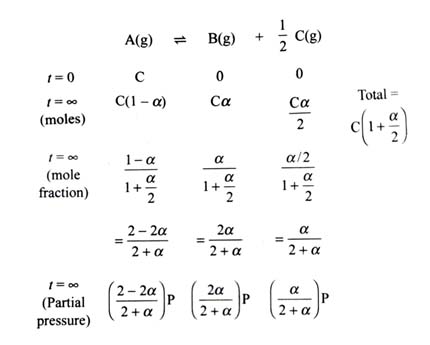
A(g)B(g)+C2(g) The correct relationship between Kp, α and equilibrium pressure P is           [2024]

  • KP=α1/2P1/2(2+α)3/2


  • KP=α1/2P3/2(2+α)3/2


  • KP=α3/2P1/2(2+α)1/2(1-α)


  • KP=α1/2P1/2(2+α)1/2


(3)

Kp=PC1/2×PBPA

= (αP2+α)1/2×(2α2+α)P(2-2α2+α)P=α3/2P1/2(2+α)1/2(1-α)


Q 9 :

A vessel at 1000 K contains CO2 with a pressure of 0.5 atm. Some of CO2 is converted into CO on addition of graphite. If total pressure at equilibrium is 0.8 atm, then Kp is:   [2025]

  • 3 atm


  • 1.8 atm


  • 0.18 atm


  • 0.3 atm


(2)

CO2(g)+C(s)2CO(g)t=00.5atm00t=(0.5-p)atm0  2patm

Total pressure at equilibrium=PCO2+PCO=0.5-p+2p=0.5+p=0.8, p=0.3atm

Hence, PCO2=0.5-p=(0.5-0.3)=0.2atm

PCO=2p=2×0.3=0.6atm

Kp=PCO2PCO2=(0.6)20.2=1.8


Q 10 :

For a reaction N2O5(g)  2NO2(g)+12O2(g) in a constant volume container, no products were present initially. The final pressure of the system when 50% of reaction gets completed is                [2025]

  • 7/4 times of initial pressure


  • 5/2 times of initial pressure


  • 5 times of initial pressure


  • 7/2 times of initial pressure


(1)

             N2O5(g) 2NO2(g)+12O2(g)

t=0p00t=p-0.5p2×0.5p12×0.5p=0.5p=p=0.25pTotal=1.75p=74p


Q 11 :

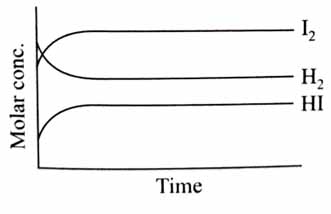
For the reaction,

H2(g)+I2(g)  2HI(g)

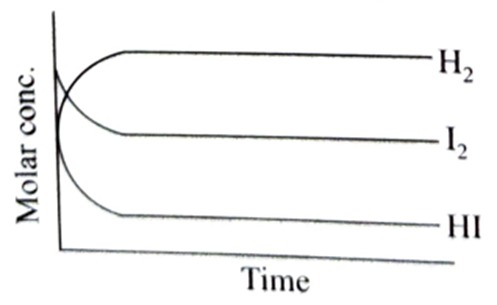
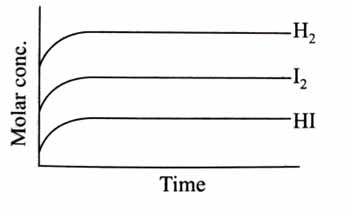
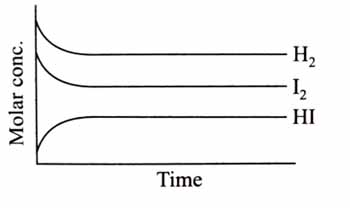
Attainment of equilibrium is predicted correctly by:                   [2025]

  •  

  •  

  •  

  •  

(3)

During the time interval from start of the reaction till equilibrium, concentration of reactants (H2 and I2) decrease and concentration of products (HI) increase. Once equilibrium is reached concentration of each species becomes constant.


Q 12 :

At temperature T, compound AB2(g) dissociates as AB2(g)AB(g)+12B2(g) having degree of dissociation x (small compared to unity). The correct expression for  x in terms of Kp and p is                 [2025]

  • 2Kp2p3


  • Kp


  • 2Kpp3


  • 2Kpp4


(1)

AB2(g)AB(g)+12B2(g)t=0 (moles)a00t=∞ (moles)a(1-x)axax/2t=∞ (mole fraction)a(1-x)a(1+x2)axa(1+x2)axa(1+x2)t=∞ (partial pressure)a(1-x)a(1+x2)paxa(1+x2)pax/2a(1+x2)ppxpxp2Total=a(1+x/2)  
Kp=PAB×(PB2)1/2PAB2 =xp×(xp2)1/2p

(Kp)2=x3p/2

x=2(Kp)2p3


Q 13 :

Consider the fraction

X2Y(g) = X2(g)+12Y2(g)

The equation representing correct relationship between the degree of dissociation (x) of X2Y(g) with its equilibrium constant Kp is _______ .   

Assume x to be very small.                        [2025]

  • x=2Kp2p3


  • x=Kp2p3


  • x=Kpp3


  • x=2Kpp3


(1)

X2Y(g)X2(g)+12Y2(g)t=0 (moles)a00t=∞ (moles)a(1-x)axax2t=∞ (mole fraction)a(1-x)a(1+x2)axa(1+x2)ax2a(1+x2)=(1-x1+x2)=(x1+x2)x2(1+x2)1xx2Partial pressures1×Px×Px×P2Total=a(1+x2)  


Kp=PX2×(PY2)1/2PX2Y=xP×(xP2)1/2P

Kp=x3/2P1/221/2

Kp2=x3P2

x=2Kp2P3


Q 14 :

Consider the following chemical equilibrium of the gas phase reaction at a constant temperature:

A(g)B(g)+C(g)

If p being the total pressure, Kp is the pressure equilibrium constant and α is the degree of dissociation, then which of the following is true at equilibrium?          [2025]

  • If p value is extremely high compared to Kp,α1


  • When p increases α decreases


  • If Kp value is extremely high compared to p,α becomes much less than unity


  • When p increases α increases


(2)

A(g)B(g)+C(g)t=0 (moles)a00t=∞ (moles)a(1-α)aαaαt=∞ (mole fraction)1-α1+αα1+αα1+αt=∞ (partial pressure)  (1-α1+α)P(α1+α)P(α1+α)PTotal=a(1+α)

Kp=PB×PCPA =(α1+α)P×(α1+α)P(1-α1+α)P=α2P1-α2

As Kp is constant for a constant temperature, as P increases, α decreases.


Q 15 :

Consider the following equilibrium,  

CO(g)+2H2(g)CH3OH(g)

0.1 mol of CO along with a catalyst is present in a 2 dm3 flask maintained at 500 K. Hydrogen is introduced into the flask until the pressure is 5 bar and 0.04 mol of CH3OH is formed.  The Kp0 is ______ ×10-3 (nearest integer).  

Given : R = 0.08 dm3 bar K-1 mol-1  

Assume only methanol is formed as the product and the system follows ideal gas behaviour.             [2025]


(74)

CO(g)+2H2(g)CH3OH(g)t=0 (moles)0.1x0t=∞ (moles)0.1-yx-2yy

As moles of CH3OH=y=0.04 mol

CO(g)+2H2(g)CH3OH(g)t=∞ (moles)0.1-0.04x-0.080.04=0.06

Total moles = 0.06+x-0.08+0.04=(0.02+x) mol

By ideal gas equation at equilibrium:

PV=nRT

5×2=(0.02+x)×0.08×500

x=0.23mol

Thus:

CO(g)+2H2(g)CH3OH(g)t=∞ (moles)0.060.23-0.08=0.150.04t=∞ (mole fraction)6251525425t=∞ (partial pressure)625×5=651525×5=3425×5=45Total=0.25


Kp=PCH3OHPCO×(PH2)2=4/5(65)×(3)2=74×10-3


Q 16 :

37.8 g of N2O5 was taken in a 1 L reaction vessel and allowed to undergo the following reaction at 500 K

2N2O5(g)2N2O4(g)+O2(g)

The total pressure at equilibrium was found to be 18.65 bar. 

Then, Kp =  ______×10-2 [nearest integer]

Assume N2O5 to behave ideally under these conditions.

Given: R = 0.082 bar L mol-1 K-1                                          [2025]


(962)

Initial moles of N2O5(nN2O5)=Given mass of N2O5Molar mass of N2O5=37.8108mol=0.35mol

Initial pressure of N2O5=nN2O5RTV 

=0.35×0.082×5001bar=14.35bar

2N2O5(g)2N2O4(g)+O2(g)t=014.35 bar00  t=14.35-2p2pp  total=14.35+p

Total pressure at equilibrium = 14.35 + p = 18.65, p = 4.3 bar

Kp=PO2×PN2O42PN2O52 =p×(2p)2(14.35-2p)2

=4.3×(2×4.3)2(14.35-2×4.3)2=4.3×(2×4.3)2(5.75)29.62=962×10-2


Q 17 :

The equilibrium constant for decomposition of H2O(g) 
H2O(g)H2(g)+12O2(g)   (ΔG°=92.34kJ mol-1)

is 8.0×10⁻³ at 2300 K and total pressure at equilibrium is 1 bar. 
Under this condition, the degree of dissociation (α) of water is _____×10-2 (nearest integer value). 

[Assume α is negligible with respect to 1]                                                [2025]


(5)

H2O(g)H2(g)+12O2(g)t=0 (mol)a00t=∞ (mol)a(1-α)aαaα2Total=a(1+α2)a(as α1)a(as α1)t=∞ (mol fraction)aa=1aαa=αaα2a=α2 t=∞1×Pα×Pα2×P(partial =1×1=α×1=α2×1pressure)=1=α=α2


Kp=(PO2)1/2×PH2PH2O =(α2)1/2×α1 =α3/22

8×10-3=α3/22

α3=128×10-6

α=(128)1/3×10-2=5.03×10-2


Q 18 :

For a concentrated solution of a weak electrolyte (Keq= equilibrium constant) A2B3, of concentration 'c', the degree of dissociation 'α' is          [2023]

  • (Keq6c5)1/5


  • (Keq25c2)1/5


  • (Keq5c4)1/5


  • (Keq108c4)1/5


(4)

A2B32A+3BInitial conc.C00C-Cα2Cα3Cα

K=[A]2[B]3[A2B3]

K=108 C5α5C=108 C4α5

α=[K108C4]1/5


Q 19 :

(i)   X(g)Y(g)+Z(g),    Kp1=3

(ii)   A(g)2B(g),    Kp2=1

If the degree of dissociation and initial concentration of both the reactants X(g) and A(g) are equal, then the ratio of the total pressure at equilibrium (P1P2) is equal to x : 1. The value of x is ________ (Nearest integer).               [2023]


(12)

X(g)Y(g)+Z(g)                KP1=α21-α2×P1=3

A(g)2B(g)                          KP2=4α21-α2×P2=1

KP1KP2=P14P2=31

So, (P1P2)=12


Q 20 :

The equilibrium composition for the reaction

PCl3+Cl2PCl5 at 298 K is given below:

[PCl3]eq=0.2 mol L-1, [Cl2]eq=0.1 mol L-1, [PCl5]eq=0.40 mol L-1

If 0.2 mol of Cl2 is added at the same temperature, the equilibrium concentration of PCl5 is _____×10-2mol L-1

Given: Kc for the reaction at 298 K is 20.                      [2023]


(49)

PCl3(g)+Cl2(g)PCl5(g)At equilibrium0.2molLit0.1molLit0.4molLitNew equilibrium(0.1-x)(0.3-x)(0.4+x)

Kc=(0.4+x(0.2-x)(0.3-x))20=0.4+x(0.2-x)(0.3-x)

     (0.4+x)=20(0.3-x)(0.2-x)

  0.4+x=20(0.06+x2-0.5x)

      20x2-11x+0.8=0

      x=11±121-6440

      x0.08625

 (PCl5)=0.4862549×10⁻²


Q 21 :

The number of correct statement/s involving equilibria in physical processes from the following is ________           [2023]

(A) Equilibrium is possible only in a closed system at a given temperature.

(B) Both the opposing processes occur at the same rate.

(C) When equilibrium is attained at a given temperature, the value of all its parameters become equal.

(D) For dissolution of solids in liquids, the solubility is constant at a given temperature.


(3)

Statements given in A, B and D are correct.

(C), when equilibrium is attained at a given temperature, the value of all its parameters becomes constant.


Q 22 :

A(g)2B(g)+C(g)

For the given reaction, if the initial pressure is 450 mm Hg and the pressure at time t is 720 mm Hg at a constant temperature T and constant volume V. The fraction of A(g) decomposed under these conditions is x×10-1. The value of x is ______ (Nearest Integer)            [2023]


(3)

A(g)2B(g)+C(g)t=045000t=t450-y2yy

                720=450-y+2y+y

           y=135

Now, fraction of A(g)decomposed=135450=0.3=3×10-1=x×10-1

          x=3


Q 23 :

A mixture of 1 mole of H2O and 1 mole of CO is taken in a 10 litre container and heated to 725 K. At equilibrium 40% of water by mass reacts with carbon monoxide according to the equation:

CO(g)+H2O(g)CO2(g)+H2(g)

The equilibrium constant Kc×102 for the reaction is ________. (Nearest integer)         [2023]


(44)

CO+H2OCO2+H2t=01100eq.1-0.41-0.40.40.4

V=10 L                             KC=0.4×0.40.6×0.6=49=0.44

KC×100=44


Q 24 :

4.5 moles each of hydrogen and iodine is heated in a sealed ten litre vessel. At equilibrium, 3 moles of HI were found. The equilibrium constant for H2(g)+I2(g)2HI(g) is ________.           [2023]


(1)

H2(g)+I2(g)2HI(g)Initial moles4.54.50Moles at eq.4.5-1.5=34.5-1.5=33

                Kequilibrium=[HI]2[H2]1[I2]1=[3]23×3=1


Q 25 :

Consider the general reaction given below at 400 K

             xA(g)yB(g)

The values of Kp and Kc are studied under the same condition of temperature but variation in x and y.

(i) Kp=85.87 and Kc=2.586 (appropriate units)
(ii) Kp=0.862 and Kc=28.62 (appropriate units)

The values of x and y in (i) and (ii) respectively are:                      [2026]

  • (i) 1, 2  (ii) 2, 1


  • (i) 4, 1  (ii) 4, 1


  • (i) 3, 1  (ii) 3, 1


  • (i) 1, 3  (ii) 2, 1


(1)

For reaction (i) : KP>KC

Δng>0

y-x>0

85.87=2.586(0.0821×400)y-x

Solving y-x=1

For reaction (ii) : KP<KC

y-x<0


Q 26 :

For the following gas phase equilibrium reaction at constant temperature,

NH3(g)12N2(g)+32H2(g)

if the total pressure is 3 atm and the pressure equilibrium constant (Kp) is 9 atm, then the degree of dissociation is given as (x×10-2)-1/2. The value of x is ______.(nearest integer)                       [2026]


(125)

NH3(g)12N2(g)+32H2(g)t=01 mole--t=teq1-αα/23α/2

Kp=(α2)1/2(3α2)3/2(1-α)[PT1+α]1                  [PT=3 atm]

9=(α2)1/2(3α2)3/2(1-α)×(3)1/21+α

9=9(α2)21-α2

1-α2=α24

5α24=1

α2=0.8

α=(0.8)1/2

α=[10.8]-1/2

α=[125×10-2]-1/2

x=125


Q 27 :

Consider the following gaseous equilibrium in a closed container of volume 'V' at T(K).

P2(g)+Q2(g)2PQ(g)

2 moles each of P2(g), Q2(g) and PQ(g) are present at equilibrium. Now one mole each of 'P2' and 'Q2' are added to the equilibrium keeping the temperature at T(K). The number of moles of P2, Q2 and PQ at the new equilibrium, respectively, are                  [2026]

  • 2.67, 2.67, 2.67


  • 1.21, 2.24, 1.56


  • 1.66, 1.66, 1.66


  • 2.56, 1.62, 2.24


(1)

P2(g)+Q2(g)2PQ(g)t=teq2 mole2 mole2 mole

Keq=222.2=1

Now 1 mole of each P2 and Q2 is added

So reaction will move in forward direction

P2(g)+Q2(g)2PQ(g)t=t'eq3-x3-x2+2x

Kc=1=(2+2x)2(3-x)(3-x)

2+2x3-x=1

2+2x=3-x

x=13

At new equilibrium:

Moles of P2=83=2.67

Moles of Q2=83=2.67

Moles of PQ=83=2.67