

Q 1 :

Given below are two statements:

Statement - I: Noble gases have very high boiling points.

Statement -II: Noble gases are monoatomic gases. They are held together by strong dispersion forces. Because of this they are liquefied at very low temperature. Hence, they have very high boiling points.

In the light of the above statements, choose the correct answer from the options given below:              [2024]

  • Statement I is false but Statement II is true.


  • Both Statement I and Statement II are true.


  • Statement I is true but Statement II is false.


  • Both Statement I and Statement II are false.


(4)

Gases which have strong intermolecular attractive forces are easy to liquefy. Noble gases are monoatomic hence non polar. As a result, intermolecular forces for noble gases are weak London dispersion forces. Hence these are difficult to liquefy and have low boiling point.


Q 2 :

Given below are two statements: one is labelled as Assertion (A) and the other is labelled as Reason (R).

Assertion (A): NH3 and NF3 molecule have pyramidal shape with a lone pair of electrons on nitrogen atom. The resultant dipole moment of NH3 is greater than that of NF3.

Reason (R): In NH3, the orbital dipole due to lone pair is in the same direction as the resultant dipole moment of the N-H bonds. F is the most electronegative element.

In the light of the above statements, choose the correct answer from the options given below:              [2024]

  • (A) is true but (R) is false


  • Both (A) and (R) are true but (R) is NOT the correct explanation of (A)


  • (A) is false but (R) is true


  • Both (A) and (R) are true and (R) is the correct explanation of (A)


(4)

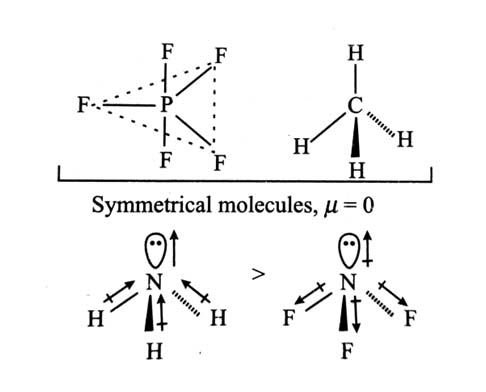
In NH3, lone pair moment and bond pair moment are in same direction whereas in NF3, lone pair moment and bond pair moment are in opposite direction. Hence dipole of NH3 is greater than in NF3.


Q 3 :

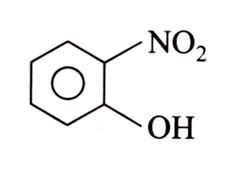
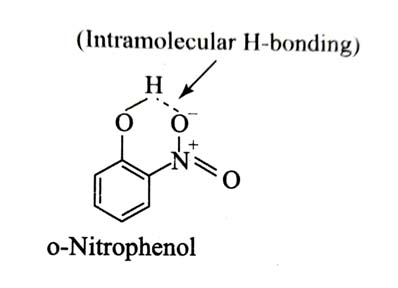
Select the compound from the following that will show intramolecular hydrogen bonding.             [2024]

  •  

  • H2O


  • C2H5OH


  • NH3


(1)

o-nitrophenol has intramolecular hydrogen bonding.

H2O,C2H5OH and NH3 have intermolecular hydrogen bonding.


Q 4 :

Which one of the following molecules has maximum dipole moment?                   [2024]

  • PF5


  • NF3


  • NH3


  • CH4


(3)

PF5 and CH4 are symmetrical molecules hence have zero dipole moment.

In NH3, lone pair moment and bond pair moment are in same direction whereas in NF3 lone pair moment and bond pair moment are in opposite direction. Hence net dipole moment which is vector sum of lone pair and bond pair moments is more for NH3 than NF3.


Q 5 :

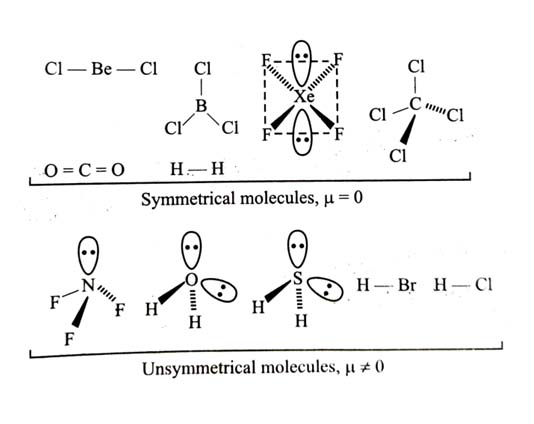
Number of compounds/species from the following with non-zero dipole moment is _____

BeCl2,BCl3,NF3,XeF4,CCl4,H2O,H2S,HBr,CO2,H2,HCl                    [2024]


(5)


Q 6 :

Number of compounds from the following with zero dipole moment is ________.

HF,H2,H2S,CO2,NH3,BF3,CH4,CHCl3,SiF4,H2O,BeF2                    [2024]


(6)


Q 7 :

Arrange the following compounds in increasing order of their dipole moment:  

HBr, H2S, NF3 and CHCl3                                        [2025]
 

  • NF3<HBr<H2S<CHCl3


  • CHCl3<NF3<HBr<H2S


  • HBr<H2S<NF3<CHCl3


  • H2S<HBr<NF3<CHCl3


(1)

Increasing value of μNF3HBrH2SCHCl3μ0.240.790.951.04(in D)


Q 8 :

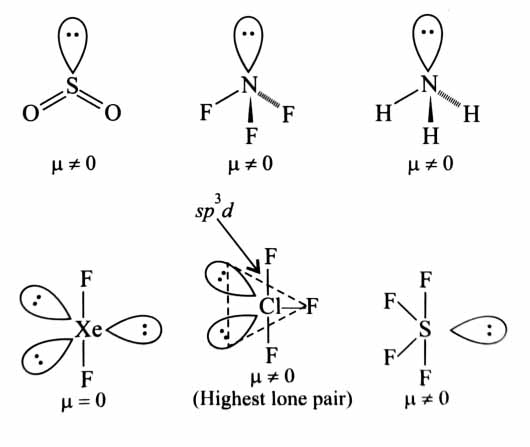
Among SO2,NF3,NH3,XeF2,ClF3 and SF4, the hybridization of the molecule with non-zero dipole moment and highest number of lone-pairs of electrons on the central atom is                      [2025]
 

  • sp3


  • dsp2


  • sp3d2


  • sp3d


(4)


Q 9 :

Statement I: Dipole moment is a vector quantity and by convention it is depicted by a small arrow with tail on the negative centre and head pointing towards the positive centre.

Statement II: The crossed arrow of the dipole moment symbolizes the direction of the shift of charges in the molecules.

In the light of the above statements, choose the most appropriate answer from the options given below:               [2023]

  • Both Statement I and Statement II are correct


  • Statement I is correct but Statement II is incorrect


  • Statement I is incorrect but Statement II is correct


  • Both Statement I and Statement II are incorrect


(1)


Q 10 :

The pair from the following pairs having both compounds with net non-zero dipole moment is          [2023]

  • 1,4-Dichlorobenzene, 1,3-Dichlorobenzene


  • Benzene, anisidine


  • CH2Cl2, CHCl3


  • cis-butene, trans-butene


(3)

[IMAGE 34]