

Securing admission to an MBBS program in India requires more than just clearing an entrance exam. It demands a strong conceptual foundation in science, disciplined preparation, consistent practice, mental resilience, and the ability to perform accurately under pressure. The NEET (National Eligibility cum Entrance Test) serves as the single gateway to MBBS seats across government and private medical colleges, making the preparation process both competitive and demanding.
At Smart Achievers, MBBS preparation is approached as a structured academic journey rather than a short-term exam strategy. The institute focuses on building students gradually—academically and mentally—so they are equipped not only to score well in NEET but also to handle the rigor of medical education ahead.
MBBS Selection Is a Process, Not an Event
NEET preparation typically spans one to two years and involves:
Strong command over Biology, Physics, and Chemistry
Clear understanding of NCERT concepts
Application-based problem-solving ability
Time management and exam temperament
Consistency across multiple academic phases
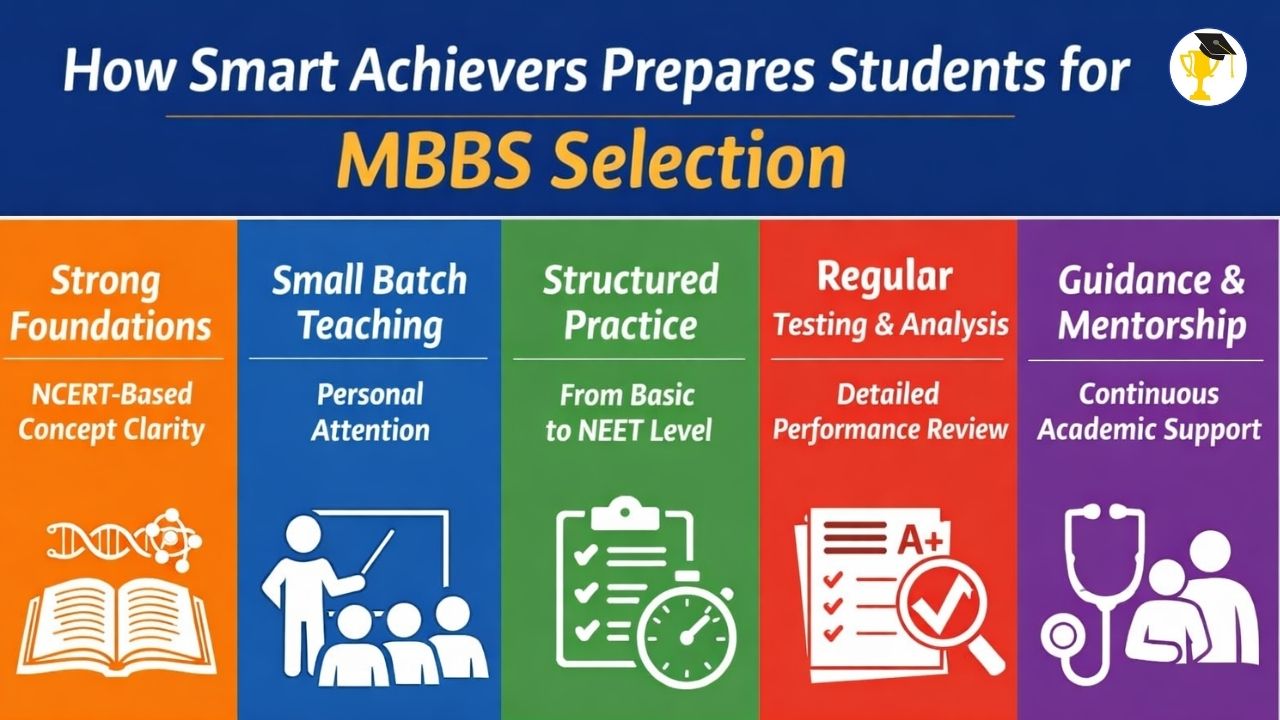
Smart Achievers treats MBBS selection as the outcome of a well-planned academic process where each stage—foundation, concept building, practice, testing, and revision—plays a critical role.
Step 1: Building Strong NCERT-Based Foundations
|
Foundation Area |
How Smart Achievers Builds It |
|---|---|
|
Concept clarity |
Teaching from first principles |
|
NCERT alignment |
Line-by-line explanation of NCERT content |
|
Biology understanding |
Logical linkage across chapters |
|
Physics fundamentals |
Concept clarity before numerical practice |
|
Chemistry basics |
Focus on reactions, mechanisms, and reasoning |
Step 2: Small Batch Teaching for Focused Learning
|
Aspect |
Academic Advantage |
|---|---|
|
Direct interaction |
Every student engages with the teacher |
|
Doubt resolution |
Questions addressed during the lecture |
|
Teaching pace |
Adjusted based on student understanding |
|
Student observation |
Early identification of struggling learners |
|
Feedback |
Continuous academic guidance |
Step 3: Concept-Driven Teaching Methodology
|
Subject |
Teaching Focus |
|---|---|
|
Biology |
Processes, diagrams, NCERT terminology |
|
Physics |
Logical derivations and physical meaning |
|
Chemistry |
Reaction mechanisms and conceptual flow |
|
Teaching tools |
Diagrams, flowcharts, conceptual maps |
|
Learning approach |
Understanding-based, not shortcut-driven |
Step 4: Structured Practice Progression
|
Practice Level |
Purpose |
|---|---|
|
Basic questions |
Concept validation |
|
NCERT-based MCQs |
Syllabus alignment |
|
Standard NEET-level problems |
Competitive readiness |
|
Mixed-topic questions |
Inter-topic application |
|
Time-bound practice |
Speed and accuracy |
Step 5: Regular Testing & Performance Analysis
Test Structure:
|
Test Type |
Objective |
|---|---|
|
Topic-wise tests |
Strengthen individual concepts |
|
Chapter-wise tests |
Evaluate complete understanding |
|
Cumulative tests |
Retention and integration |
|
Full-length NEET mocks |
Exam simulation |
Post-Test Analysis
|
Analysis Area |
Outcome |
|---|---|
|
Conceptual errors |
Targeted revision |
|
Calculation mistakes |
Accuracy improvement |
|
Time usage |
Better exam strategy |
|
Weak chapters |
Focused practice plans |
Step 6: Continuous Academic Monitoring
|
Monitoring Area |
Academic Benefit |
|---|---|
|
Classroom participation |
Engagement assessment |
|
Written work |
Concept application tracking |
|
Test trends |
Performance consistency |
|
Concept retention |
Early gap correction |
Step 7: Supporting Average Students
|
Support Area |
Approach |
|---|---|
|
Learning gaps |
Early identification |
|
Weak topics |
Targeted practice |
|
Confidence building |
Gradual milestones |
|
Progress tracking |
Consistent evaluation |
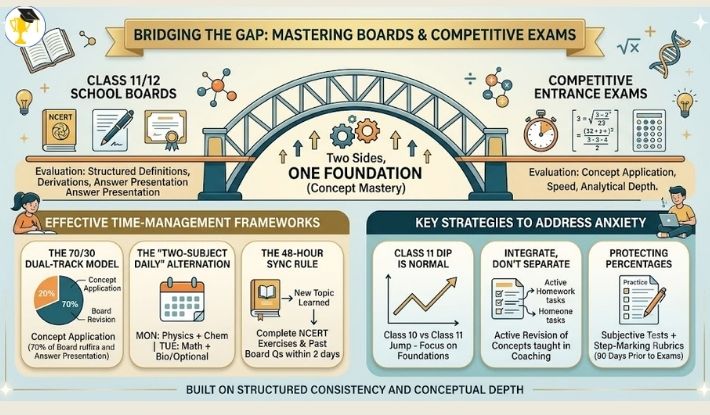
Step 8: Balancing Boards & NEET Preparation
|
Academic Area |
Integration Strategy |
|---|---|
|
NCERT syllabus |
Common foundation for boards & NEET |
|
Theory & derivations |
Board relevance maintained |
|
Revision planning |
Aligned with school exams |
|
Academic load |
Reduced duplication |
Step 9: Developing Exam Temperament
|
Skill |
Training Focus |
|---|---|
|
Question reading |
Avoid careless mistakes |
|
Negative marking |
Risk management |
|
Time allocation |
Balanced subject handling |
|
Mental composure |
Stress control during exams |
What Defines a Smart Achievers MBBS Aspirant?
|
Attribute |
Description |
|---|---|
|
Conceptual strength |
Deep NCERT-based understanding |
|
Accuracy |
Fewer careless errors |
|
Discipline |
Consistent preparation habits |
|
Confidence |
Calm exam performance |
|
Growth mindset |
Continuous improvement |
Smart Achievers’ Academic Philosophy (Summary Table)
|
Core Principle |
Implementation |
|---|---|
|
Small batch teaching |
Personalized attention |
|
Concept-based learning |
Long-term retention |
|
Structured practice |
Gradual skill building |
|
Continuous monitoring |
Steady progress |
|
Student-centric approach |
Sustainable MBBS preparation |
Smartachivers
Jan 30,2026
Smartachivers
Jan 30,2026
Smartachivers
Jan 29,2026
Smartachivers
Jan 28,2026
Smartachivers
Jan 28,2026
Smartachivers
Jan 28,2026
Smartachivers
Jan 28,2026
Smartachivers
Jan 28,2026
Smartachivers
Jan 24,2026
Smartachivers
Jan 30,2026
Smartachivers
Jan 30,2026
Smartachivers
Jan 22,2026
Smartachivers
Jan 25,2026
Smartachivers
Jan 25,2026
Smartachivers
Jan 21,2026
Smartachivers
Jan 21,2026
Smartachivers
Jan 30,2026
Smartachivers
Jan 20,2026
Smartachivers
Jan 24,2026
Smartachivers
Jan 24,2026