

If the collision frequency of hydrogen molecules in a closed chamber at 27°C is Z, then the collision frequency of the same system at 127°C is [2024]
(4)
Collision frequency
If is the number density and is the diameter of the molecule, then the average distance covered by a molecule between two successive collisions (i.e. mean free path) is represented by [2024]
(1)
The mean free path,
number of molecules per unit volume,
and diameter of the molecule
A sample contains mixture of helium and oxygen gas. The ratio of root mean square speed of helium and oxygen in the sample, is [2024]
(4)
Given below are two statements:
Statement (I): The mean free path of gas molecules is inversely proportional to square of molecular diameter.
Statement (II): Average kinetic energy of gas molecules is directly proportional to absolute temperature of gas.
In the light of the above statements, choose the correct answer from the options given below: [2024]
Statement I is false but Statement II is true
Both Statement I and Statement II are true
Statement I is true but Statement II is false
Both Statement I and Statement II are false
(2)
Statement 1: Mean free path
using
Statement 2:
The temperature of a gas is – 78°C and the average translational kinetic energy of its molecules is K. The temperature at which the average translational kinetic energy of the molecules of the same gas becomes 2K is [2024]
– 39°C
117°C
127°C
– 78°C
(2)
Average translational kinetic energy
At – 78°C = 273 – 78 = 195 K
...(i)
Now when kinetic energy becomes 2K, the temperature is T K.
...(ii)
From equations (i) and (ii)
T = 390 K
in °C, 390 – 273 = 117°C
Two vessels A and B are of the same size and are at same temperature. A contains 1 g of hydrogen and B contains 1 g of oxygen. and are the pressures of the gases in A and B respectively, then is [2024]
16
8
4
32
(1)
Ideal gas equation,
and
from (i) and (ii),
Given and
The temperature of a gas having molecules per cubic meter at 1.38 atm is
(Given, ) [2024]
300 K
500 K
100 K
200 K
(2)
ldeal gas equation,
N = Total no. of molecules
At what temperature the r.m.s. velocity of a hydrogen molecule equal to that of an oxygen molecule at 47°C ? [2024]
80 K
– 73 K
4 K
20 K
(4)
If the root mean square velocity of hydrogen molecule at a given temperature and pressure is 2 km/s, the root mean square velocity of oxygen at the same condition in km/s is [2024]
2.0
0.5
1.5
1.0
(2)
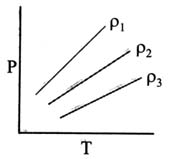
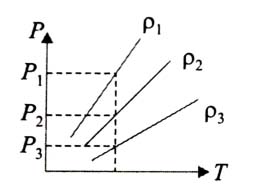
P-T diagram of an ideal gas having three different densities (in three different cases) is shown in the figure. Which of the following is correct? [2024]

(1)
Ideal Gas Equation,
(Where m is the mass of gas and M is the molecular mass of gas)

For the same temperature,
So, the correct answer is (1)
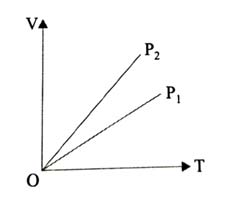
The given figure represents two isobaric processes for the same mass of an ideal gas, then [2024]

(1)
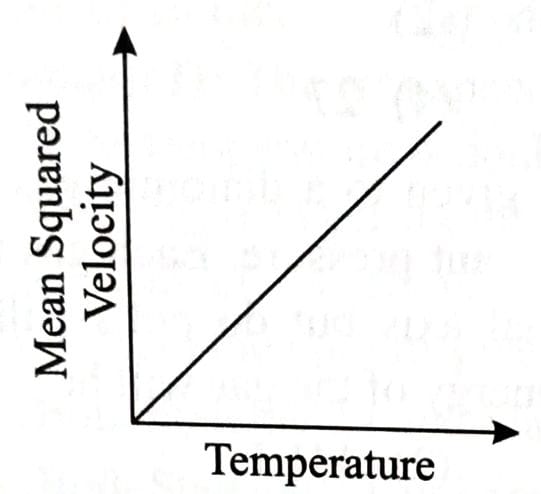
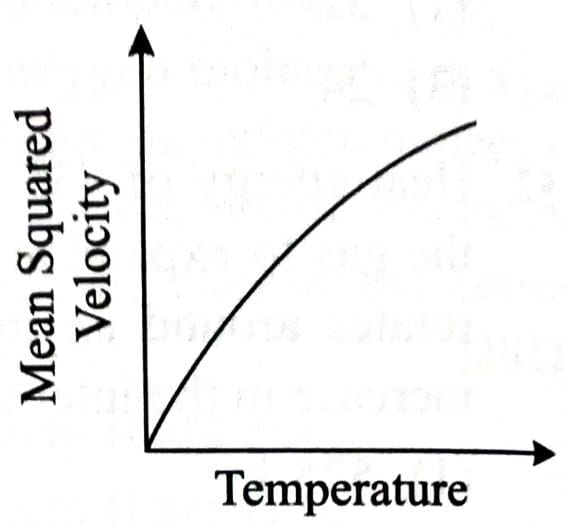
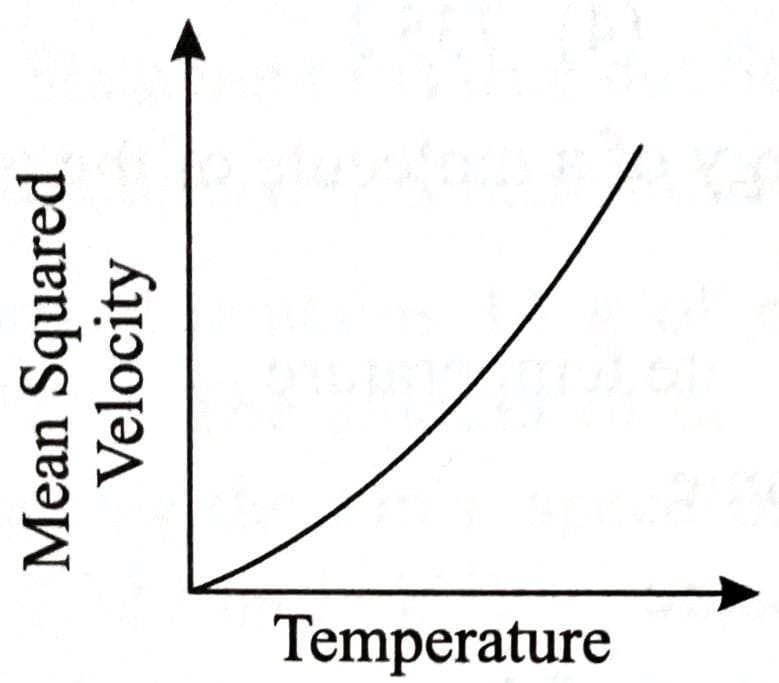
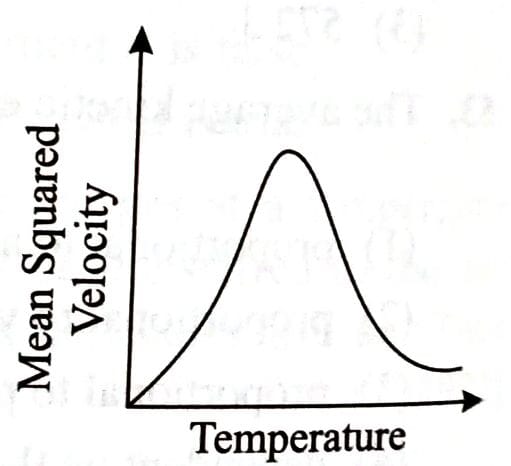
For a particular ideal gas which of the following graphs represents the variation of mean squared velocity of the gas molecules with temperature? [2025]


(1)
Mean squared velocity i.e., (mean squared velocity) (Temperature). Hence, graph is a straight line.
The ratio of vapour densities of two gases at the same temperature is , then the ratio of r.m.s. velocities will be: [2025]
(3)
Pressure of an ideal gas, contained in a closed vessel, is increased by 0.4% when heated by 1°C. Its initial temperature must be: [2025]
25°C
2500 K
250 K
250°C
(3)
Isochoric process, P T
The mean free path and the average speed of oxygen molecules at 300 K and 1 atm are and 600 m/s, respectively. Find the frequency of its collisions. [2025]
(3)
Frequency of collision
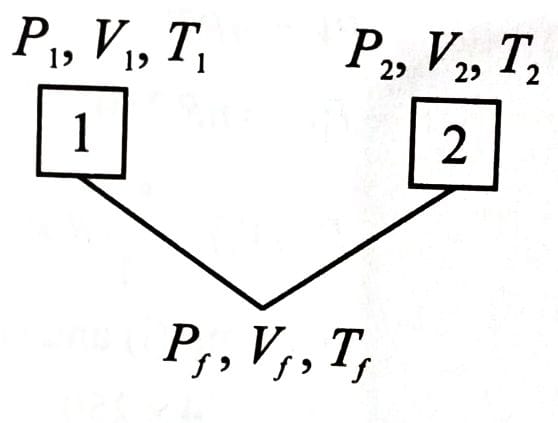
There are two vessels filled with an ideal gas where volume of one is double the volume of other. The large vessel contains the gas at 8 kPa at 1000 K while the smaller vessel contains the gas at 7 kPa at 500 K. If the vessels are connected to each other by a thin tube allowing the gas to flow and the temperature of both vessels is maintained at 600 K, at steady state the pressure in the vessels will be (in kPa). [2025]
4.4
6
24
18
(2)

Number of masses will remain constant
A container of fixed volume contains a gas at 27°C. To double the pressure of the gas, the temperature of gas should be raised to ________ °C. [2025]
(327)
For V = constant,
Given below are two statements: [2023]
Statement I: The temperature of a gas is −73°C. When the gas is heated to 527°C, the root mean square speed of the molecules is doubled.
Statement II: The product of pressure and volume of an ideal gas will be equal to translational kinetic energy of the molecules.
In the light of the above statements, choose the correct answer from the options given below:
Statement I is false but Statement II is true
Both Statement I and Statement II are true
Both Statement I and Statement II are false
Statement I is true but Statement II is false
(4)
The root mean square velocity of molecules of gas is [2023]
inversely proportional to square root of temperature
proportional to square root of temperature
proportional to square of temperature
proportional to temperature
(2)
A bicycle tyre is filled with air having pressure of 270 kPa at 27°C. The approximate pressure of the air in the tyre when the temperature increases to 36°C is [2023]
270 kPa
262 kPa
278 kPa
360 kPa
(3)
At 300 K, the rms speed of oxygen molecules is times to that of its average speed in the gas. Then, the value of will be (use ) [2023]
32
28
24
27
(2)
Heat energy of 735 J is given to a diatomic gas allowing the gas to expand at constant pressure. Each gas molecule rotates around an internal axis but does not oscillate. The increase in the internal energy of the gas will be [2023]
525 J
441 J
572 J
735 J
(2)
The average kinetic energy of a molecule of the gas is [2023]
proportional to absolute temperature
proportional to volume
proportional to pressure
dependent on the nature of the gas
(1)
Translational K.E. on average of a molecule is which is independent of nature, pressure, and volume.
The temperature of an ideal gas is increased from 200 K to 800 K. If the r.m.s. speed of the gas at 200 K is , then the r.m.s. speed of the gas at 800 K will be [2023]
(4)
Increasing the temperature 4 times, the rms speed gets doubled.
An air bubble of volume rises from the bottom of a lake 40 m deep to the surface at a temperature of . The atmospheric pressure is , the density of water is and . There is no difference of the temperature of water at the depth of 40 m and on the surface. The volume of the air bubble when it reaches the surface will be [2023]
2
4
5
3
(3)
At T is constant,
Three vessels of equal volume contain gases at the same temperature and pressure. The first vessel contains neon (monoatomic), the second contains chlorine (diatomic) and the third contains uranium hexafluoride (polyatomic). Arrange these on the basis of their root mean square speed () and choose the correct answer from the options given below: [2023]
(2)
The root mean square speed of molecules of nitrogen gas at is approximately:
(Given mass of a nitrogen molecule and take Boltzmann constant ) [2023]
523 m/s
1260 m/s
91 m/s
27.4 m/s
(1)
If the r.m.s. speed of chlorine molecule is 490 m/s at 27°C, the r.m.s. speed of argon molecules at the same temperature will be (Atomic mass of argon = 39.9 , molecular mass of chlorine = 70.9 ) [2023]
751.7 m/s
451.7 m/s
651.7 m/s
551.7 m/s
(3)
The r.m.s. speed of oxygen molecule in a vessel at a particular temperature is where is the average speed of the molecule. The value of will be: (Take ) [2023]
28
27
8
4
(1)
The mean free path of molecules of a certain gas at STP is 1500 , where is the diameter of the gas molecules. While maintaining the standard pressure, the mean free path of the molecules at 373 K is approximately [2023]
1098
2049
750
1500
(2)