

The speed of sound in oxygen at S.T.P. will be approximately:
(Given, ) [2024]
310 m/s
333 m/s
341 m/s
325 m/s
(1)
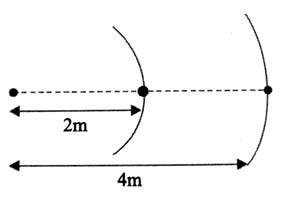
A point source is emitting sound waves of intensity at the origin. The difference in intensity (magnitude only) at two points located at distances of 2 m and 4 m from the origin respectively will be ____ [2024]
(3)
We know for point source,

at 2m,
At 4m,
Given below are two statements: one is labelled as Assertion (A) and the other is labelled as Reason (R)
Assertion (A) : A sound wave has higher speed in solids than gases.
Reason (R) : Gases have higher value of Bulk modulus than solids.
In the light of the above statements, choose the correct answer from the options given below [2025]
Both A and R are true and R is the correct explanation of A.
A is false but R is true.
Both A and R are true but R is Not the correct explanation of A.
A is true but R is false.
(4)
Speed of sound in a medium depends on inertial and elastic properties as for gases and for solids. Since the elastic property of solid happens to be many folds greater than that of gases, the speed of sound in solids is higher than in gases.
Also, bulk modulus of gases varies between 0 and hence reason is false.
Consider the sound wave travelling in ideal gases of He, and . All the gases have the same ratio , where P is the pressure and is the density. The ratio of the speed of sound through the gases is given by [2025]
(3)
A person observes two moving trains, ‘A’ reaching the station and ‘B’ leaving the station with equal speed of 30 m/s. If both trains emit sounds with frequency 300 Hz, (Speed of sound = 330 m/s) approximate difference of frequencies heard by the person will be [2023]
33 Hz
55 Hz
80 Hz
10 Hz
(2)
The ratio of speed of sound in hydrogen gas to the speed of sound in oxygen gas at the same temperature is [2023]
4 : 1
1 : 2
1 : 4
1 : 1
(1)
The engine of a train moving with speed 10 towards a platform sounds a whistle at frequency 400 Hz. The frequency heard by a passenger inside the train is: (neglect air speed. Speed of sound in air = 330 ) [2023]
388 Hz
400 Hz
412 Hz
200 Hz
(2)
The relative velocity of a passenger with source of sound (engine) is 0. So there will be no Doppler’s effect. So frequency heard is 400 Hz.
A car P travelling at sounds its horn at a frequency of 400 Hz. Another car Q is travelling behind the first car in the same direction with a velocity . The frequency heard by the passenger of the car Q is approximately (Take, velocity of sound ) [2023]
514 Hz
421 Hz
485 Hz
471 Hz
(2)
A train blowing a whistle of frequency 320 Hz approaches an observer standing on the platform at a speed of 66 m/s. The frequency observed by the observer will be (given speed of sound = 330 ) ________ Hz. [2023]
(400)

A person driving a car at a constant speed of 15 m/s is approaching a vertical wall. The person notices a change of 40 Hz in the frequency of his car’s horn upon reflection from the wall. The frequency of horn is __________ Hz. (Given: Speed of sound is 330 m/s) [2023]
(420)