

Q 1 :

On Celsius scale the temperature of body increases by 40°C. The increase in temperature on Fahrenheit scale is                [2024]

  • 68° F


  • 70° F


  • 72° F


  • 75° F


(3) 

         C-0100=F-32180

         C=59(F-32)C=59F

         40=59FF=72oF

         40o change on Celsius scale will corresponds to 72o change on Fahrenheit scale.


Q 2 :

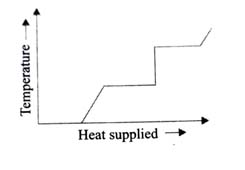
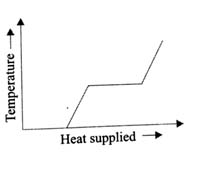
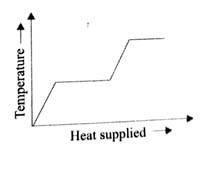
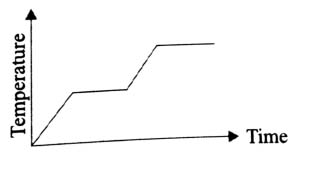
A block of ice at −10°C is slowly heated and converted to steam at 100°C. Which of the following curves represent the phenomenon qualitatively?    [2024]

  •  

  •  

  •  

  •  

(4)

-10°C ice  changeTemp.0°C ice changeTemp.0°C

 water  changeTemp.100°C waterPhase change100°C steam

In this process, there are two phase changes and two temperature changes.


Q 3 :

An amount of ice of mass 103 kg and temperature –10°C is transformed to vapour of temperature 110°C by applying heat. The total amount of work required for this conversion is, (Take, specific heat of ice = 2100 J kg1 K1, specific heat of water = 4180 J kg1 K1, specific heat of steam = 1920 J kg1 K1, Latent heat of ice = 3.35×10⁵ J kg1 and Latent heat of steam = 2.25×10⁶ J kg1)          [2025]

  • 3022 J


  • 3043 J


  • 3003 J


  • 3024 J


(2)

First, Ice at –10°C Q1 Ice at 0°C Q2 Water at 0°C. Then, Water at 0°C Q3 Water at 100°C Q4 Vapour at 100°C Q5 Vapour at 110°C

Q1=m×SI×T=103×2100×10=21 J

Q2=m×Lf=103×3.35×105=335 J

Q3=m×Sw×T=103×4180×100=418 J

Q4=m×Lv=103×2.25×106=2250 J

Q5=m×Sv×T=103×1920×10=19.2 J

Qnet=3043.2 J


Q 4 :

A gun fires a lead bullet of temperature 300 K into a wooden block. The bullet having melting temperature of 600 K penetrates into the block and melts down. If the total heat required for the process is 625 J, then the mass of the bullet is ______ grams.

(Latent heat of fusion of lead =25×104 J Kg1 and specific heat capacity of lead =125 J Kg1 K1)          [2025]

  • 20


  • 15


  • 10


  • 5


(3)

Q=msT+mL

625=m×125×300+m×2.5×10⁴

625=m{3.75+2.5}×104

 m=625625×104 kg=10 g


Q 5 :

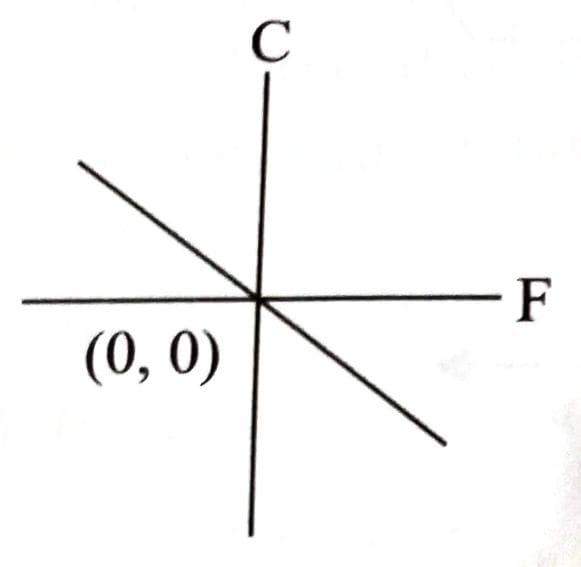
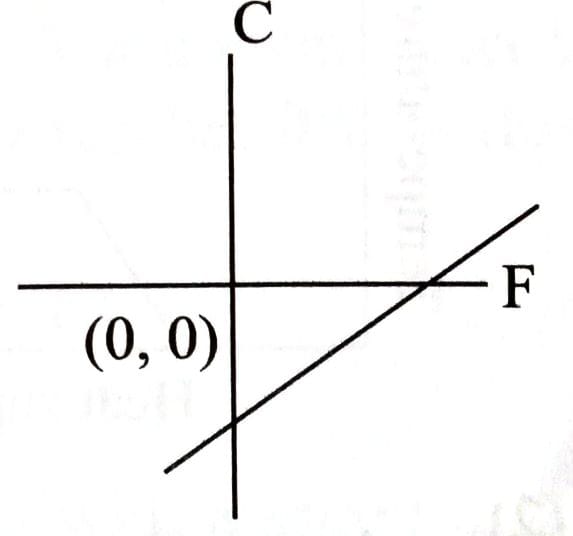
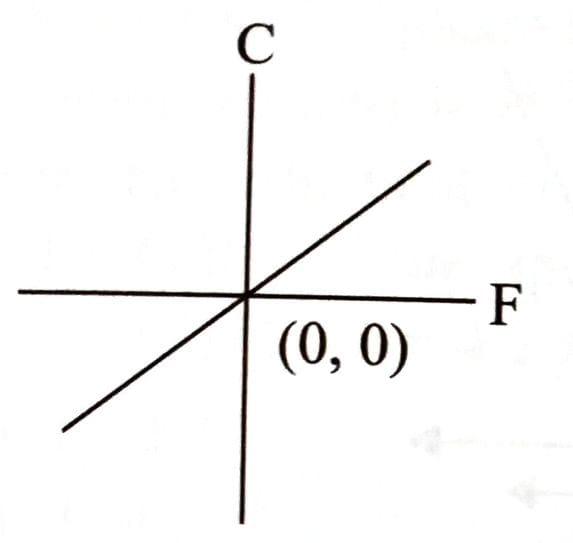
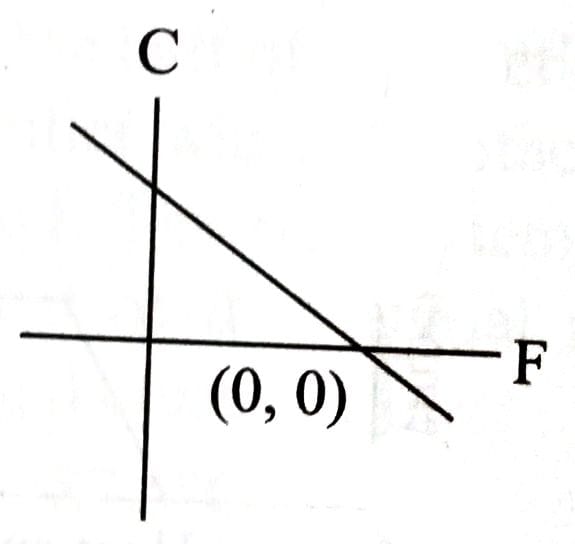
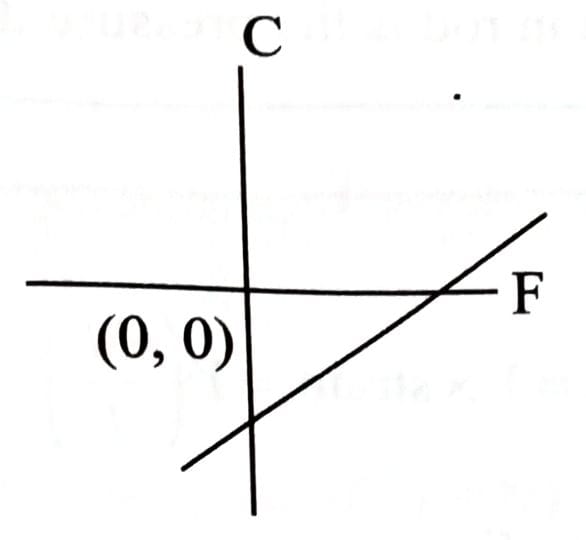
Which of the following figure represents the relation between Celsius and Fahrenheit temperatures?          [2025]

  •  

  •  

  •  

  •  

(2)

C5=F329  C=5F91609

Clearly slope is +ve and intercept is –ve


Q 6 :

Water falls from a height of 200 m into a pool. Calculate the rise in temperature of the water assuming no heat dissipation from the water in the pool. (Take, g = 10 m/s2 specific heat of water = 4200 J/(kg K))          [2025]

  • 0.23 K


  • 0.36 K


  • 0.14 K


  • 0.48 K


(4)

mgh=msT

T=ghs=10×2004200=0.48 K


Q 7 :

1 g of a liquid is converted to vapour at 3×10⁵ Pa pressure. If 10% of the heat supplied is used for increasing the volume by 1600 cm3 during this phase change, then the increase in internal energy in the process will be:          [2023]

  • 4800 J


  • 4320 J


  • 4.32×10⁸ J


  • 432000 J


(2)

Work done=PΔV

                     =3×105×1600×10-6=480 J

Only 10% of heat is used in work done.

Hence ΔQ=4800 J

The rest goes into internal energy, which is 90% of heat.

Change in internal energy=0.9×4800=4320 J


Q 8 :

Heat energy of 184 kJ is given to ice of mass 600 g at -12°C. Specific heat of ice is 2222.3 J kg-1o C-1 and latent heat of ice is 336 kJ/kg-1.         [2023]

(A) Final temperature of the system will be 0°C.

(B) Final temperature of the system will be greater than 0°C.

(C) The final system will have a mixture of ice and water in the ratio of 5 : 1.

(D) The final system will have a mixture of ice and water in the ratio of 1 : 5.

(E) The final system will have water only.

Choose the correct answer from the options given below:

  • A and D only


  • B and D only


  • A and E only


  • A and C only


(1)

ΔQ=184×103

m=0.600 kg at -12°C

S=2222.3 J/kg/°C

L=336×103 J/kg

Q1=0.600×2222.3×12=16000.56 J

Remaining heat:

ΔQ1=184000-16000.56=167999.44 J

For melting at 0°C

ΔQ2=0.600×336000=201600 J (needed)

100% ice is not melted

Amount of ice melted

167999.44=m×336000=0.4999 kg

 Mass of water=0.4999 kg

       Mass of ice=0.1001 kg

 Ratio=0.10010.49991:5


Q 9 :

The graph between two temperature scales P and Q is shown in the figure. Between the upper fixed point and the lower fixed point, there are 150 equal divisions of scale P and 100 divisions on scale Q. The relationship for conversion between the two scales is given by          [2023]

  • tP100=tQ-180150


  • tQ150=tP-180100


  • tP180=tQ-40100


  • tQ100=tP-30150


(4)

reading on scale-lower fixed pointupper fixed point-lower fixed point=constant

tp-30180-30=t0-0100-0

tp-30150=t0100


Q 10 :

For three low density gases A, B, C pressure versus temperature graphs are plotted while keeping them at constant volume, as shown in the figure.         

The temperature corresponding to the point ‘K’ is:               [2023]

  • −273°C


  • −100°C


  • −373°C


  • −40°C


(1)

For isochoric process,

PT=nRV=constant

P=nRV(t+273)

If P=0t=-273°C


Q 11 :

On a temperature scale ‘X’, the boiling point of water is 65°X and the freezing point is –15°X. Assume that the X scale is linear. The equivalent temperature corresponding to –95°X on the Fahrenheit scale would be             [2023]

  • –63°F


  • –112°F


  • –48°F


  • –148°F


(4)

X-XfreezXboil-Xfreez=t-32212-32

-95-(-15)65-(-15)=t-32180

-8080=t-32180

         t=-180+32

 t=-148°F


Q 12 :

A faulty thermometer reads 5°C in melting ice and 95°C in steam. The correct temperature on the absolute scale will be _____ K when the faulty thermometer reads 41°C.             [2023]


(313)

41°-5°95°-5°=C-0°100°-0°

C=3690×100=40°C=313 K


Q 13 :

In a perfectly inelastic collision, two spheres made of the same material with masses 15 kg and 25 kg, moving in opposite directions with speeds 10 m/s and 30 m/s respectively, strike each other and stick together. The rise in temperature (inC), if all the heat produced during the collision is retained by these spheres, is:

(specific heat of sphere material 31 cal/kg°C and 1 cal = 4.2 J)               [2026]

  • 1.95


  • 1.15


  • 1.75


  • 1.44


(4)

(K.E.)lost=12μVrel2(1-e2)

=12(m1m2m1+m2)(10+30)2(1-0)

=12[(15)(25)40][40]2

=7500 J

(K.E.)loss=(m1+m2)(S)(ΔT)

[S=31×4.2 J/kg-°C]

7500=(40)(31)(ΔT)

ΔT=750040×31×4.2=1.44°C


Q 14 :

A gas based geyser heats water flowing at the rate of 5.0 litres per minute from 27°C to 87°C. The rate of consumption of the gas is _____ g/s.  (Take heat of combustion of gas = 5.0×10⁴ J/g) specific heat capacity of water = 4200 J/kg. °C         [2026]

  • 0.21


  • 2.1


  • 4.2


  • 0.42


(4)

Water flow rate=5 /min=560kg/s

  Power of heater=dmdtSΔT=112×4200×60 W

  Let rate of consumption of gas be x g/s.

   x×5.0×104=112×4200×60

  x=4200×10-4=0.42 g/s


Q 15 :

10 kg of ice at -10°C is added to 100 kg of water to lower its temperature from 25°C. Consider no heat exchange to surroundings. The decrement to the temperature of water is ______ °C.

specific heat of ice =2100 J/kg°C, specific heat of water =4200 J/kg°C, latent heat of fusion of ice =3.36×10⁵ J/kg      [2026]

  • 11.6


  • 10


  • 15


  • 6.67


(2)

10×3.36×105+10×2100×10+10×4200×(T-0)

=100×4200×(25-T)

T=15°C

ΔT=25-15=10°C