

Q 1 :

A bullet is fired into a fixed target looses one third of its velocity after travelling 4cm. It penetrates further D×10-3 m before coming to rest. The value of D is                                                  [2024]

  • 32


  • 5


  • 3


  • 4


(1) 

       v2-u2=2as

       (2u3)2=u2+2(-a)(4×10⁻²)

        4u29=u2-2a(4×10⁻²)

        -5u29=-2a(4×10⁻²)                            ...(1)

       0=(2u3)2+2(-a)(x)

       -4u29=-2ax                                            ...(2)

       (1)/(2),54=4×10-2x

        x=165×10-2

        x=3.2×10⁻²m


Q 2 :

A particle is moving in a straight line. The variation of position 'x' as a function of time 't' is given as x=(t3-6t2+20t+15)m. The velocity of the body when its acceleration becomes zero is                                             [2024]

  • 6 m/s


  • 10 m/s


  • 8 m/s


  • 4 m/s


(3) 

       x=t3-6t2+20t+15

       dxdt=v=3t2-12t+20

        dvdt=a=6t-12

       When a=0

        t=2sec

       At t=2sec

       v=3(2)2-12(2)+20=8m/s


Q 3 :

The relation between time 't' and distance 'x' is t=αx2+βx, where α and β are constants. The relation between acceleration (a) and velocity (v) is               [2024]

  • a=-2αv3


  • a=-2αv4


  • a=-2αv2


  • a=-2αv5


(1) 

       t=αx2+βx (differentiating wrt time)

      dtdx=2αx+β

       1v=2αx+β

       (differentiating wrt time) -1v2 dvdt=2αdxdt

       dvdt=-2αv3


Q 4 :

A particle moves in a straight line so that its displacement x at any time t is given by x2=1+t2. Its acceleration at any time t is x-n where n=_____.       [2024]


(3)     x2=1+t2x=1+t2

          v=dxdt=121+t2·2tv=t1+t2

          a=dvdt=1+t2(1)-t·12(t2+1)-1/2·2t(1+t2)

          a=1+t2-t21+t2(1+t2)=t2+1-t2(t2+1)3/2

            a=1(1+t2)3/2=1x3=x-3n=3


Q 5 :

A particle is moving in one dimension (along x-axis) under the action of a variable force. It's initial position was 16 m right of origin. The variation of its position (x) with time (t) is given as x=-3t3+18t2+16t, where x is in m and t in s. The velocity of the particle when its acceleration becomes zero is _____ m/s.            [2024]


(52)        x=3t3+18t2+16t

              v=-9t2+36t+16

              a=-18t+36

              a=0 at t=2 s

              v=-9(2)2+36×2+16

              v=52m/s


Q 6 :

A particle initially at rest starts moving from reference point. x=0 along x-axis, with velocity v that varies as v=4x m/s. The acceleration of the particle is _____ ms-2.      [2024]


(8)           Given, v=4x

                x-axis

              x=0,t=0

              a=vdvdx=(4x)d(4x)dx=16x·12x

              16x·12x=8m/s2


Q 7 :

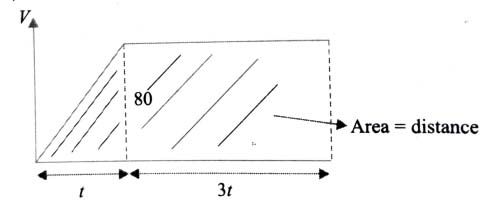
A train starting from rest first accelerates uniformly up to a speed of 80 km/h for time t, then it moves with a constant speed for time 3t. The average speed of the train for this duration of journey will be (in km/h) :              [2024]

  • 30


  • 80


  • 40


  • 70


(4)

Average speed=DistanceTime=12(t)(80)+80×3t4t

Vav=40t+240t4t=2804=70 km/hr


Q 8 :

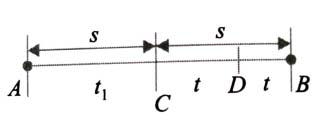
A particle moving in a straight line covers half the distance with speed 6 m/s. The other half is covered in two equal time intervals with speeds 9 m/s and 15 m/s respectively. The average speed of the particle during the motion is              [2024]

  • 8.8 m/s


  • 10 m/s


  • 9.2 m/s


  • 8 m/s


(4)

BCs=9t+15t=24t

ACs=6t1=24tt1=4t

vav=dist.time=48t2t+t1

vav=48t2t+4t48t6t8 m/s


Q 9 :

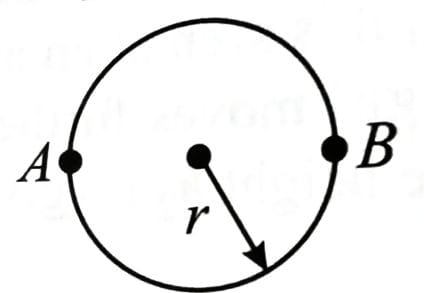
A sportsman runs around a circular track of radius r such that he traverses the path A B A B. The distance travelled and displacement, respectively, are          [2025]

  • 2r, 3πr


  • 3πr, πr


  • πr, 3r


  • 3πr, 2r


(4)

Displacement = 2r

Distance = 2πr+πr=3πr


Q 10 :

A particle moves along the x-axis and has its displacement x varying with time t according to the equation x=c0(t22)+c(t2)2 where c0 and c are constants of appropriate dimensions. Then, which of the following statements is correct?          [2025]

  • the acceleration of the particle is 2c0


  • the acceleration of the particle is 2c


  • the initial velocity of the particle is 4c


  • the acceleration of the particle is 2(c+c0)


(4)

x=C0(t22)+C(t2+44t)

v=dxdt=2tC0+2C(t2)

a=dvdt=2C0+2C


Q 11 :

A person travelling on a straight line moves with a uniform velocity v1 for a distance x and with a uniform velocity v2 for the next 32x distance. The average velocity in this motion is 507 m/s. If v1 is 5 m/s then v2 = __________ m/s.          [2025]


(10)

vavg=x1+x2t1+t2

 507=x+3x2x5+3x2v2

 507=5/215+32v2

 v2=10 m/s


Q 12 :

The distance travelled by a particle is related to time t as x=4t2. The velocity of the particle at t = 5 s is                   [2023]

  • ms-1


  • 20 ms-1


  • 25 ms-1


  • 40 ms-1


(4)

x=4t2

v=dxdt=8t

At t=5 s,  

      v=8×5=40 m/s


Q 13 :

A vehicle travels 4 km with speed of 3 km/h and another 4 km with speed of 5 km/h, then its average speed is           [2023]

  • 4.25 km/h


  • 3.50 km/h


  • 4.00 km/h


  • 3.75 km/h


(4)

2Vav=13+15=815

 Vav=154=3.75 km/h


Q 14 :

An object moves with speeds v1, v2 and v3 along the line segments AB, BC and CD respectively as shown in the figure. Where AB = BC and AD = 3AB, then the average speed of the object will be:                   [2023]

  • (v1+v2+v3)3


  • v1v2v33(v1v2+v2v3+v3v1)


  • 3v1v2v3v1v2+v2v3+v3v1


  • (v1+v2+v3)3v1v2v3


(3)

AB=x and BC=x

2x+CD=3x

 CD=x

<v>=3xxv1+xv2+xv3=3v1v2v3v2v3+v1v3+v1v2


Q 15 :

A car travels a distance of 'x' with speed v1 and then the same distance 'x' with speed v2 in the same direction. The average speed of the car is:             [2023]

  • v1v22(v1+v2)


  • 2xv1+v2


  • 2v1v2v1+v2


  • v1+v22


(3)

Vavg=S+SSV1+SV2=2V1V2V1+V2                 


Q 16 :

A person travels x distance with velocity v1 and then x distance with velocity v2 in the same direction. The average velocity of the person is v, then the relation between vv1 and v2 will be:                    [2023]

  • v=v1+v2


  • v=v1+v22


  • 2v=1v1+1v2


  • 1v=1v1+1v2


(3)

Average velocity=x+xxv1+xv2=v

1v1+1v2=2v


Q 17 :

The distance travelled by an object in time t is given by s=(2.5)t2. The instantaneous speed of the object at t = 5 s will be:               [2023]

  • 12.5 ms-1


  • 62.5 ms-1


  • ms-1


  • 25 ms-1


(4)

Distance (s)=(2.5)t2

Speed (v)=dsdt=ddt{(2.5)t2}

               v=5t

At t=5,  v=5×5=25 m/s

Option (4) is correct


Q 18 :

The position of a particle related to time is given by x=(5t2-4t+5)m. The magnitude of velocity of the particle at t=2 s will be:           [2023]

  • 10 ms-1


  • 14 ms-1


  • 16 ms-1


  • 6 ms-1


(3)

x=5t2-4t+5

v=10t-4

At t=2 s,  v=16 m/s


Q 19 :

A horse rider covers half the distance with 5 m/s speed. The remaining part of the distance was travelled with speed 10 m/s for half the time and with speed 15 m/s for the other half of the time. The mean speed of the rider averaged over the whole time of motion is x/7 m/s. The value of x is ______.           [2023]


(50)

tAB=x5 m/s

In motion BC, x=d1+d2

where d1 and d2 are the distances travelled with 10 m/s and 15 m/s respectively in equal time intervals 't'2 each.

d1=10t2,  d2=15t2

d1+d2=x=t2(10+15)=25t2

<v>=2xx5+2x25=2×255+2=507 m/s