

Q 1 :

The ratio of the shortest wavelength of Balmer series to the shortest wavelength of Lyman series for hydrogen atom is          [2024]

  • 2 : 1


  • 1 : 4


  • 1 : 2


  • 4 : 1


(4)         

              For Balmer series limit,1λB=R[1(2)2-12]=R4

              For Lyman series limit,1λL=R[1(1)2-12]=R

               λBλL=4:1


Q 2 :

The longest wavelength associated with Paschen series is

(Given RH=1.097×10⁷ in SI unit)               [2024]

  • 2.973×10⁻⁶m


  • 3.646×10⁻⁶m


  • 1.094×10⁻⁶m


  • 1.876×10⁻⁶m


(4)           

               For longest wavelength in Paschen's series:

                 1λ=R[1n12-1n22]

                  n1=3 and n2=4

                  1λ=R[1(3)2-1(4)2]=R[16-916×9]

                  λ=16×97R=16×97×1.097×107=1.876×10⁻⁶m


Q 3 :

If the wavelength of the first member of Lyman series of hydrogen is λ. The wavelength of the second member will be           [2024]

  • 527λ


  • 2732λ


  • 3227λ


  • 275λ


(2)         

                 1λ=13.6z2hc[112-122]                                ...(i)

                 1λ'=13.6z2hc[112-132]                               ...(ii)

                 On dividing (i) and (ii) λ'=2732λ


Q 4 :

The minimum energy required by a hydrogen atom in ground state to emit radiation in Balmer series is nearly            [2024]

  • 1.5 eV


  • 13.6 eV


  • 1.9 eV


  • 12.1 eV


(4)           

                Transition from n1 to n3

                   E=13.6×Z[1n22-1n12]

                   =13.6×1×[11-19]

                    =13.6×89=12.1eV


Q 5 :

The shortest wavelength of the spectral lines in the Lyman series of hydrogen spectrum is 915 .The longest wavelength of spectral lines in the Balmar series will be ________ .                 [2024]


(6588)               hcλ=-13.6(1n12-1n22)

                          Lyman series, shortest wavelength, highest energetic

                          hcλ0=-13.6×1

                          Balmer Series, n1=2,n2=3 (for longest wavelength)

                          hcλ1=-13.6(122-132)

                                 =-13.6×536

                             λ1=365·λ0=365×915=6588


Q 6 :

Hydrogen atom is bombarded with electrons accelerated through a potential difference of V, which causes excitation of hydrogen atoms. If the experiment is being performed at T = 0 K, the minimum potential difference needed to observe any Balmer series lines in the emission spectra will be α10V, where α = _______ .                 [2024]


(121)                ΔEmin=E3-E1

                                    =-1.51-(-13.6)

                         ΔEmin=12.09eV

                         Vmin=12.09 volt=α10

                         α=120.9 =121


Q 7 :

A particular hydrogen like ion emits the radiation of frequency 3×10¹⁵ Hz when it makes transition from n=2 to n=1. The frequency of radiation emitted in transition from n=3 to n=1 is x9×1015 Hz, when x= __________ .                  [2024]


(32)               E=-13.6Z2(1ni2-1nf2)

                      E=C(1nf2-1ni2)

                       hν=C[1nf2-1ni2]

                      ν1ν2=[1nf2-1ni2]2-1[1nf2-1ni2]3-1

                        =[11-14][11-19]=3/48/9=34×98

                           ν1ν2=2732

                            ν2=3227ν1=3227×3×1015Hz=329×1015Hz

                            Given, f2=x9×1015Hz

                            x=32


Q 8 :

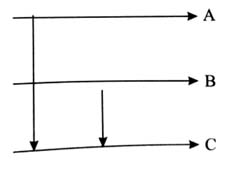
During the transition of electron from state A to state C of a Bohr atom, the wavelength of emitted radiation is 2000 A° and it becomes 6000 A° when the electron jumps from state B to state C. Then the wavelength of the radiation emitted during the transition of electrons from state A to state B is         [2025]

  • 3000 A°


  • 6000 A°


  • 4000 A°


  • 2000 A°


(1)

For A to CEAEC=hc2000 A°          ... (i)

and for B to CEBEC=hc6000 A°          ... (ii)

Now for A to BEAEB=(EAEC)(EBEC)

hcλAB=hc2000hc6000

1λAB=13000 A°  λAB=3000 A°


Q 9 :

The number of spectral lines emitted by atomic hydrogen that is in the 4th energy level, is          [2025]

  • 6


  • 0


  • 3


  • 1


(1)

Number of spectral line (N) = n(n1)2. here n = 4

So, N = 6

Total posible transition = 6


Q 10 :

For a hydrogen atom, the ratio of the largest wavelength of Lyman series to that of the Balmer series is.          [2025]

  • 5 : 36


  • 5 : 27


  • 3 : 4


  • 27 : 5


(2)

Largest wavelength of Lyman series,

1λ1=R[1114]=3R4

λ1=43R           ... (i)

Largest wavelength of Balmer series

1λ2=R[1419]=5R36

λ2=365R

Then, λ1λ2=527


Q 11 :

The energy levels of an atom is shown in figure. Which one of these transitions will result in the emission of a photon of wavelength 124.1 nm? Given (h=6.62×10⁻³⁴ Js)               [2023]

  • D


  • B


  • A


  • C


(1)

λ=hcΔE

ΔEA=2.2 eV

ΔEB=5.2 eV

ΔEC=3 eV

ΔED=10 eV

λA=6.62×10-34×3×1082.2×1.6×10-19=12.41×10-72.2m=564 nm

λB=12415.2 nm=238.65 nm

λC=12413 nm=413.66 nm

λD=124110 nm=124.1 nm


Q 12 :

An electron of a hydrogen like atom, having Z = 4, jumps in from 4th energy state to 2nd energy state. The energy released in this process, will be: (Given Rch=13.6 eV) Where R = Rydberg constant c = Speed of light in vacuum h = Planck's constant                      [2023]

  • 13.6 eV


  • 10.5 eV


  • 3.4 eV


  • 40.8 eV


(4)

ΔE=13.6Z2[122-142] eV

      =13.6×(4)2(14-116) eV

       =13.6[4-1] eV=13.6×3=40.8 eV


Q 13 :

The energy levels of an hydrogen atom are shown below. The transition corresponding to emission of shortest wavelength is          [2023]

  • C


  • A


  • D


  • B


(3)

ΔE=hcλ  λ1ΔE

For shortest wavelength, energy gap should be maximum.  

So, correct choice is transition from n=3 to n=1.


Q 14 :

The angular momentum for the electron in Bohr’s orbit is L. If the electron is assumed to revolve in second orbit of hydrogen atom, then the change in angular momentum will be                  [2023]

  • L2


  • zero


  • L


  • 2L


(3)

L=mvr,  rn2,  v1n
 Ln

Also, L=nh2π,

Bohr orbit is, L1=L=1h2π

         L2=2[L]=2L

         L2=2h2π

So change = L2-L1=2L-L=L


Q 15 :

The energy of He+ ion in its first excited state is.                              [2023]

(The ground state energy for the Hydrogen atom is −13.6 eV)

  • −3.4 eV


  • −54.4 eV


  • −13.6 eV


  • −27.2 eV


(3)

Ea=-13.6Z2n2=-13.6×44=-13.6 eV


Q 16 :

A 12.5 eV electron beam is used to bombard gaseous hydrogen at room temperature. The number of spectral lines emitted will be             [2023]

  • 2


  • 1


  • 3


  • 4


(3)

According to Bohr's postulates, an electron makes jump to higher energy orbital if it absorbs a photon of energy equal to difference between the energies of an excited state and the ground state. Assuming that collided electron takes energy equal to 10.2 eV or 12.09 eV from the incoming electron beam (some part lost due to collision). The maximum excited state is n=3. So, number of spectral lines =3(3-1)2=3


Q 17 :

For hydrogen atom, λ1 and λ2 are the wavelengths corresponding to the transitions 1 and 2 respectively as shown in figure. The ratio of λ1 and λ2 is x32. The value of x is _________.                   [2023]


(27)

1λ=Rz2[1n12-1n22]

1λ1=Rz2[112-132]=89Rz2    (1)

1λ2=Rz2[112-122]=34Rz2    (2)

12λ2λ1=89×43=3227λ1λ2=2732


Q 18 :

The wavelength of the radiation emitted is λ0 when an electron jumps from the second excited state to the first excited state of hydrogen atom. If the electron jumps from the third excited state to the second orbit of the hydrogen atom, the wavelength of the radiation emitted will be 20xλ0. The value of 'x' is ________.            [2023]


(27)

1λ0=R[1n12-1n22]

1λ0=R[14-19]=5R36    (i)

1λ=R[14-116]=3R16    (ii)

12λλ0=536×163=2027


Q 19 :

The radius of fifth orbit of the Li++ is _______ ×10-12m.

Take: radius of hydrogen atom =0.51Å.                   [2023]


(425)

rn=r0n2Zrn=0.51×253Å=4.25×10⁻¹⁰ m


Q 20 :

The ratio of wavelength of spectral lines Hα and Hβ in the Balmer series is x20. The value of x is ________.            [2023]


(27)

1λ=R[1n12-1n22]  for H-atom

For Balmer series, n1=2

1λ=R[14-1n22]

For Hα, n2=3 and Hβ, n2=4

1λHα=R[14-19]=5R36

1λHβ=R[14-116]=3R16

1λHα1λHβ=5R363R16

λHαλHβ=2720=x20x=27


Q 21 :

If 917 Å be the lowest wavelength of Lyman series then the lowest wavelength of Balmer series will be _________ Å.                [2023]


(3668)

For lowest wavelength of Lyman series,    1λ=RZ2[112-12]=RZ2

For lowest wavelength of Balmer series,    1λ'=RZ2[122-12]=RZ24

λ'=4RZ2=4×917=3668 Å


Q 22 :

A monochromatic light is incident on a hydrogen sample in ground state. Hydrogen atoms absorb a fraction of light and subsequently emit radiation of six different wavelengths. The frequency of incident light is x×1015Hz. The value of x is _______. (Given h=4.25×10⁻¹⁵eVs)                   [2023]


(3)

6=C24  n2=4

hν=E4-E1

 ν=13.6(112-142)×14.25×10-15=3×10¹⁵ Hz


Q 23 :

An atom absorbs a photon of wavelength 500 nm and emits another photon of wavelength 600 nm. The net energy absorbed by the atom in this process is n×10-4eV. The value of n is ________.                  [2023]

[Assume the atom to be stationary during the absorption and emission process]

(Take h=6.6×10⁻³⁴Js and c=3×10⁸m/s)                     


(4125)

E=E1-E2=hcλ1-hcλ2=hc(1λ1-1λ2)

=6.6×10-34×3×108(1500×10-9-1600×10-9)

=6.6×10⁻²⁰ J

=6.6×10-201.6×10⁻¹⁹ eV=4.125×10⁻¹ eV=4125×10-4 eV


Q 24 :

As per given figure A, B and C are the first, second and third excited energy level of hydrogen atom respectively. If the ratio of the two wavelengths (i.e., λ1λ2) is 74n, then the value of n will be _______.                [2023]


(5)

As    1λ=RZ2[1n12-1n22]

1λ1=R(1)2[1(2)2-1(3)2]=R(536)    (i)

1λ2=R(1)2[1(3)2-1(4)2]=R(7144)    (ii)

(ii) + (i) gives

λ1λ2=7144536=720=74×5

 n=5


Q 25 :

The smallest wavelength of Lyman series is 91 nm. The difference between the largest wavelengths of Paschen and Balmer series is nearly ______ nm.       [2026]

  • 1217


  • 1550


  • 1784


  • 1875


(1)

n=4 ___________________

n=3 ___________________  Paschen

n=2 ___________________  Balmer

n=1 ___________________  Lyman

Smallest wavelength of Lyman

1λ=R(112-12)

R=1λ=191nm-1

λmax for Balmer series

n1=2n2=3

1λB=R(14-19)

1λB=191(536)

λB=(91×365)=655.2nm

λmax Paschen

n1=3n2=4

1λp=191(132-142)=191(7144)

λp=(91×1447)=1872nm

Δλ=λp-λB

Δλ=1872-655.2

Δλ=1216.8

Δλ1217