

Q 1 :

An electric field is given by (6i^+5j^+3k^)N/C. The electric flux through a surface area 30i^  m2  lying in YZ-plane (in SI unit) is              [2024]

  • 180


  • 90


  • 150


  • 60


(1)     

            E=(6i^+5j^+3k^)N/C

             A=30i^ m2

            Electric flux, ϕ=E·A

            ϕ=(6i^+5j^+3k^)·(30i^)=180Nm2C


Q 2 :

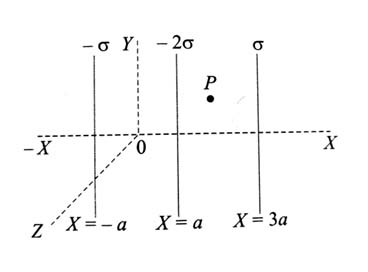
Three infinitely long charged thin sheets are placed as shown in figure. The magnitude of electric field at the point P is xσε0. The value of x is _____ (all quantities are measured in Sl units).              [2024]


(2)       E=E1+E2+E3

            =σ2ε0(-i^)+-2σ2ε0(i^)+-σ2ε0(i^)

             =-4σ2ε0i^=2σε0(-i^)


Q 3 :

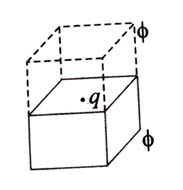
A charge q is placed at the center of one of the surfaces of a cube. The flux linked with the cube is          [2024]

  • q2ε0    


  • q4ε0


  • q8ε0    


  • zero


(1)

ϕtotal=qenε0

Let us enclose the charge with an identical cube as shown,

Total flux, 2ϕ=qε0ϕ=q2ε0


Q 4 :

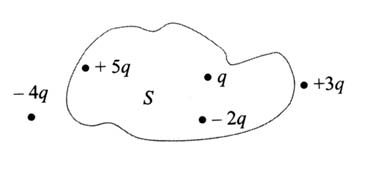
Five charges +q, +5q, −2q, +3q and −4q are situated as shown in the figure. The electric flux due to this configuration through the surface S is        [2024]

  • 5qε0 


  • 4qε0


  • 3qε0


  • qε0


(2)

As per Gauss' theorem,

ϕ=qinε0=q+(-2q)+5qε0=4qε0


Q 5 :

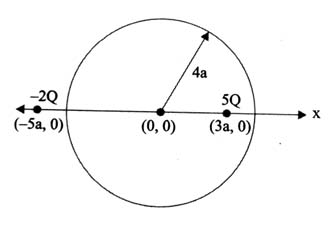
Two charges of 5Q and −2Q are situated at the points (3a,0) and (−5a,0) respectively. The electric flux through a sphere of radius 4a having center at origin is      [2024]

  • 2Qε0


  • 5Qε0


  • 7Qε0


  • 3Qε0


(2)

If we draw the sphere, the charge -2Q will be outside of sphere and 5Q charge is inside the spherical region

The flux through sphere 5Qε0


Q 6 :

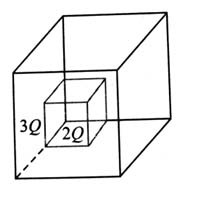
C1 and C2 are two hollow concentric cubes enclosing charges 2Q and 3Q respectively as shown in the figure. The ratio of electric flux passing through C1 and C2 is    [2024]

  • 2 : 5


  • 5 : 2


  • 2 : 3


  • 3 : 2


(1)

Flux through C1ϕ1=qinε0=2Qε0

Flux through C2ϕ2=qinε0=2Q+3Qε0=5Qε0

C1C2=ϕ1ϕ2=2Q/ε05Q/ε0=25


Q 7 :

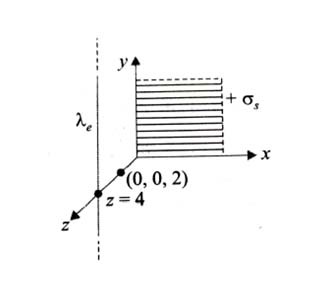
An infinite plane sheet of charge having uniform surface charge density +σs C/m2 is placed on the x-y plane. Another infinitely long line charge having uniform linear charge density +λeC/m is placed at z=4 m plane and parallel to the y-axis. If the magnitude values σs=2λethen at point (0,0,2), the ratio of magnitudes of electric field values due to sheet charge to that of line charge is πn:1. The value of n is ______ .       [2024]


(16)

Esheet=σs2ε0k^=λeε0k^

Ewire=2kλer(-k^)=2kλe2(-k^)=kλ(-k^)

|Esheet||Ewire|=λeε0×1kλe=1ε0k=1ε0×14πε0=4π

4π=πnn=16


Q 8 :

An electric field, E=2i^+6j^+8k^6 passes through the surface of 4m2 area having unit vector n^=(2i^+j^+k^6). The electric flux for that surface is ____ Vm.   [2024]


(12)

ϕ=E·A=(2i^+6j^+8k^6)·4(2i^+j^+k^6)

ϕ=46×(4+6+8)=12 Vm


Q 9 :

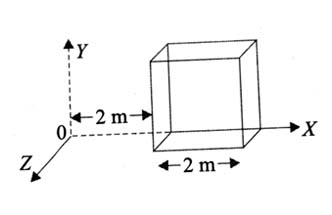
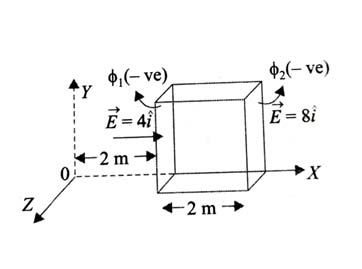
An electric field E=(2xi^)NC-1 exists in space. A cube of side 2 m is placed in the space as per figure given below. The electric flux through the cube is _____ Nm2/C.  [2024]


(16)

Given E=(2xi^) N/C

ϕ=E·A

ϕin=-4×4=-16 Nm2/C

ϕout=8×4=32 Nm2/C

ϕnet=ϕin+ϕout=-16+32=16 Nm2/C


Q 10 :

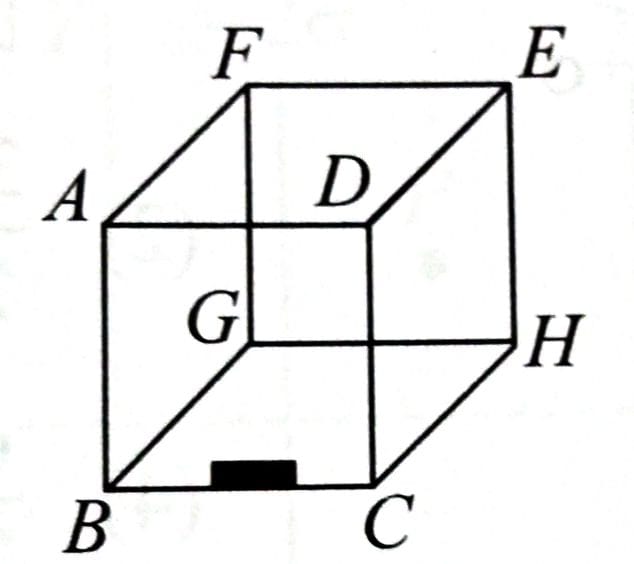
A line charge of length 'a'2 is kept at the center of an edge BC of a cube ABCDEFGH having edge length 'a' as shown in the figure. If the density of line charge is λ C per unit length, then the total electric flux through all the faces of the cube will be ______ (Take, ε0 as the free space permittivity)          [2025]

  • λa8ε0


  • λa16ε0


  • λa2ε0


  • λa4ε0


(1)

Charge of the line charge =aλ2

Portion of wire inside cube =14

Total charge inside the cube, qen=14(aλ2)=λa8

  ϕ=qenε0=λa8ε0


Q 11 :

Match List I with List II

  List I   List II
A. Electric field inside (distance r > 0 from center) of a uniformly charged spherical shell with surface charge density σ, and radius R. I. σ/ε0
B. Electric field at distance r > 0 from a uniformly charged infinite plane sheet with surface charge density σ. II. σ/2ε0
C. Electric field outside (distance r > 0 from center) of a uniformly charged spherical shell with surface charge density σ, and radius R. III. 0
D. Electric field between 2 oppositely charged infinite plane parallel sheets with uniform surface charge density σ. IV. σ/ε0r2


Choose the correct answer from the options given below:            [2025]

  • (A)-(IV), (B)-(I), (C)-(III), (D)-(II)


  • (A)-(IV), (B)-(II), (C)-(III), (D)-(I)


  • (A)-(II), (B)-(I), (C)-(IV), (D)-(III)


  • (A)-(III), (B)-(II), (C)-(IV), (D)-(I)


(none)

Inside uniformly charged spherical shell, E = 0

  AIII

For uniformly charged infinite plate

           E=σ2ε0

           BII

Outside of spherical shell

           E=Q4πε0r2=σR2ε0r2

None of the option is matching for C.

Between two plates E=σε0

           DI

None of the option is correct.


Q 12 :

A point charge causes an electric flux of 2×10⁴ Nm2C1 to pass through a spherical Gaussian surface of 8.0 cm radius, centred on the charge. The value of the point charge is: (Given ε0=8.85×10¹²C2N1m2)          [2025]

  • 17.7×10⁸ C


  • 15.7×10⁸ C


  • 17.7×10⁸ C


  • 15.7×10⁸ C


(1)

ϕ=2×10⁴Nm2C

ϕ=qε0

 q=ε0ϕ=(8.85×1012)×(2×104)

q=17.7×10⁸C


Q 13 :

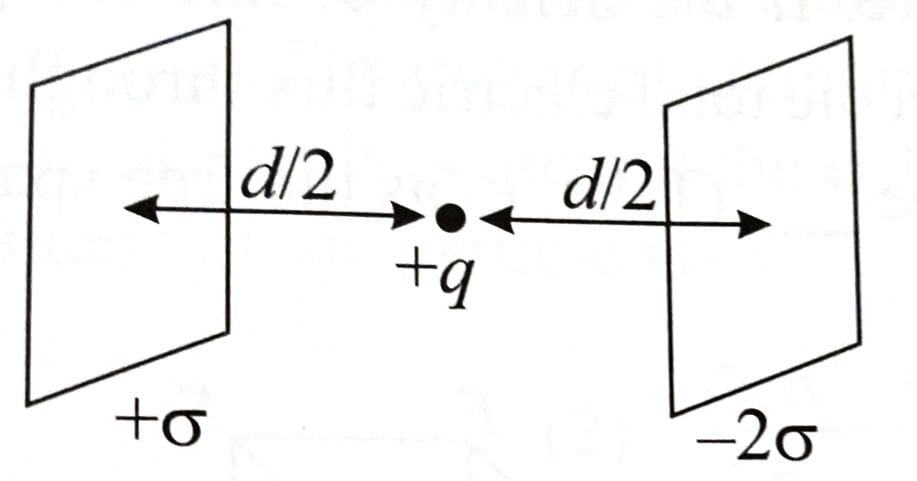
Consider two infinitely large plane parallel conducting plates as shown below. The plates are uniformly charged with a surface charge density +σ and 2σ. The force experienced by a point charge +q placed at the midpoint between two plates will be:          [2025]

  • σq4ε0


  • 3σq2ε0


  • 3σq4ε0


  • σq2ε0


(2)

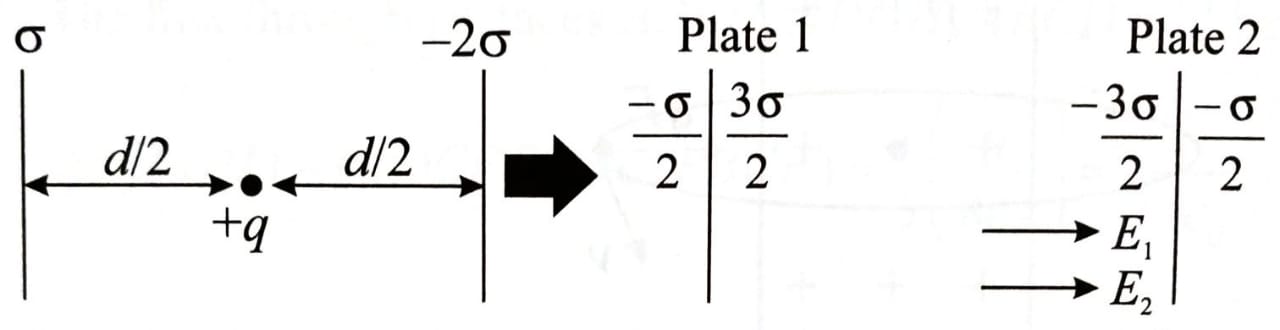
Final charge distribution on different surfaces,

Electric field between the plates,

E=E1+E2=(32σ)2ε0+(32σ)2ε0=3σ2ε0

 F=Eq=3σq2ε0


Q 14 :

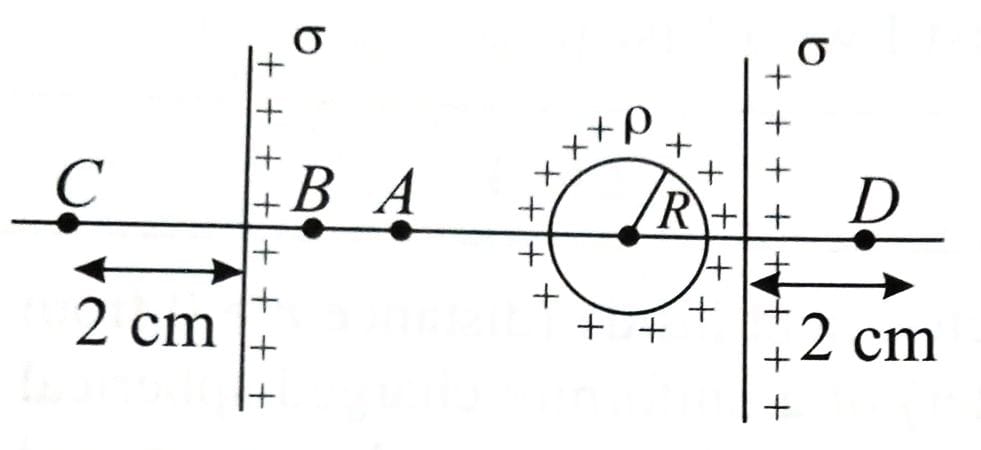
Two infinite identical charged sheets and a charged spherical body of charge density 'ρ' are arranged as shown in figure. Then the correct relation between the electrical fields at A, B, C and D points is:          [2025]

  • EA=EB; EC=ED


  • EA>EB; EC=ED


  • ECED; EA>EB


  • |EA|=|EB|; EC>ED


(3)

At points A and B sum of field due to plates is zero.

A is closer to the body so EA>EB.

D and C are not symmetric w.r.t. body so ECED


Q 15 :

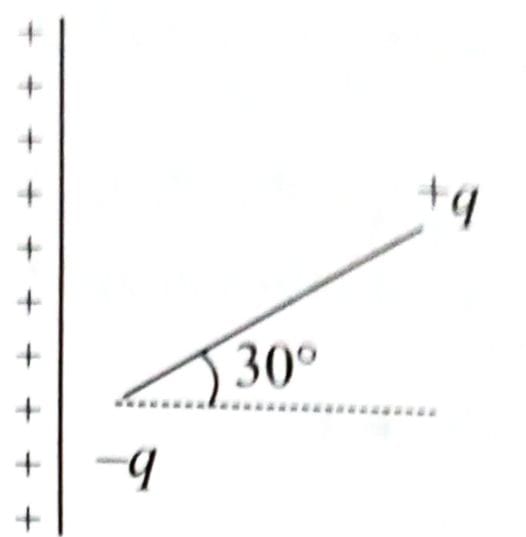
Two small spherical balls of mass 10 g each with charges 2μC and 2μC, are attached to two ends of very light rigid rod of length 20 cm. The arrangement is now placed near an infinite non-conducting charge sheet with uniform charge density of 100 μC/m2 such that length of rod makes an angle of 30° with electric field generated by charge sheet. Net torque acting on the rod is: (Take ε0 : 8.85×10¹² C2/Nm2)          [2025]

  • 112 Nm


  • 1.12 Nm


  • 2.24 Nm


  • 11.2 Nm


(2)

E=σ2ε0=100×1062×8.85×1012N/C

τ=PE sin θ=qdE sin θ

      =2×106×0.2×100×1062×8.85×1012×12

 τ=1.12 Nm


Q 16 :

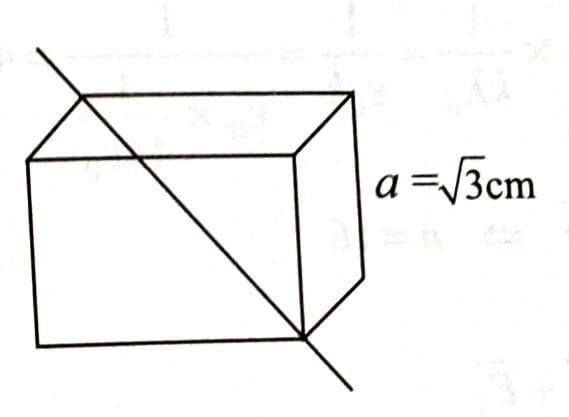
An infinitely long wire has uniform linear charge density λ=2 nC/m. The net flux through a Gaussian cube of side length 3 cm, if the wire passes through any two corners of the cube, that are maximally displaced from each other would be x Nm2C1, where x is: [Neglect any edge effects and use 14πε0=9×10⁹ SI units]          [2025]

  • 0.72 π


  • 4.44 π


  • 6.48 π


  • 2.16 π


(4)

ϕ=qenclosedε0

l=3a=3 cm

qenclosed=λl

 ϕ=λlε0

         =2×109×3×102×4π×9×109

         =2.16π


Q 17 :

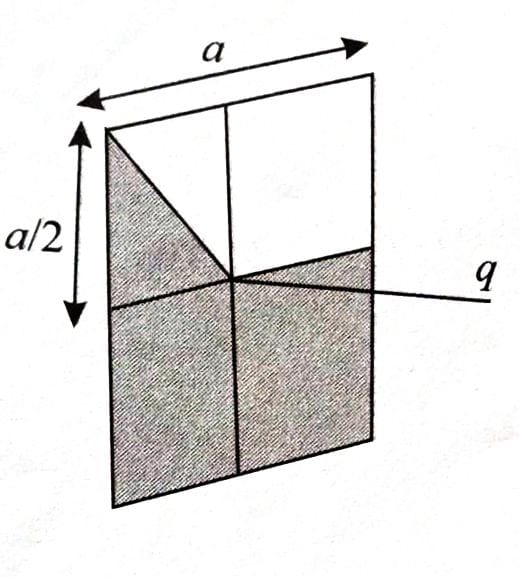
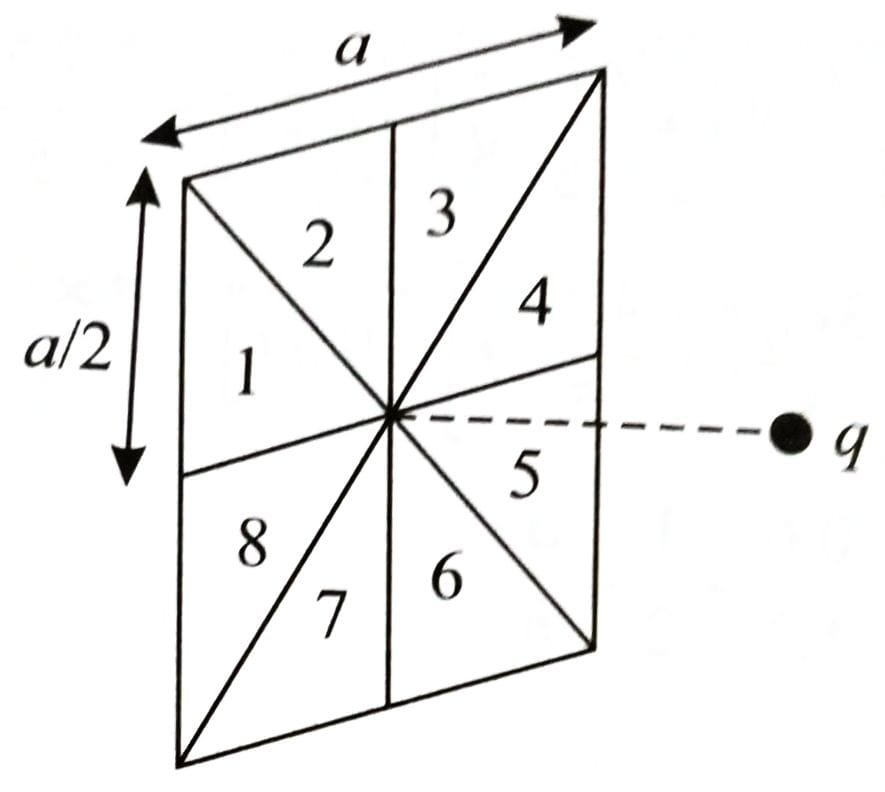
A square loop of sides a = 1 m is held normally in front of a point charge q = 1 C. The flux of the electric field through the shaded region is 5p×1ε0Nm2C, where the value of p is __________.          [2025]


(48)

Total flux through square =qε0(16)

Lets divide square in 8 equal parts.

Flux is same for each part.

 Flux through shaded portion is 58 (Total flux)

                        =58×qε016=5481ε0


Q 18 :

The electric field in a region is given by E=(2i^+4j^+6k^)×103 N/C. The flux of the field through a rectangular surface parallel to xz plane is 6.0 Nm2C1. The area of the surface is __________cm2 .          [2025]


(15)

ϕ=E·A=(2i^+4j^+6k^)×103·Aj^

6=4×10³A

A=1.5×10³m2=15 cm2


Q 19 :

Let σ be the uniform surface charge density of two infinite thin plane sheets shown in the figure. Then the electric fields in three different regions EI, EII and EIII is     [2023]

  • EI=2σε0n^,  EII=0,  EIII=2σε0n^


  • EI=0,  EII=σε0n^,  EIII=0


  • EI=σ2ε0n^,  EII=0,  EIII=σ2ε0n^


  • EI=-σε0n^,  EII=0,  EIII=σε0n^


(4)

Assuming RHS to be n^

EI=σ2ε0(-n^)+σ2ε0(-n^)=-σε0n^

EII=0

EIII=σ2ε0(n^)+σ2ε0(n^)=σε0(n^)


Q 20 :

In a cuboid of dimension 2L×2L×L, a charge q is placed at the centre of the surface 'S' having area 4L2. The flux through the opposite surface to 'S' is given by     [2023]

  • q12ε0


  • q3ε0


  • q2ε0


  • q6ε0


(4)

ϕ=Q/ε06

Flux passing through shaded face=q6ε0


Q 21 :

As shown in the figure, a point charge Q is placed at the centre of the conducting spherical shell of inner radius a and outer radius b. The electric field due to charge Q in three different regions I, II and III is given by:            

(I: r<a, II: a<r<b, III: r>b)                                 [2023]


  • EI=0,  EII=0,  EIII0


  • EI0,  EII=0,  EIII0


  • EI0,  EII=0,  EIII=0


  • EI=0,  EII=0,  EIII=0


(2)

EI0  (inside region)

EII=0  (conducting region)

EIII0=KQr2 (r>b)


Q 22 :

Given below are two statement: one is labelled as Assertion A and the other is labelled as Reason R.           

Assertion A: If an electric dipole of dipole moment 30×10-5 Cm is enclosed by a closed surface, the net flux coming out of the surface will be zero.

Reason R: Electric dipole consists of two equal and opposite charges.

In the light of above statements, choose the correct answer from the options given below:                [2023]

  • Both A and R are true and R is the correct explanation of A


  • A is true but R is false


  • Both A and R are true but R is NOT the correct explanation of A


  • A is false but R is true


(1)

P=30×10-5 Cm

Using Gauss law

ϕ=Qinε0 and Qin=0  ϕ=0


Q 23 :

As shown in the figure, a cuboid lies in a region with electric field E=2x2i^-4yj^+6k^ N/C. The magnitude of charge within the cuboid is nε0 C. The value of n is _______  (if dimensions of cuboid is 1×2×3 m3)           [2023]


(12)

E=2x2i^-4yj^+6k^

ϕnet=-8×3+2×6=-12

-12=qε0  |q|=12ε0


Q 24 :

Expression for an electric field is given by E=4000x2i^ V/m. The electric flux through the cube of side 20 cm when placed in the electric field (as shown in the figure) is ________ V cm.            [2023]


(640)

Flux=E·A=4000(0.2)2Vm·(0.2)2 m2

         =4000×16×10-4V m=640 Vcm


Q 25 :

A cubical volume is bounded by the surfaces x=0, x=a, y=0, y=a, z=0, z=a. The electric field in the region is given by E=E0xi^, where E0=4×10⁴ NC-1m-1. If a=2cm, the charge contained in the cubical volume is Q×10-14 C. The value of Q is __________. (Take ε0=9×10-12 C2/Nm2).            [2023]


(288)

E=E0xi^

ϕnet=ϕABCD=E0a·a2

qenε0=E0a3

  qen=E0ε0a3

qen=4×104×9×10-12×8×10-6=288×10-14 C

  Q=288


Q 26 :

An electron revolves around an infinite cylindrical wire having uniform linear charge density 2×10⁻⁸ Cm-1 in a circular path under the influence of attractive electrostatic field as shown in the figure. The velocity of the electron with which it is revolving is __________ ×106 ms-1. Given, mass of electron =9×10-31kg.     [2023]


(8)

eE=mv2r

e2kλr=mv2r

v=e·2kλm=1.6×10-19×2×9×109×2×10-89×10-31

=8×10⁶ m/s


Q 27 :

Two point charges 2q and q are placed at vertex A and centre of face CDEF of the cube as shown in the figure. The electric flux passing through the cube is:      [2026]

  • 3q2ε0


  • qε0


  • 3q4ε0


  • 3qε0


(3)

ϕ=Qinε0

ϕ=q4+q2ε0=3q4ε0