

Q 21 :

Let a and b be two distinct positive real numbers. Let the 11th term of a GP, whose first term is a and third term is b, is equal to pth term of another GP, whose first term is a and fifth term is b. Then p is equal to     [2024]

  • 21


  • 24


  • 20


  • 25


(1)

Given, T1=a,T3=ar12=b

r1=(ba)1/2                                   ...(i)

Also, T1=a,T5=b

ar24=br2=(ba)1/4                 ...(ii)

And 11th term of first GP = pth term of second GP

Now, ar110=ar2p-1

a(ba)5=a{(ba)1/4}p-1                  (Using (i) and (ii))

(ba)5=(ba)p-145=p-14p-1=20p=21


Q 22 :

For 0<c<b<a, let (a+b-2c)x2+(b+c-2a)x+(c+a-2b)=0 and α1 be one of its root. Then, among the two statements                            [2024]

(I) If α(-1,0), then b cannot be the geometric mean of a and c

(II) If α(0,1), then b may be the geometric mean of a and c

  • only (II) is true


  • Both (I) and (II) are true


  • only (I) is true


  • Neither (I) nor (II) is true


(2)

We have, (a+b-2c)x2+(b+c-2a)x+(c+a-2b)=0

Put x=1

       a+b-2c+b+c-2a+c+a-2b=0

       0=0

    x=1 is another root

    α·1=c+a-2ba+b-2c  α=c+a-2ba+b-2c

If -1<α<0, then -1<c+a-2ba+b-2c<0

0<c+a-2b+a+b-2ca+b-2c<10<2a-b-ca+b-2c<1

Since, a>b>c>0a+b>c+c

a+b>2ca+b-2c>0

    2a-b-c>02a>b+ca>b+c2

   b can not be the geometric mean of a and c

If 0<α<1, then 0<c+a-2ba+b-2c<1

0<c+a-2b and c+a-2b<a+b-2c

c<b

       2b<c+a,b<c+a2

 b may be the geometric mean of a and c.


Q 23 :

Let 2nd, 8th and 44th terms of a non-constant A.P. be respectively the 1st, 2nd and 3rd terms of a G.P. If the first term of the A.P. is 1, then the sum of its first 20 terms is equal to           [2024]

  • 990


  • 980


  • 970


  • 960


(3)

We have, first term of an A.P. =1.

Let the 1st, 2nd and 3rd terms of a G.P. are ar,a,ar respectively.

Now, T2=ar1+(2-1)d=ar1+d=ar                ...(i)

T8=a1+7d=a                                                                     ...(ii)

T44=ar1+43d=ar                                                             ...(iii)

Using equations (i) and (ii), we get

1+d1+7d=1r                                                                                      ...(iv)

From (ii) and (iii), we get

1+7d1+43d=1r                                                                                   ...(v)

     1+d1+7d=1+7d1+43d

1+43d+d+43d2=1+14d+49d2

6d2-30d=06d(d-5)=0d=0,d=5

 d=5 ( d0)

 S20=202[2+19×5]=10[2+95]=970


Q 24 :

If the range of f(θ)=sin4θ+3cos2θsin4θ+cos2θ, θR is [α,β], then the sum of the infinite G.P., whose first term is 64 and the common ratio is αβ, is equal to _______.          [2024]


(96)

We have, f(θ)=sin4θ+3cos2θsin4θ+cos2θ

=1+2cos2θsin4θ+cos2θ=1+2cos2θ1+cos4θ-cos2θ

=1+21cos2θ+cos2θ-1

Now, cos2θ+1cos2θ2                      [A.M.G.M.]

1cos2θ+cos2θ-11cos2θ+1cos2θ-1[1,)

1cos2θ+1cos2θ-1(0,1]

When cosθ=0,f(θ)=1

    f(θ)[1,3]α=1,β=3

Sum of infinite G.P. with first term 64 and common ratio

13=641-13=32×3=96


Q 25 :

If three successive terms of a G.P. with common ratio r(r>1) are the lengths of the sides of a triangle and [r] denotes the greatest integer less than or equal to r, then 3[r]+[-r] is equal to ______.                   [2024]


(1)

Let a,ar and ar2 be the three sides of the triangle. 

Now, a+ar>ar2

r2-r-1<0r(1-52,1+52)

So, 3[r]+[-r]=3+(-2)=1


Q 26 :

If 8=3+14(3+p)+142(3+2p)+143(3+3p)+, then the value of p is _______ .               [2024]


(9)

8=3+1(4)(3+p)+1(4)2(3+2p)+1(4)3(3+3p)+          ...(i)

Multiplying both sides by 14, we get  2=34+3+p(4)2+3+2p(4)3++                                       ...(ii)

Subtracting (ii) from (i), we get 6=3+p4+p42+

3=p[14+1(4)2+1(4)3++]

3=p[141-14]                    [ S=a1-r for infinite geometric series ]

3=p[14×43]p=9


Q 27 :

Let the coefficient of xr in the expansion of (x+3)n-1+(x+3)n-2(x+2)+(x+3)n-3(x+2)2++(x+2)n-1 be αr. If r=0nαr=βn-γn,β,γN, then the value of β2+γ2 equals ______ .                    [2024]


(25)

We have, 

(x+3)n-1+(x+3)n-2(x+2)+(x+3)n-3(x+2)2++(x+2)n-1

   r=0nαr=4n-1+4n-2×3+4n-3×32++3n-1

=4n-1[1+34+(34)2++(34)n-1]

=4n-1×1-(34)n1-34=4n-1(1-(34)n)(4)

=4n-3n=β-γb=4,γ=3

    β2+γ2=16+9=25


Q 28 :

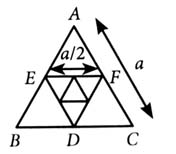
Let ABC be an equilateral triangle. A new triangle is formed by joining the middle points of all sides of the triangle ABC and the same process is repeated infinitely many times. If P is the sum of perimeters and Q is the sum of areas of all the triangles formed in this process, then:                 [2024]

  • P2=63Q


  • P2=723Q


  • P2=363Q


  • P=363Q2


(3)

ABC is an equilateral triangle of side 'a' unit.

Perimeter of ABC=3a

Area of ABC=34a2

Now, DEF is made by joining midpoints of the sides of ABC

    DE=EF=DF=a2

Perimeter of DEF=3a2

Area of DEF=34×a24=316a2

   P=3a+3a2+3a4+

=3a[1+12+122+]=3a1-12=6a

Now, Q=34a2[1+14+142+]=34a21-14=43×34a2

=13a2=13(P6)2                   [ P=6a]

363Q=P2


Q 29 :

Let a1,a2,a3,... be a G.P. of increasing positive numbers. If a3a5=729 and a2+a4=1114, then 24(a1+a2+a3) is equal to           [2025]

  • 131


  • 129


  • 128


  • 130


(2)

Let a be the first term and r be the common ratio of GP respectively.

Given, a3a5=729  ar2·ar4=729

 a2r6=729  ar3=27          ... (i)

and a2+a4=ar+ar3=1114

 ar+27=1114  ar=34          ... (ii)

Now, divide equation (i) by equation (ii), we get

   ar3ar=273/4

 r2=36  r=6          [ G.P. is an increasing series]

Substitute r = 6 in equation (ii), we get

           a=18

Now,   24(a1+a2+a3)

       =24(a+ar+ar2)

       =24a(1+r+r2)

       =24×18(1+6+36)

         = 3(43) = 129.


Q 30 :

Let x1,x2,x3,x4 be in a geometric progression. If 2, 7, 9, 5 are subtracted respectively from x1,x2,x3,x4, then the resulting numbers are in an arithmetic progression. Then the value of 124(x1x2x3x4) is :          [2025]

  • 36


  • 216


  • 72


  • 18


(2)

Given, x1,x2,x3,x4 be in a G.P.

x1=a, x2=ar, x3=ar2, x4=ar3

According to question

a2, ar7, ar29, ar35 are in A.P.

So, 2(ar7)=a2+ar29          ... (i)

       2(ar29)=ar7+ar35          ... (ii)

Solving (i) and (ii), we get r = 2, a = – 3

Product =x1x2x3x4=a4r6=81×64=5184

   The value of 124(x1x2x3x4)=(5184)24=216.