
Q 1 :

If the area of the region {(x,y):ax2≤y≤1x,1≤x≤2,0<a<1} is (loge2)-17 then the value of 7a-3 is equal to :               [2024]

  • 2


  • - 1


  • 1


  • 0


(2)

Area of region  {(x,y):ax2≤y≤1x,1≤x≤2,0<a<1}=∫12(1x-ax2)dx

⇒(ln2)-17=[lnx+ax]12=ln2+a2-(ln(1+a))

=ln2-a2⇒a2=17⇒a=27

So,7a-3=27×7-3=-1


Q 2 :

The area (in square units) of the region enclosed by the ellipse x2+3y2=18 in the first quadrant below the line y=x is                [2024]

  • 3π


  • 3π+34


  • 3π-34


  • 3π+1


(1)

We have, x2+3y2=18

⇒x218+y26=1

⇒x2(32)2+y2(6)2=1

 For point of intersection of ellipse and line y=x, we have, x2+3x2=18

⇒x2=184⇒x2=92⇒x=±32

Required area =∫03/2x dx+∫3/23218-x23 dx

=[x22]03/2+13[x218-x2+9sin-1x32]3/232

=94+13[9sin-1(1)-322·332-9sin-1(12)]

=94+13[9π2-934-9π6]=133π=3π


Q 3 :

Three points O(0,0),P(a,a2),Q(-b,b2),a>0,b>0, are on the parabola y=x2. Let S1 be the area of the region bounded by the line PQ and the parabola, and S2 be the area of the triangle OPQ. If the minimum value of S1S2 is mn,gcd(m,n)=1, then m+n is equal to _______ .                  [2024]


(7)

Equation of line PQ is, y-a2=b2-a2-b-a(x-a)

⇒y=x(a-b)+ab

∴S1=∫-ba(x(a-b)+ab-x2)dx

           =[(a-b)x22+abx-x33]-ba

=(a-b)(a2-b2)2+ab(a+b)-(a3+b3)3

⇒S1=16(a+b)3                                                      ...(i)

Also, S2=12|001aa21-bb21|=12ab(a+b)

Now,S1S2=(a+b)3/6ab(a+b)/2=13(a+b)2ab

=a2+b2+2ab3ab=a3b+b3a+23=13(ab+ba+2)

Now,ab+1a/b≥2

∴Minimum value of S1S2=43

So, m+n=4+3=7


Q 4 :

The sum of squares of all possible values of k, for which area of the region bounded by the parabolas 2y2=kx and ky2=2(y-x) is maximum, is equal to _______ .         [2024]


(8)

ky2=2(y-x) and 2y2=kx

Point of intersection

y(ky-2(1-2yk))=0

⇒ ky2-2(y-2y2k)=0

⇒y=0 and ky=2(1-2yk)⇒ky+4yk=2

y=2k+4k=2kk2+4        ∴A=∫02kk2+4((y-ky22)-(2y2k))·dy

=[y22-(k2+2k)·y33]02kk2+4

=(2kk2+4)2[12-k2+42k×13×2kk2+4]=16×4×(1k+4k)2

A.M.≥G.M.⇒(k+4k2)≥2⇒k+4k≥4

So, area is maximum when k=4k⇒k=2,-2

∴Sum of squares of all possible values of k

=22+(-2)2=8


Q 5 :

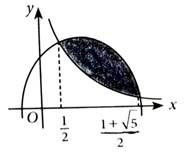
One of the points of intersection of the curves y=1+3x-2x2 and y=1x is (12,2). Let the area of the region enclosed by these curves be 124(l5+m)-nloge(1+5), where l,m,n∈N. Then l+m+n is equal to                     [2024]

  • 32


  • 30


  • 29


  • 31


(2)

Given curves are y=1+3x-2x2 and y=1x

On solving, 2x3-3x2-x+1=0

⇒(2x-1)(x2-x-1)=0⇒x=12,  x=1±52

Required Area = ∫121+52(1+3x-2x2-1x) dx

=[x+3x22-2x33-lnx]121+52

=[5+12+38(5+1)2-112(5+1)3-ln(5+12)]-(12+38-112-ln12)

=124[12(5+1)+9(5+1)2-2(5+1)3-12-9+2]-(ln5+12+ln2)

=124[12(5+1)+9(6+25)-2(55+1+35(5+1)-19)]-ln(5+12×2)

=124[145+15]-ln(5+1)

=124(l5+m)-nloge(1+5)                                   [Given]

∴ l=14, m=15 and n=1

Hence, l+m+n=30


Q 6 :

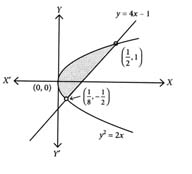
The area (in sq. units) of the region described by {(x,y):y2≤2x, and y≥4x-1} is                      [2024]

  • 1112


  • 1132


  • 932  


  • 89


(3)

Required Area=∫-121(y+14-y22) dy

=[y28+y4-y36]-121

=(18+14-16)-(132-18+148)=932


Q 7 :

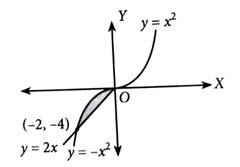
The area enclosed between the curves y=x|x| and y=x-|x| is:               [2024]

  • 83    


  • 23    


  • 43    


  • 1


(3)

y=x|x|={x2,x≥0-x2,x<0

y=x-|x|={0,x≥02x,x<0

∴ Required Area=∫-20(-x2-2x) dx

=[-x33-x2]-20

=-83+4=43


Q 8 :

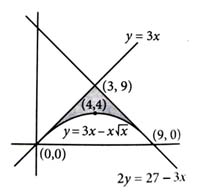
Let the area of the region enclosed by the curves y=3x, 2y=27-3x and y=3x-xx be A. Then 10A is equal to               [2024]

  • 162


  • 184


  • 154


  • 172


(1)

Required area, 

A=∫03(3x-(3x-xx)) dx+∫3927-3x2-(3x-xx) dx

=∫03x3/2 dx+∫39272-9x2+x3/2 dx

=25[x5/2]03+272[x]39-94[x2]39+25[x5/2]39

=2535/2+272×6-94×72+25[95/2-35/2]

=81-162+25·35=815

So, 10A=10×815=162


Q 9 :

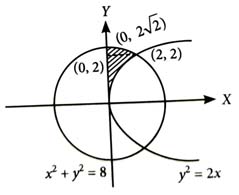
The area of the region in the first quadrant inside the circle x2+y2=8 and outside the parabola y2=2x is equal to:               [2024]

  • π2-23    


  • π2-13    


  • π-13    


  • π-23


(4)

We have, x2+y2=8 and y2=2x

Required area = area of the shaded region

=∫02y22 dy+∫2228-y2 dy

=16[y3]02+[y28-y2+4sin-1(y22)]222

=43+[2π-2-π]=π-23


Q 10 :

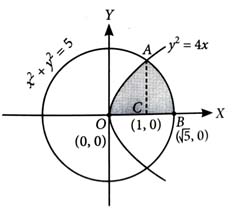
The parabola y2=4x divides the area of the circle x2+y2=5 in two parts. The area of the smaller part is equal to :                 [2024]

  •  13+5sin-1(25)


  •  23+5sin-1(25)


  •  23+5sin-1(25)


  •  13+5sin-1(25)


(3)

The points of intersection of y2=4x and x2+y2=5 are (1, 2) and (1, -2).

∴  Required Area=2{Area of OACO+Area of CABC}

=2[∫012x dx+∫155-x2 dx]

=2[|43x32|01+(12x5-x2+52sin-1x5)]15

=2[(43-0)+(0+5π4)-(1+52sin-115)]

=2[13+5π4-52sin-115]=23+5[π2-sin-115]

=23+5cos-1(15)                     [∵ sin-1x+cos-1x=π2]

=23+5sin-1(25)


Q 11 :

The area enclosed by the curves xy+4y=16 and x+y=6 is equal to:               [2024]

  • 28-30loge2    


  • 32-30loge2    


  • 30-28loge2    


  • 30-32loge2


(4)

We have, y=16x+4 and x+y=6⇒y=6-x

For intersecting points:

6-x=16x+4⇒(6-x)(x+4)=16

⇒x2-2x-8=0⇒x2-4x+2x-8=0

⇒x(x-4)+2(x-4)=0

⇒(x+2)(x-4)=0⇒x=-2, 4

∴  y=8, when x=-2 and y=2, when x=4

So, Area=∫-24((6-x)-16x+4) dx=[6x-x22-16loge(x+4)]-24

=24-8-16loge8+12+2+16loge2=30-16loge(82)

=30-16loge22=30-32loge2


Q 12 :

The area (in square units) of the region bounded by the parabola y2=4(x-2) and the line y=2x-8, is                               [2024]

  • 9


  • 7


  • 8


  • 6


(1)

Parabola : y2=4(x-2)                    ...(i)

and line : y=2x-8                           ...(ii)

⇒4(x-4)2=4(x-2)                       

⇒x2-9x+18=0

⇒x=3,6

From (ii), we get

⇒y=-2,4

Points of intersection of (i) and (ii) are (3,-2) and (6,4)

∴ Required Area=∫-24[(y+82)-(y24+2)] dy

=[y24-y312+2y]-24

=9 sq. units


Q 13 :

The area of the region

{(x,y):y2≤4x, x<4, xy(x-1)(x-2)(x-3)(x-4)>0, x≠3} is                                   [2024]

  • 323


  • 163


  • 83


  • 643


(1)

The area of region xy(x-1)(x-2)(x-3)(x-4), y2-4x≤0

⇒yx(x-1)(x-2)(x-3)(x-4)<0

Case 1: y>0

So, x(x-1)(x-2)(x-3)(x-4)<0

⇒x∈(0,1)∪(2,3)

Case 2: y<0

So, x(x-1)(x-2)(x-3)(x-4)>0⇒x∈(1,2)∪(3,4)

Area=∫042x dx=23×16=323


Q 14 :

The area of the region enclosed by the parabolas y=4x-x2 and 3y=(x-4)2 is equal to                            [2024]

  • 6


  • 4


  • 143


  • 329


(1)

Given, y=4x-x2                              ...(i)

3y=(x-4)2                                      ...(ii)

From (i),

3y=3(4x-x2)=12x-3x2

From (ii),

(x-4)2=12x-3x2

⇒x2-8x+16=12x-3x2⇒x2-5x+4=0

⇒(x-1)(x-4)=0⇒x=1,4

Points of intersection are (1,3) and (4,0)

Required area = ∫14[(4x-x2)-(x-4)23]dx

=[2x2-x33-13(x-4)33]14

=[(32-643-13(0))-(2-13-13(-273))]

=30-643+13-3=27-21=6 sq. units


Q 15 :

The area of the region enclosed by the parabolas y=x2-5x and y=7x-x2 is ___________                   [2024]


(72)

Given, y=x2-5x and y=7x-x2

Both curves passes through the origin

For the points of intersection, we have x2-5x=7x-x2

⇒2x2=12x

⇒2x(x-6)=0

⇒x=0,6

∴  Area bounded by the curves =∫06[(7x-x2)-(x2-5x)]dx

=∫06(7x-x2-x2+5x)dx=∫06(12x-2x2)dx

=12(622)-23(6)3

=72 sq. units


Q 16 :

Let the area of the region enclosed by the curve y=min{sinx,cosx} and the x-axis between x=-π to x=π be A. Then A2 is equal to ______ .          [2024]


(16)

Required area, A=∫-π-3π4-cosxdx+∫-3π40-sinxdx+∫0π4sinxdx+∫π4π2cosxdx+∫π2π-cosxdx

=[-sinx]-π-3π4+[cosx]-3π40-[cosx]0π4+[sinx]π4π2-[sinx]π2π

=12+1+12-12+1+1-12+1=4

∴   A2=16


Q 17 :

Let the area of the region {(x,y):x-2y+4≥0, x+2y2≥0, x+4y2≤8, y≥0} be mn, where m and n are coprime numbers. Then m+n is equal to _____ .      [2024]


(119)

Given, x-2y+4=0                  ...(i)

x+2y2=0                                    ...(ii)

x+4y2=8                                    ...(iii)

The point intersection of (i) and (iii) are (-1,1.5) and (-8,-2).

The point of intersection of (i) and (ii) are (-2,1) and (-8,-2).

∴  Required area

∫01 [(8-4y2)-(-2y2)] dy+∫13/2[(8-4y2)-(2y-4)] dy

= [8y- 2y33]01+[12y-y2-43y3]13/2

=(8-23)+(12(32)-(32)2-43(32)3)-(12-1-43)

=223+18-94-92-293=10712=mn

∴   m+n=119


Q 18 :

If the area of the region {(x,y):0≤y≤min{2x,6x-x2}} is A, then 12A is equal to ____________.               [2024]             


(304)

Region {(x,y):0≤y≤min(2x,6x-x2)}

∴ Let A be the area of the required region.

A=2∫04x dx+∫46(6x-x2) dx

=[x2]04+[3x2-x33]46

=16+3(36-16)-13(216-64)

=16+60-1523=228-1523=763⇒A=763 sq. units

∴  12A=12×763=4×76=304


Q 19 :

The area (in sq. units) of the part of the circle x2+y2=169 which is below the line 5x-y=13 is πα2β-652+αβsin-1(1213), where α,β are coprime numbers. Then α+β is equal to _______ .                [2024]


(171)

∴Required Area=∫-1312(169-y2-y+135)dy

=[12y169-y2+1692sin-1y13]-1312-[y210+135y]-1312

=[12×12×5+1692sin-11213]-[0+1692(-π2)]-[14410+135×12]+[16910-1695]

=1692(π2)+1692sin-1(1213)-652

∴  α=169 and β=2

Thus, α+β=169+2=171


Q 20 :

Let the area of the region {(x,y):0≤x≤3,0≤y≤min{x2+2,2x+2}} be A. Then 12A is equal to ___________ .         [2024]


(164)

Required area, A=∫02(x2+2) dx+∫23(2x+2) dx

=[x33+2x]02+[2x22+2x]23

⇒A=83+4+(9+6-4-4)=413

∴   12A=164 sq. units


Q 21 :

The area of the region enclosed by the parabola (y-2)2=x-1, the line x-2y+4=0 and the positive coordinate axes is ____________.       [2024]


(5)

Given, equation of parabola

(y-2)2=(x-1)                                   ...(i)

and line x-2y+4=0                           ...(ii)

From (ii), we have

x-2(y-2)=0⇒y-2=x2

Putting in (i), we get (x2)2=(x-1)

⇒x2-4x+4=0

⇒(x-2)2=0⇒x=2

From (ii), we have, y=3

∴     Intersection point of (i) and (ii) is (2,3).

∴   Required area=∫03((y-2)2+1) dy-Area of triangle

                                    =∫03(y2-4y+5) dy-12×2×1

=[y33-2y2+5y]03-1=(9-18+15)-1=6-1=5 sq. units


Q 22 :

The area of the region {(x,y):|x–y|≤y≤4x} is          [2025]

  • 512


  • 20483


  • 10243


  • 5123


(3)

We have, |x–y|≤y≤4x

Now, y=|x–y|⇒ y2=(x–y)2

⇒ y=x2 and x=0

Required Area =∫064(4x–x2)dx

=[4x3/23/2–x24]064=83·83–6424=642(112)=10243.


Q 23 :

Let f:[0,∞)→R be a differentiable function such that f(x)=1–2x+∫0xex–tf(t)dt for all x∈[0,∞).

Then the area of the region bounded by y = f(x) and the coordinates axes is           [2025]

  • 12


  • 2


  • 5


  • 2


(1)

We have, y=1–2x+ex∫0xe-tf(t)dt

⇒ dydx=–2+e–x·exf(x)+ex∫0xe-tf(t)dt

                 =–2+y+y+2x–1

⇒ dydx–2y=2x–3

This is a linear differential equation, so we have

ye–2x=∫(2x–3)·e–2xdx+c          [∵ I.F.=e∫–2dx=e–2x]

⇒ ye–2x=–(2x–3)2e–2x+∫e–2x·dx+c

⇒ ye–2x=–(2x–3)2e–2x–e–2x2+c

∵  f(0)=1        ∴ c=1–32+12=0

⇒ y=–(2x–3)2–12 ⇒ x+y=1

So, area =12×1×1=12.


Q 24 :

A line passing through the point A(–2, 0), touches the parabola P : y2=x–2 at the point B in the first quadrant. The area, of the region bounded by the line AB, parabola P and the x-axis, is :          [2025]

  • 73


  • 2


  • 3


  • 83


(4)

Given parabola P : y2=x–2 and line is passing through A(–2, 0)

Tangent is y = m(x + 2)

⇒ (m(x+2))2=x–2

⇒ m2x2+(4m2–1)x+(4m2+2)=0

As D = 0

⇒ (4m2–1)2=4m2(4m2+2) ⇒ m=14

So, tangent is y=14(x+2)

Point of tangency is (6, 2)

∴   Area of region =∫02(y2+2)–(4y–2)dy

                                        =83–8+8=83 sq. units.


Q 25 :

If the area of the region bounded by the curves y=4–x24 and y=x–42 is equal to α, then 6α equals          [2025]

  • 240


  • 220


  • 210


  • 250


(4)

Given, y=4–x24          ... (i)

and y=x–42          ... (ii)

From (i) & (ii), we get

x = –6, 4 and y = –5, 0

Thus, point of intersection of (i) & (ii) are (–6, 5) and (4, 0).

Required Area =∫–64{(4–x24)–(x–42)}dx

⇒α=∫–64{–x24–x2+6}dx

α=–x312–x24+6x|–64

      =–(6412+21612)–(164–364)+6(4+6)

      =1253

∴  6α=250.


Q 26 :

If the area of the region {(x,y):1+x2≤y≤min {x+7,11–3x}} is A, then 3A is equal to          [2025]

  • 47


  • 49


  • 50


  • 46


(3)

A=∫–21(x+7–x2–1)dx+∫12(11–3x–x2–1)dx

=[x22+6x–x33]–21+[10x–3x22–x33]12

=503 ⇒ 3A=50.


Q 27 :

The area of the region, inside the circle (x–23)2+y2=12 and outside the parabola y2=23x is :          [2025]

  • 3π+8


  • 3π–8


  • 6π–16


  • 6π–8


(3)

We have, (x–23)2+y2=12, a circle with centre (23,0) and radius 12 and a parabola y2=23x.

∴   Required Area = π(12)2–2∫023(23)12x1/2dx

                                   =6π–2(23)1/2[x3/23·2]023

                                   =6π–43(23)1/2(23)3/2

                                    =6π–43(23)2=6π–16.


Q 28 :

Let f : R→R be a twice differentiable function such that f(x + y) = f(x)f(y) for all x, y∈R. If f'(0)=4a and f satisfies f''(x)=3af'(x)–f(x)=0, a > 0, then the area of the region R={(x,y) | 0≤y≤f(ax), 0≤x≤2} is :          [2025]

  • e4+1


  • e2–1


  • e4–1


  • e2+1


(2)

We have, f(x + y) = f(x)f(y)

Let f(x)=eλx

Differentiating w.r.t. x, we get

f'(x)=λ·eλx

Put x = 0, we get

f'(0)=λ          [∵ f'(0)=4a]

⇒ λ=4a

So, f(x)=e4ax

Now, f''(x)–3af'(x)–f(x)=0

⇒ ddx(λeλx)–3a(λeλx)–eλx=0

⇒ λ2–3aλ–1=0

⇒ 16a2–12a2–1=0 ⇒ 4a2=1

⇒ a=12          [∵ a>0]

∴  f(x)=e2x

Now, f(x)=f(ax)=ex

∴   Area of region ∫02exdx=[ex]02=e2–1.


Q 29 :

The area of the region enclosed by the curves y=x2–4x+4 and y2=16–8x is :          [2025]

  • 5


  • 4/3


  • 8/3


  • 8


(3)

The given curves are y=x2–4x+4 and y2=16–8x

Points of intersection are (2, 0) and (0, 4).

∴   Required Area =∫02(16–8x–(x2–4x+4))dx

                                     =22∫022–xdx–∫02(x–2)2dx

                                     =22[2(2–x)3/2–3]02–[(x–2)33]02

                                     =163–83=83 sq. units.


Q 30 :

If the area of the region {(x,y):–1≤x≤1, 0≤y≤a+e|x|–e–x, a>0} is e2+8e+1e, then the value of a is :          [2025]

  • 6


  • 8


  • 7


  • 5


(4)

Required area =a+∫01(a+ex–e–x)dx

=a+[ax+ex+e–x]01

⇒ 2a+e+e–1–2=e+8+1e

⇒ 2a–2=8

⇒ 2a=10 ⇒ a=5.