

Q 11 :

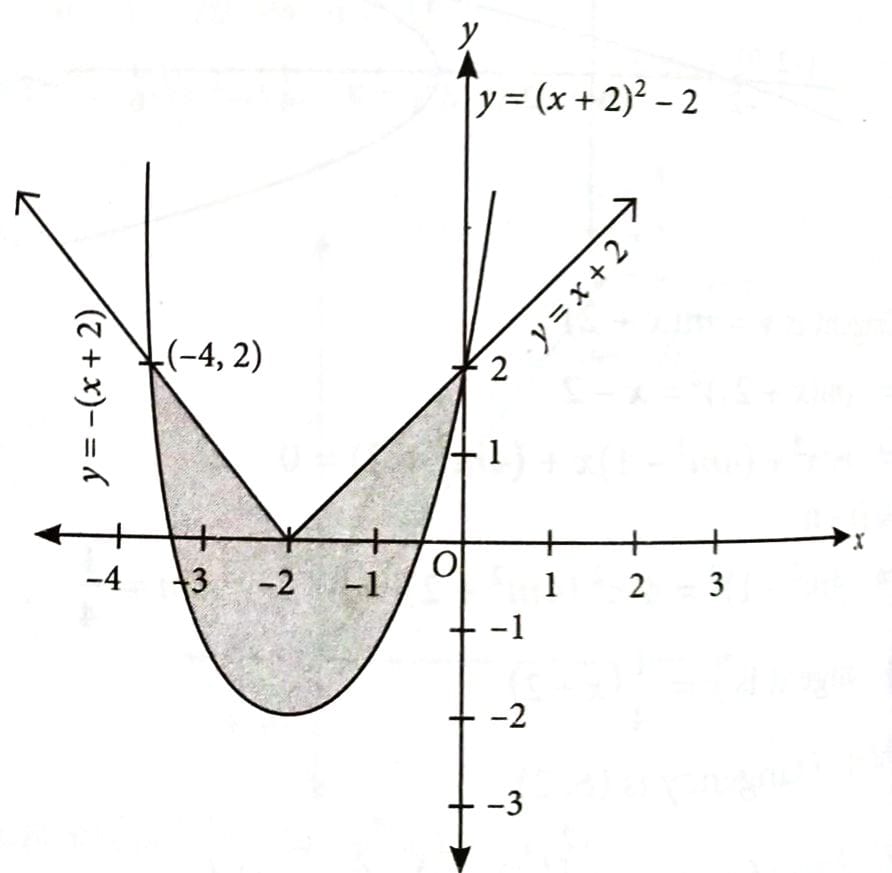
The area of the region {(x,y):x2+4x+2≤y≤|x+2|} is equal to         [2025]

  • 5


  • 7


  • 24/5


  • 20/3


(4)

We have, x2+4x+2≤y≤|x+2|

⇒ (x+2)2–2≤y≤|x+2|

∴   Required area =∫–4–2|(–x–2)–(x+2)2+2|dx+∫–20|(x+2)–(x+2)2+2|dx

=∫–4–2|–x–(x+2)2|dx+∫–20|x–(x+2)2+4|dx

=[|–x22–(x+2)33|]–4–2+[|x22–(x+2)33+4x|]–20

=103+103=203.


Q 12 :

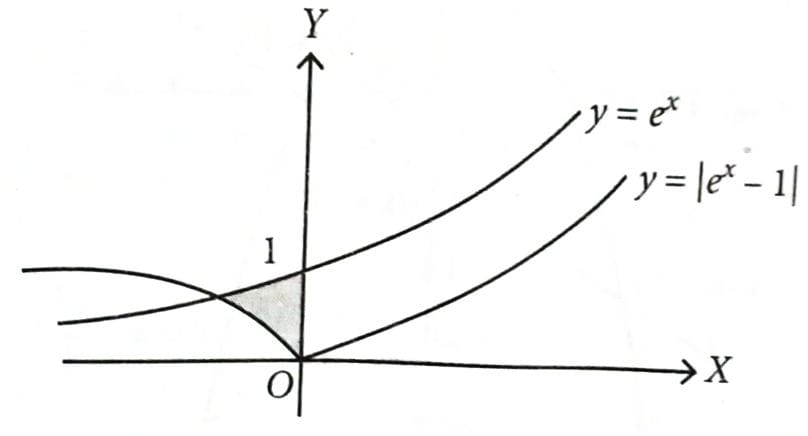
The area of the region enclosed by the curves y=ex, y=|ex–1| and y-axis is:          [2025]

  • loge2


  • 1–loge2


  • 2loge2–1


  • 1+loge2


(2)

Given: Region is bounded by curves y=ex and y=|ex–1|.

The graph is given by

When ex=|ex–1|

⇒ ex=–ex+1                              [∵ex-1<0]

⇒ 2ex=1 ⇒ ex=1/2 ⇒ x=–ln(2)

Now, area is given by.

A=∫–ln(2)0[ex–(1–ex)]dx=∫–ln(2)0(2ex–1)dx

=(2ex–x)–ln(2)0=2–1–ln(2)=1–ln(2).


Q 13 :

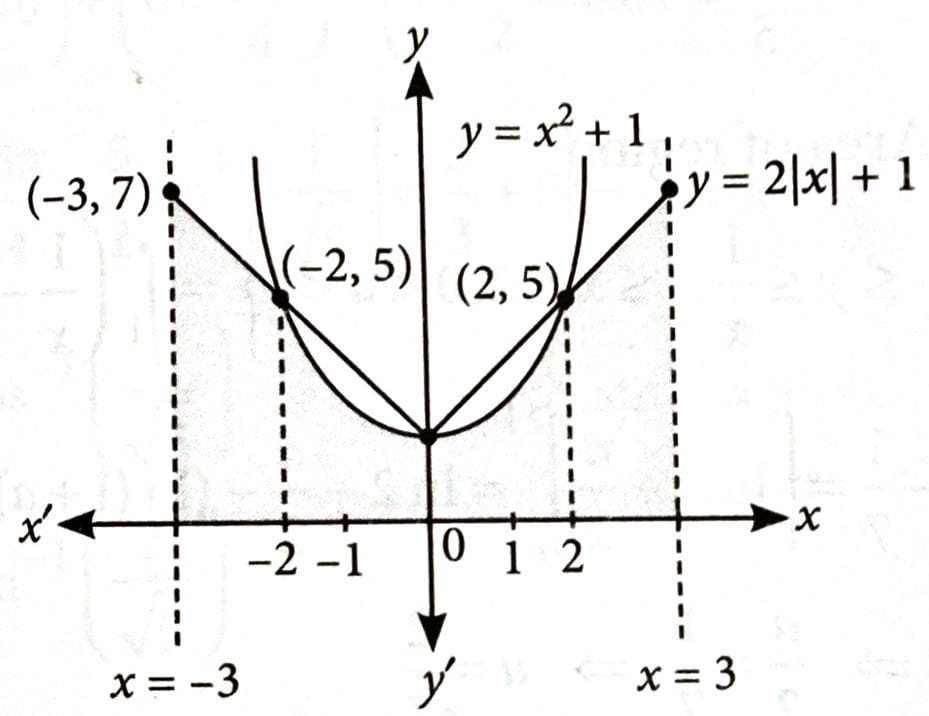
The area of the region {(x,y):0≤y≤2|x|+1, 0≤y≤x2+1, |x|≤3} is         [2025]

  • 173


  • 323


  • 643


  • 803


(3)

Given, the area of region

{(x,y):0≤y≤2|x|+1, 0≤y≤x2+1, |x|≤3}

∴   Required area =2∫02(x2+1)dx+∫23(2x+1)dx

                                    =2[(x33+x)02+(2x22+x)23]

                                    =2[83+2]+2(6)

                                    =2[143]+12

=643 sq. units.


Q 14 :

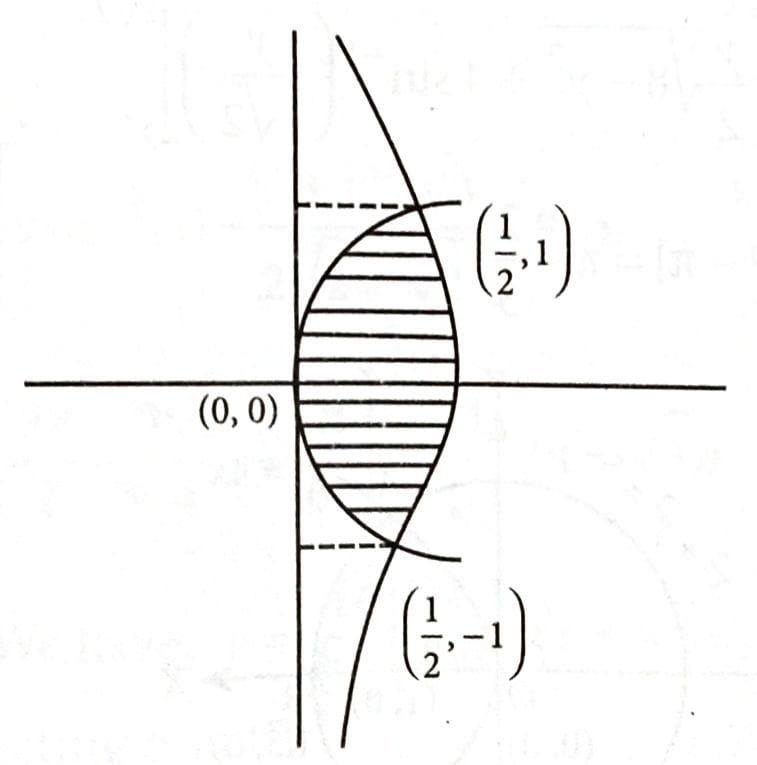
The area of the region bounded by the curves x(1+y2)=1 and y2=2x is :         [2025]

  • 2(π2–13)


  • π4–13


  • π2–13


  • 12(π2–13)


(3)

We have, x(1+y2)=1         ... (i)

and y2=2x          ... (ii)

From equation (i) and (ii), we get

x(1+2x)=1⇒ 2x2+x–1=0

⇒ x=12, x=–1          (Reject)

From (ii), y2=2(12) ⇒ y=±1

∴   Required area =∫–11(11+y2–y22)dy

                                   =(tan–1y-y36)|–11=π2-13.


Q 15 :

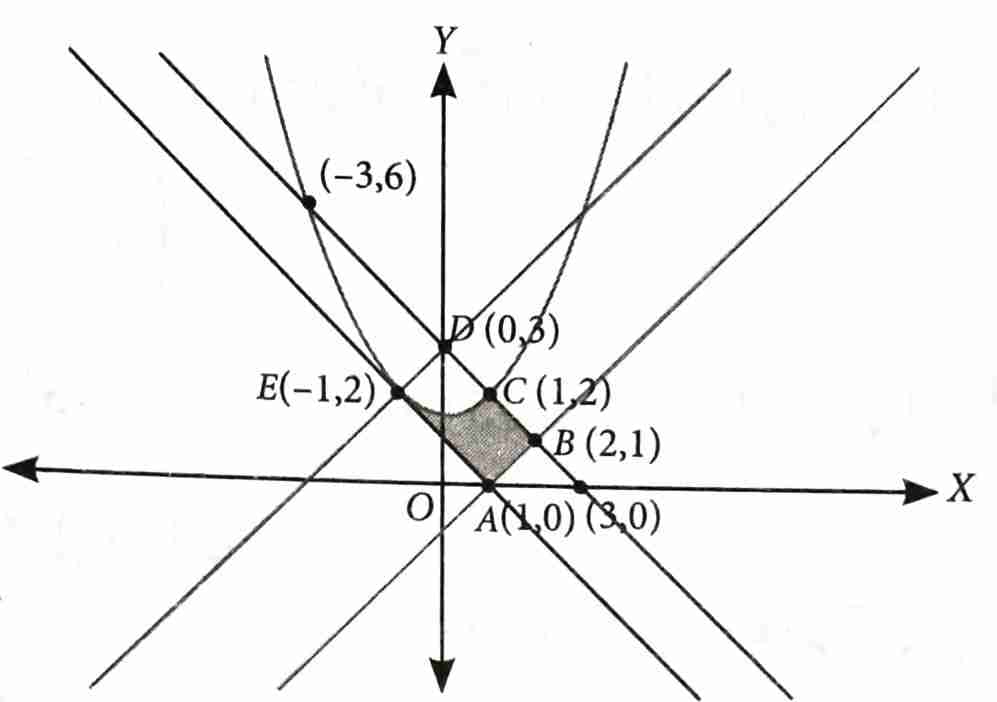
Let the area of the region {(x,y):2y≤x2+3, y+|x|≤3, y≥|x–1|} be A. Then 6A is equal to :           [2025]

  • 14


  • 16


  • 18


  • 12


(1)

Required area, A = Rectangle ABDE – Area of region EDC

⇒ A=4–2∫01((3–x)–(x2+32))dx

⇒ A=4–2{3x–x22–x36–32x}01

⇒ A=4–2{3–12–16–32}=73

So, 6A = 14.


Q 16 :

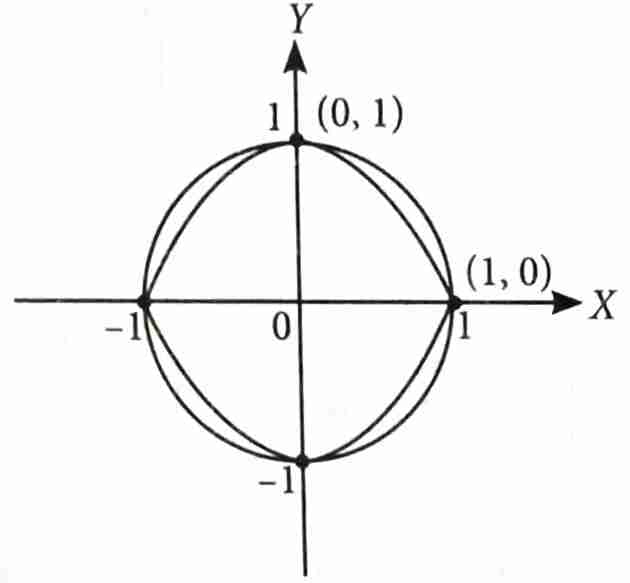
Let the area enclosed between the curves |y|=1–x2 and x2+y2=1 be α. If 9α=βπ+γ; β, γ are integers, then the value of |β–γ| equals           [2025]

  • 27


  • 15


  • 33


  • 18


(3)

We have, c1 : |y|=1–x2 and c2 : x2+y2=1

∴   Required area =α=4[(Area of circle in1st quadrant)–∫01(1–x2)dx]

=4[(π(1)4)–[x–x33]01]

=4[π4–(1–13)]=4[π4–23]

=π–83

Hence, 9α=9π–24

On comparing with 9α=βπ+γ, we get β=9 and γ=–24

∴  |β–γ|=|9–(–24)|=33.


Q 17 :

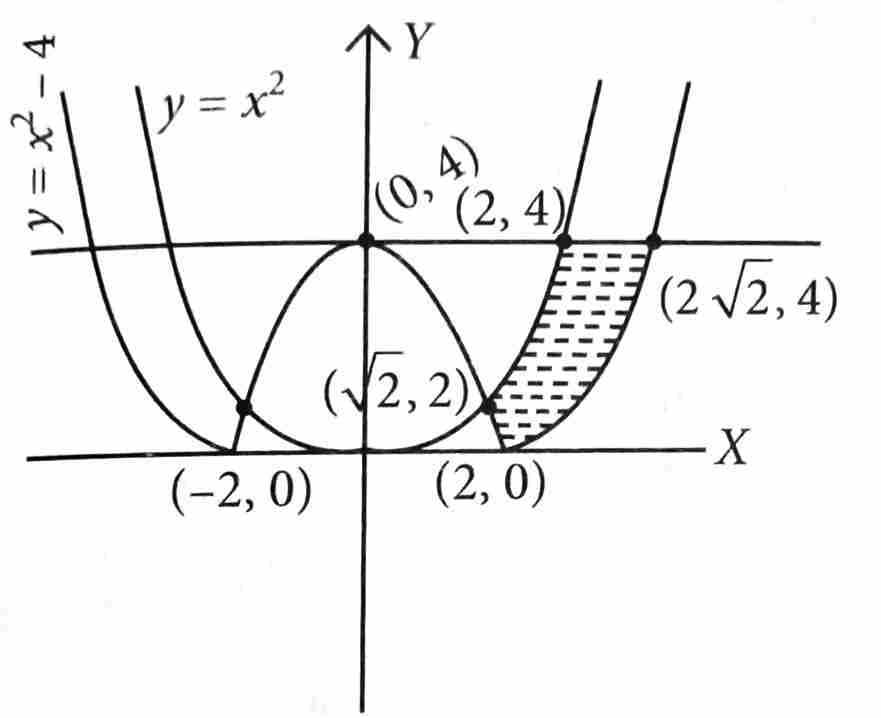
If the area of the region {(x,y):|4–x2|≤y≤x2, y≤4, x≥0} is (802α–β), α, β∈N, then α+β is equal to _________.          [2025]


(22)

Required area =∫22(x2–(4–x2))dx+(22–2)×4–∫222(x2–4)dx

=[2x33–4x]22+82–8–[x33–4x]222

=4023–16=8026–6

⇒ α=6, β=16

⇒ α+β=22.


Q 18 :

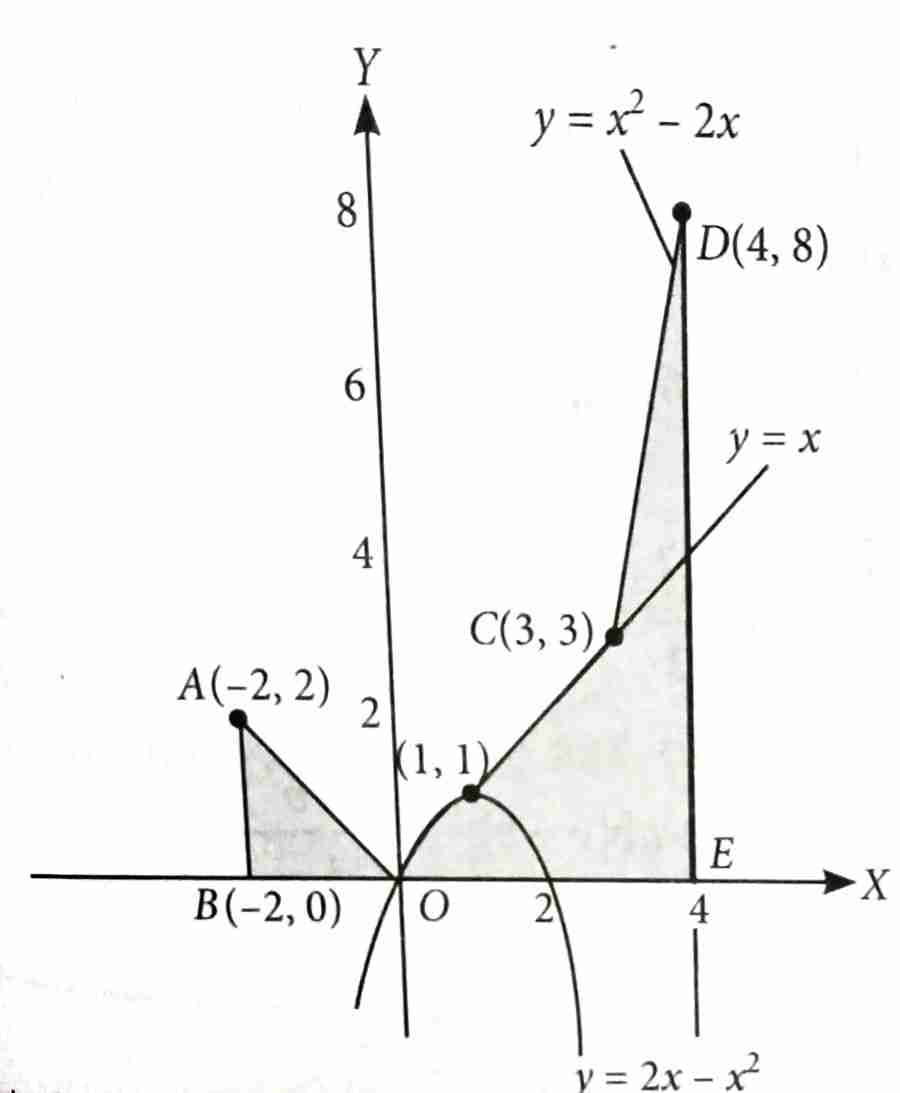
The area of the region bounded by the curve y = max {|x|,x|x–2|}, the x-axis and the lines x = –2 and x = 4 is equal to _________.          [2025]


(12)

Required Area = Area of △OAB + Area of region OCDEO

=12×2×2+∫01(2x–x2)dx+∫13xdx+∫34(x2–2x)dx

=2+23+4+163

= 12 sq. units.


Q 19 :

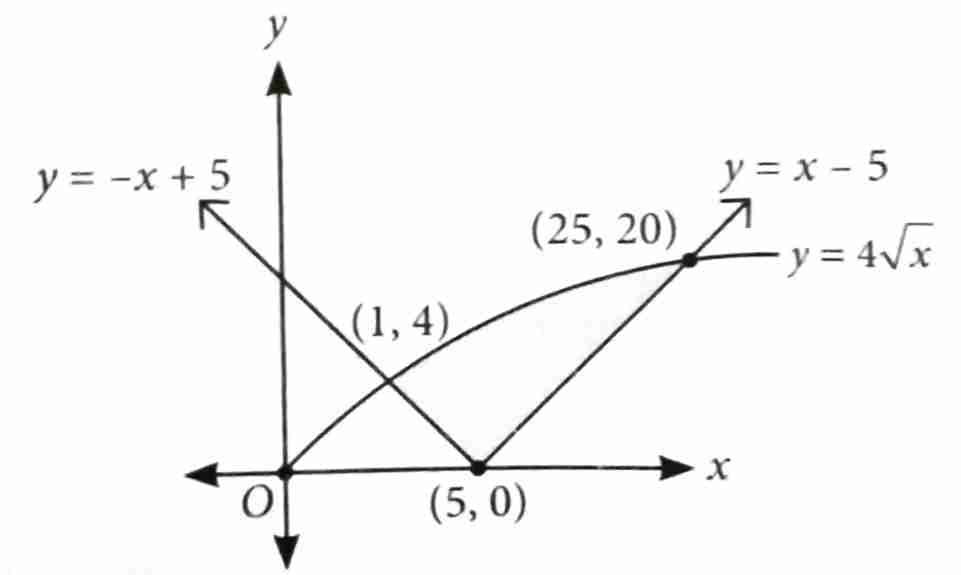
If the area of the region {(x,y):|x–5|≤y≤4x} is A, then 3A is equal to __________.          [2025]


(368)

Area A=∫1254xdx–12×4×4–12×20×20

                =[4x3/2×23]125–208

                =83(125–1)–208

                =3683 sq. units

⇒ 3A=368.


Q 20 :

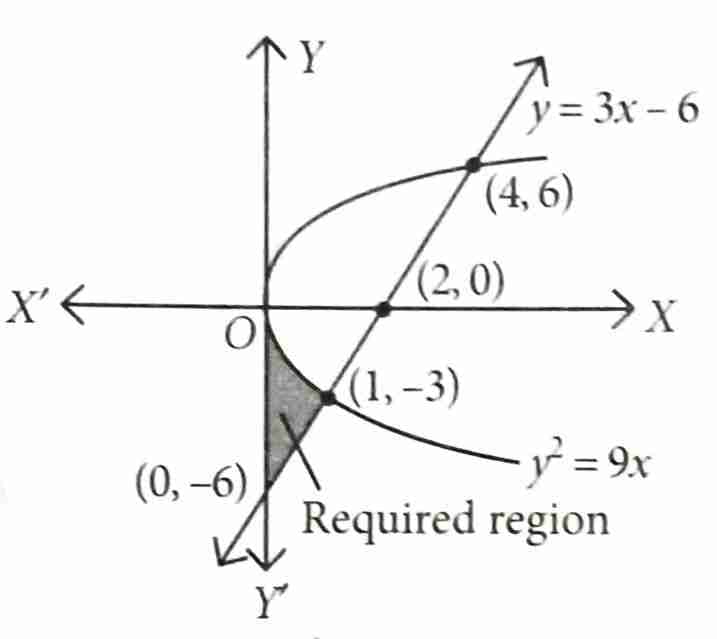
Let the area of the bounded region {(x,y):0≤9x≤y2, y≥3x–6} be A. Then 6A is equal to __________.          [2025]


(15)

We have,  0≤9x≤y2, y≥3x–6

Required area = A=|∫0–3y29dy+∫–3–6(y+63)dy|

                                  =|19[y33]0–3+13(y22+6y)–3–6|

                                  =|19[–9–0]+13[18–36–92+18]|

                                  =|–1+13[–92]|

                                  =|–1–32|=|–52|=52 sq. units

∴  6A=6×52=15


Q 21 :

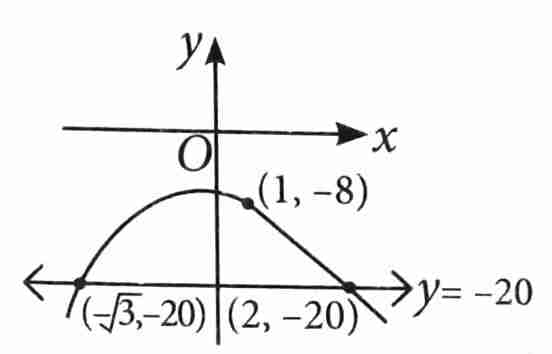
Let the function, f(x)={–3ax2–2,x<1a2+bx,x≥1 be differentiable for all x∈R, where a > 1, b∈R. If the area of the region enclosed by y = f(x) and the line y = –20 is α+β3, α, β∈Z then the value of α+β is __________.           [2025]


(34)

Given, f(x) is continuous and differentiable at x = 1.

f(x)={–3ax2–2,x<1a2+bx,x≥1

⇒ f'(x)={–6ax,x<1b,x≥1

L.H.L. at x=1 ⇒ –3a–2

R.H.L. at x=1 ⇒ a2+b

∴   L.H.L. = R.H.L.          {∵ f(x) is continuous}

⇒ –3a–2=a2+b          ... (i)

L.H.D. at x=1 ⇒ –6a

R.H.D. at x=1 ⇒ b

∴   L.H.D. = R.H.D.          [∵ f(x) is differentiable]

⇒ –6a=b          ... (ii)

From (i) and (ii), we get

–3a–2=a2-6a

⇒ a2–3a+2=0 ⇒ (a–1)(a–2)=0

⇒ a=1 or a=2 ⇒ a=2           (∵ a > 1)

From (ii), b = –12

Now, f(x)={–6x2–2,x<14–12x,x≥1

∴  Area of region =∫–31(–6x2–2+20)dx+∫12(4–12x+20)dx

=(–6x33–2x+20x)–31+(4x–12x22+20x)12

⇒ 16+123+6=22+123

⇒ 22+123=α+β3

So, α=22 and β=12

∴  α+β=22+12=34


Q 22 :

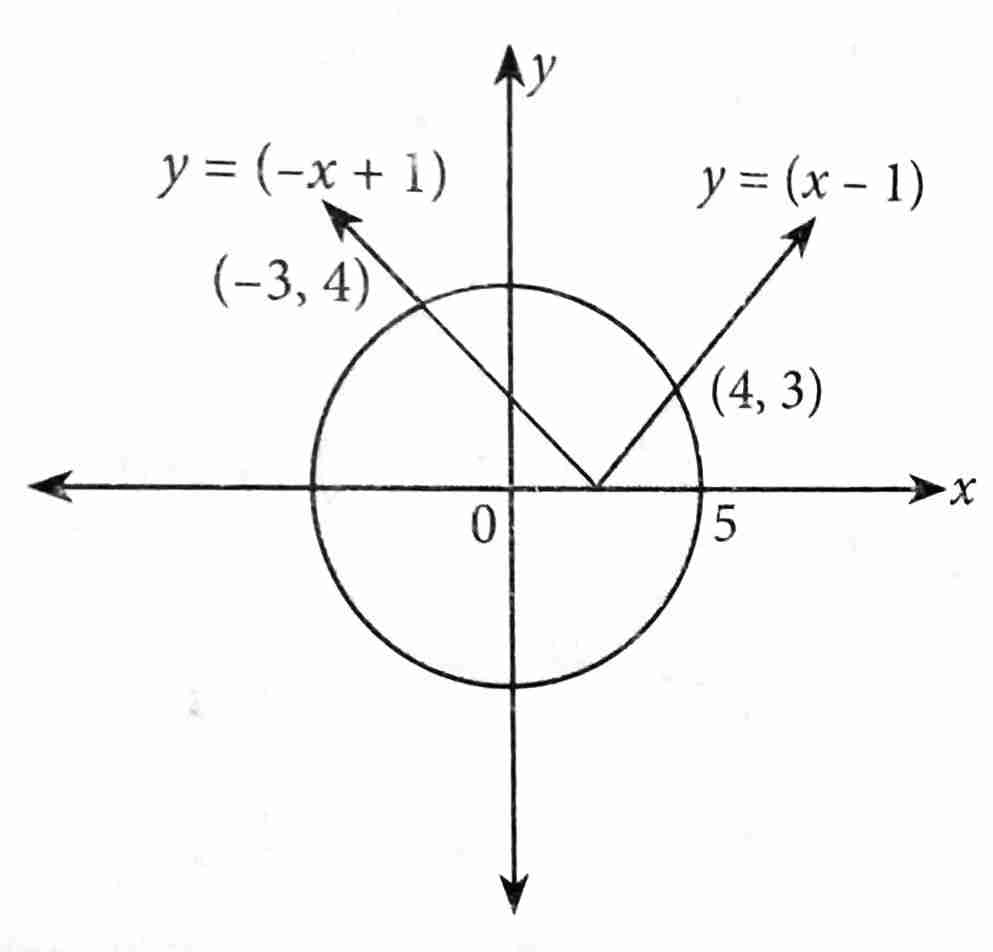
If the area of the larger portion bounded between the curves x2+y2=25 and y=|x–1| is 14(bπ+c), b, c∈N, then b + c is equal to __________.          [2025]


(77)

Given, x2+y2=25

⇒ x2+(x–1)2=25          [∵ y = |x –1|]

⇒ x=4,–3

∴   Required area =25π–(∫–34(25–x2–|x–1|)dx)

=25π–[12x25–x2+252sin–1x5]–34+∫–31(1–x)dx+∫14(x–1)dx

=25π+252–(2×3+252sin–1(45)+32×4+252sin–1(35))

=25π+252–12–25π4

=75π4+12=14(75π+2)

∴  14(bπ+c)=14(75π+2)

⇒ b=75, c=2

⇒ b+c=77.


Q 23 :

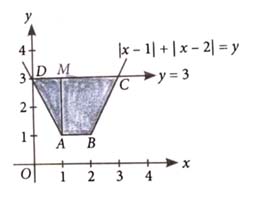
The area bounded by the curves y=|x-1|+|x-2| and y=3 is equal to               [2023]
 

  • 6


  • 3


  • 5


  • 4


(4)

Required area is shaded in the given figure, which is a trapezium.

∴  Area=12×Sum of parallel sides×Height

=12×(AB+CD)×AM=12(1+3)×2=4 sq. units


Q 24 :

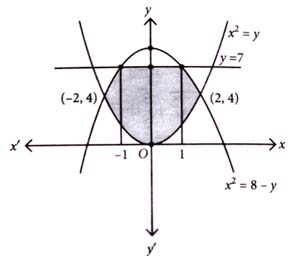
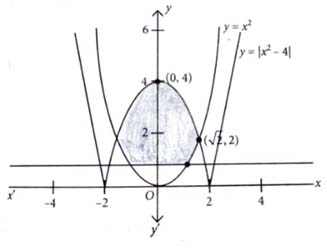
The area of the region {(x,y):x2≤y≤8-x2, y≤7} is         [2023]
 

  • 24


  • 20


  • 18


  • 21


(2)

We have,

x2≤y

8-x2≥y

y≤7

Converting the given inequations into equations, we get  x2=y and y=8-x2

Solving these equations to find their point of intersection

i.e.,  x2=8-x2

⇒2x2=8⇒x2=4⇒x=±2

∴  y=4

Required area=∫-22(8-x2-x2)dx- ∫-11(8-x2-7)dx

=∫-22(8-2x2)dx-∫-11(1-x2)dx=[8x-23x3]-22-[x-x33]-11

=[(16-163)-(-16+163)]-[23+23]

=16-163+16-163-43=20 sq. units


Q 25 :

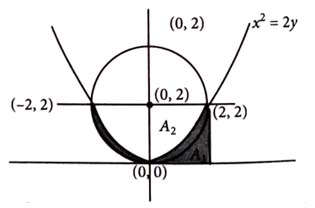
Area of the region {(x,y):x2+(y-2)2≤4, x2≥2y} is        [2023]
 

  • 2π-163    


  • π-83    


  • π+83    


  • 2π+163


(1)

Given that x2+(y-2)2≤22 and x2≥2y

Convert the given inequalities into equations:

x2+(y-2)2=4 and x2=2y

Solving circle and parabola simultaneously:

2y+y2-4y+4=4, y2-2y=0, y=0, 2

Put y=2 in x2=2y⇒x=±2 ⇒(2,2) and (-2,2)

A1=2×2-14·π·22=4-π

Required area=2[∫02x22 dx-(4-π)]

=2[x36|02-4+π]=2[43+π-4]=2[π-83]=2π-163sq. units


Q 26 :

The area of the region enclosed by the curve y=x3 and its tangent at the point (-1,-1) is      [2023]

  • 274    


  • 314    


  • 234    


  • 194


(1)

Given, y=x3

Equation of tangent to the curve y=x3 at point (-1,-1) is

y+1=3(x+1) ⇒ y=3x+2

Point of intersection with the curve is (2,8)

So, area =∫-12[(3x+2)-x3]dx

=[3×x22+2x-x44]-12

=274 sq. units


Q 27 :

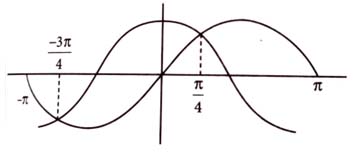
The area of the region enclosed by the curve f(x)=max{sinx,cosx}, -π≤x≤π and the x-axis is         [2023]

  • 4(2)


  • 2(2+1)


  • 22(2+1)


  • 4


(4)

We have f(x)=max{sinx,cosx}, -π≤x≤π

Now, the area of the region enclosed by the given curve and the x–axis is

=|∫-π-3π/4sinx dx|+|∫-3π/4-π/2cosx dx|+|∫-π/2π/4cosx dx|+|∫π/4πsinx dx|

=-12+1+1-12+12+1+1+12=4


Q 28 :

The area of the region {(x,y):x2≤y≤|x2-4|,y≥1} is            [2023]

  • 43(42+1)


  • 34(42-1)


  • 34(42+1)


  • 43(42-1)


(4)

Required area=2(∫12ydy+∫244-ydy)

=2([y3/23/2]12-[(4-y)3/23/2]24)

=43[(22-1)-(0-22)]=43(42-1)


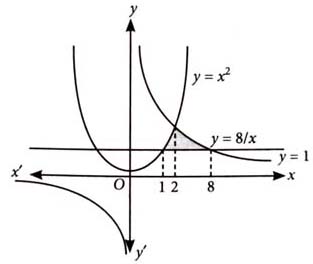
Q 29 :

The area of the region given by {(x,y):xy≤8, 1≤y≤x2} is           [2023]

  • 16loge2-143


  • 8loge2-133


  • 8loge2+76


  • 16loge2+73


(1)

Area=∫12(x2-1)dx+∫28(8x-1)dx

=(x33-x)12+8(logex)28-(x)28

=43+8(2loge2)-6=16loge2-143


Q 30 :

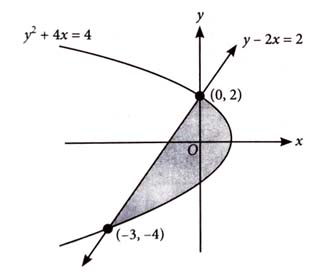
The area enclosed by the curves y2+4x=4 and y-2x=2 is            [2023]

  • 233


  • 223


  • 9


  • 253


(3)

Given curves are y2+4x=4 and y-2x=2

The points of intersection of the given curves are (0, 2) and (- 3, - 4)

Required area=∫-42[(4-y24)-(y-22)]dy

=∫-42-y2-2y+84dy=14[-y33-y2+8y]-42

=14[(-83-4+16)-(643-16-32)]

=14[(283)-(-803)]=14(1083)=10812=9 sq. units.


Q 31 :

Let A={(x,y)∈ℝ2:y≥0, 2x≤y≤ 4-(x-1)2 }

and B={(x,y)∈ℝ×ℝ:0≤y≤min{2x, 4-(x-1)2 }}.

Then the ratio of the area of A to the area of B is                             [2023]

  • ππ+1    


  • π-1π+1    


  • π+1π-1    


  • ππ-1


(2)

Let A={(x,y)∈ℝ2:y≥0, 2x≤y≤4-(x-1)2}

and B={(x,y)∈ℝ×ℝ:0≤y≤min{2x,4-(x-1)2}}

We have the following diagram y2+(x-1)2=4

Shaded portion A

Area A=area of quadrant of circle-area of (OAB)

              =π(4)4-12(2)(1)=(π-1)                      ...(i)

Now, for finding the area of portion B, we have

Area B=area of (∆AOB)+area of quadrant of circle

              =12·(1)(2)+π(2)24=(π+1)                     ...(ii)

Thus, according to the question, ratio of area A to area

B=π-1π+1


Q 32 :

Let Δ be the area of the region {(x,y)∈ℝ2:x2+y2≤21, y2≤4x, x≥1}. Then 12(Δ-21sin-127) is equal to          [2023]

  • 3-23


  • 23-23


  • 23-13


  • 3-43


(4)

If Δ be the area of region {(x,y)∈ℝ2:x2+y2≤21, y2≤4x, x≥1}. Then we have,

Area=2∫132xdx+2∫321(21-x2)dx

Δ=83·(33-1)+21sin-1(27)-63

⇒[Δ-21sin-1(27)]=23-832

⇒12[Δ-21sin-127]=3-43


Q 33 :

The area of the region A={(x,y):|cosx-sinx|≤y≤sinx, 0≤x≤π2} is               [2023]

  • 5-22+1


  • 5+22-4.5


  • 1-32+45


  • 35-32+1


(1)

The area of the region, A={(x,y):|cosx-sinx|≤y≤sinx, 0≤x≤π2}

⇒|cosx-sinx|≤y≤sinx

For finding the intersecting point we must have  

cosx-sinx=sinx

⇒tanx=12

Let ϕ=tan-112

So, tanϕ=12, sinϕ=15, cosϕ=25

Area=∫ϕπ/2(sinx-|cosx-sinx|)dx

=∫ϕπ/4(sinx-(cosx-sinx))dx+∫π/4π/2(sinx-(sinx-cosx))dx

=∫ϕπ/4(2sinx-cosx)dx+∫π/4π/2cosx dx

=[-2cosx-sinx]ϕπ/4+[sinx]π/4π/2

=5-22+1


Q 34 :

Let q be the maximum integral value of p in [0,10] for which the roots of the equation x2-px+54p=0 are rational. Then the area of the region 
{(x,y):0≤y≤(x-q)2, 0≤x≤q} is            [2023]

  • 164


  • 243


  • 1253


  • 25


(2)

Given equation is x2-px+54p=0

D=p2-5p, which is a perfect square when p=9.

∴  q=9

Required area=∫09(x-9)2dx

=∫09(x2-18x+81)dx=[x33-18×x22+81x]09

=243 sq. units.


Q 35 :

If the area of region S={(x,y): 2y-y2≤x2≤2y, x≥y} is equal to n+2n+1-πn-1, then the natural number n is equal to _______ .    [2023]


(5)

Given, x2+y2-2y≥0; x2-2y≤0; x≥y

Area of segment OAB=90°360°×π(1)2-12×1×1

=(π4-12)

Hence, required area =∫02(x-x22)dx-(π4-12)

=(x22-x36)02 -(π-24)=2-43-π4+12=76-π4

Now, n+2n+1-πn-1=76-π4

For n=5, n+2n+1-πn-1=76-π4       ∴  n=5


Q 36 :

Let the area enclosed by the lines x+y=2, y=0, x=0 and the curve f(x)=min{x2+34, 1+[x]}, where [x] denotes the greatest integer ≤x, be A. Then the value of 12A is____________ .             [2023]


(17)


Q 37 :

Let y=p(x) be the parabola passing through the points (-1,0),(0,1) and (1,0). If the area of the region

 {(x,y):(x+1)2+(y-1)2≤1, y≤p(x)} is A, then 12(π-4A) is equal to ______ .         [2023]


(16)

There can be infinite parabola through given points.

In question, it must be given that axis of parabola is parallel to y-axis.

Equation of parabola passing through (-1, 0), (0, 1) and (1, 0) is x2=-(y-1)                     ...(i)

∴  Required area, A=∫-10[(1-x2)-(1-1-(x+1)2)]dx

=∫-10(-x2+1-(x+1)2)dx

=[-x33+x+121-(x+1)2+12sin-1(x+11)]-10

=12(π2)-13=π4-13

∴ 12(π-4A)=12(π-4(π4-13))=12(43)=16


Q 38 :

If the area of the region {(x,y):|x2-2|≤y≤x} is A, then 6A+162 is equal to _______ .           [2023]


(27)

We have,   

Region={(x,y):|x2-2|≤y≤x}

The graph of the region is as shown in figure.

Required area, A=∫12[x-{-(x2-2)}]dx+∫22{x-(x2-2)}dx

=∫12(x2+x-2)dx+∫22(-x2+x+2)dx

=(x33+x22-2x)12+(-x33+x22+2x)22

=(223+1-22)-(13+12-2)+(-83+2+4)-(-223+1+22)

=27-1626     ∴  6A+162=27-162+162=27


Q 39 :

If A is the area in the first quadrant enclosed by the curve C: 2x2-y+1=0, the tangent to C at the point (1, 3) and the line x+y=1, then the value of 60A is ______ .    [2023]


(16)

Given, C:2x2-y+1=0

⇒4x-dydx=0 ⇒dydx=4x ⇒[dydx](1,3)=4

Equation of tangent to the curve C is

     y-3=4(x-1)

⇒y-4x+1=0    ...(i)

Also, given line is x+y=1    ...(ii)

Solving (i) and (ii), we get x=0.4, y=0.6

Given curve and equation (ii) intersect each other at (0,1) and (-0.5,1.5).

Required area,  

A=∫01(2x2+1)dx-area of ∆EOA-area of ∆BED+area of ∆EDC

=[2x33+x]01-12×1×1-12(1-14)×3+12×(1-14)×0.6

=(23+1)-12-98+940=1660 sq. units

∴   60A=1660×60=16


Q 40 :

If the area bounded by the curve 2y2=3x, lines x+y=3, y=0 and outside the circle (x-3)2+y2=2 is A, then 4(π+4A) is equal to _____ .       [2023]


(42)

Given, y2=3x2, x+y=3, y=0, and (x-3)2+y2=2

⇒2y2=3(3-y)

⇒2y2+3y-9=0 ⇒2y2-3y+6y-9=0

⇒(2y-3)(y+3)=0⇒y=32,-2

Required area, A=∫032((3-y)-2y23)dy-π8(2)

=(3y-y22-2y39)03/2-π4=3×32-98-29(278)-π4

=92-98-34-π4

∴ 4A+π=4[92-98-34]=212=10.50

∴  4(4A+π)=42