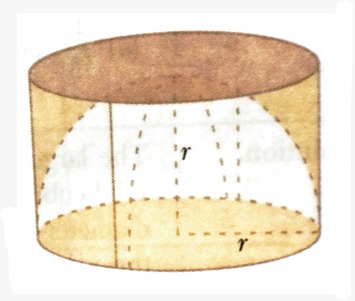


Q 1 :

The radius of the largest right circular cone that can be cut out from a cube of edge 4.2 cm is

  • 2.1 cm


  • 4.2 cm


  • 3.1 cm


  • 2.2 cm


(1)

The diameter of the largest right circular cone that can be cut out from a cube of edge 4.2 cm.

  2r=4.2 cmr=2.1 cm

⇒ Radius of the largest right circular cone = 2.1 cm.


Q 2 :

Volume and surface area of a solid hemisphere are numerically equal. What is the diameter of hemisphere?

  • 9 units


  • 6 units


  • 4.5 units


  • 18 units


(1)

Volume of hemisphere = Surface area of hemisphere

23πr3=3πr2r=92units

 d = 9 units


Q 3 :

Two identical solid hemispheres of equal base radius are stuck along their bases. The total surface area of the combination is

  • πr2


  • 2πr2


  • 3πr2


  • 4πr2


(4)

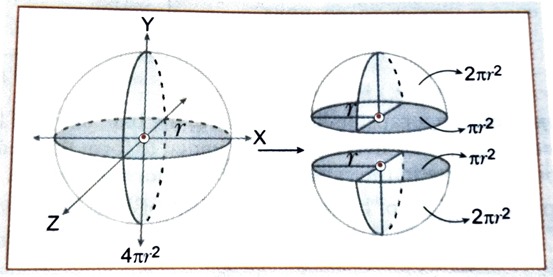
The resultant solid will be a sphere of radius r whose total surface area is 4πr2


Q 4 :

The sum of the length, breadth and height of a cuboid is 63cm and the length of its diagonal is 23cm. The total surface area of the cuboid is

  • 48cm2


  • 72cm2


  • 96cm2


  • 108cm2


(3)

Given: l+b+h=63 cm        ...(i)

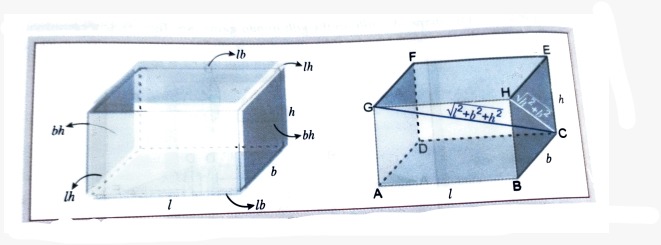
        and the length of its diagonal =23 cm  l2+b2+h2=23

Squaring both sides, we get l2+b2+h2=12   ...(ii)

From eq. (i), (l+b+h)2=(63)2

l2+b2+h2+2(lb+bh+hl)=108

12+2(lb+bh+hl)=108 [From eq. (iii)] 2(lb+bh+hl)=96

Hence, total surface area of the cuboid is 96cm2


Q 5 :

The volume of the largest right circular cone that can be carved out from a solid cube of edge 2 cm is :

  • 4π3 cu cm


  • 5π3 cu cm


  • 8π3 cu cm


  • 2π3 cu cm


(4)

Radius of cone = 1 cm

Height of cone = 2 cm

Volume of cone =13πr2h=13π(1)2×2=2π3 cu cm


Q 6 :

A solid sphere is cut into two hemispheres. The ratio of the surface areas of sphere to that of two hemispheres taken together, is:

  • 1 : 1


  • 1 : 4


  • 2 : 3


  • 3 : 2


(3)

The total surface area of a sphere = 4πr2

The surface area of one hemi-sphere = 3πr2

 The total surface area of two hemi-spheres = 6πr2

Required Ratio = 4πr26πr2=46=23


Q 7 :

A cap is cylindrical in shape, surmounted by a conical top. If the volume of the cylindrical part is equal to that of the conical part, then the ratio of the height of the cylindrical part to the height of the conical part is :

  • 1 : 2


  • 1 : 3


  • 2 : 1


  • 3 : 1


(2)     1 : 3


Q 8 :

A solid sphere is cut into two hemisphere. The ratio of the surface areas of sphere to that of two hemisphere taken together, is:

  • 1 : 1


  • 1 : 4


  • 2 : 3
     

  • 3 : 2


(3)

Let r be the radius of sphere.

Surface area of sphere=4πr2Total surface area of each hemisphere =Curved surface area=2πr2

Basearea=πr2Total=2πr2+πr2=3πr2So for two hemispheres:

3πr2+3πr2=6πr2Required ratio:=4πr23πr2+3πr2=4πr26πr2=46=23


Q 9 :

The shape of a gilli, in the gilli-danda game (see figure), is a combination of:

  • two cylinders


  • a cone and a cylinder


  • two cones and a cylinder


  • two cylinders and a cone


(3)

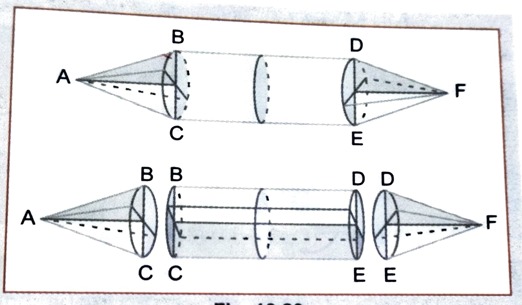
The shape of a gilli, in the gilli-danda game is a combination of two cones (ABC and DEF) and a cylinder (BDEC).


Q 10 :

If the surface area of a sphere is 616 cm², its diameter (in cm) is:

  • 7


  • 14


  • 21


  • 56


(2)

4πr2=616r2=616×14×722=49r=7 cmDiameter = 2r = 2 × 7 = 14 cm


Q 11 :

The total surface area of a hemisphere of radius 7 cm is:

  • 588π cm²


  • 392π cm²


  • 147π cm²


  • 98π cm²


(3)

Here, R = 7cm

Total surface area of hemisphere:

=3πR2=(3π×7×7) cm2=147π cm2


Q 12 :

For a cuboid with length (l), breadth (b) and height (h), which of the following statements are true?

(i) Total surface area of the cuboid =2(lb+bh+lh) square units.

(ii) Diagonal of the cuboid has a length of l2+b2+h2 units.

(iii) If the cuboid was a room, the area of its walls would be (2l+2b+2h) square units.

(iv) All cuboids are cube.

Choose the correct option from the following:

  • (i) and (ii)
     

  • (ii) and (iii)
     

  • (i) and (iv)


  • (ii) and (iv)


(1)

(i) Total surface area =Sum of areas of all faces =lb+bh+lh+bh+lh+lb=2(lb+bh+lh) 

(ii) Diagonal length =l2+b2+h2

The diagonal joins two opposite vertices of the cuboid.

(iii) Sum of the areas of the walls =lh+bh+lh+bh=2hl+b

(iv) All cubes are cuboid but all cuboids are not cube.


Q 13 :

The appearance of an ice-cream cone is a combination of:

(i) Cube
(ii) Hemisphere
(iii) Cone
(iv) Cylinder

Choose the correct option from the following:

  • (i) and (iii)
     

  • (i) and (iv)


  • (ii) and (iii)


  • (ii) and (iv)


(3)

The shape of ice-cream is a combination of a hemisphere and a cone.


Q 14 :

We convert a solid sphere into a cylinder, then which of the following statements hold true?

(i) Surface area might change but volume stays the same.
(ii) Volume changes but surface area remains the same.
(iii) Volume of the sphere > volume of the cylinder
(iv) Nothing changes

Choose the correct option from the following:

  • (ii) and (iii)


  • Only (i)


  • (iii) and (iv)


  • (i) and (ii)


(2)

When an entire object is converted from one shape to another, their volume remains the same.

∴ Volume of sphere = Volume of cylinder

Surface area may or may not change.

Therefore,

Option (b) is correct.


Q 15 :

A cylinder has a radius of 3 cm and a height of 5 cm. Which of the following represents its total surface area and curved surface area?

(i) Total surface area = 48π cm²
(ii) Curved surface area = 62π cm²
(iii) Curved surface area = 30π cm²
(iv) Total surface area = 3π cm²

Choose the correct option from the following:

  • Only (i)


  • (ii) and (iv)


  • (iii) and (iv)


  • (i) and (iii)


(4)

Total surface area of cylinder =curved surface area+2×area of base

=2πrh+2πr2=2π(3)(5)+2π(3)2=2π(3)(3+5)=48π cm2Curved surface area of cylinder=2πrh=2π(3)(5)=30π cm2So, (i) and (iii) are correct.


Q 16 :

Two cones have their heights in the ratio 1 : 3 and radii in the ratio 3 : 1. Then ratio of their volume is:

  • 1 : 3


  • 2 : 3


  • 3 : 1


  • 1 : 1


(3)

Let height of the cones are h and 3h respectively and their radii are 3r and r respectively.

∴ Ratio of volumes = volume of first conevolume of second cone=13π(3r)2×h13πr2×3h=93=31 Required ratio is 3 : 1.


Q 17 :

12 spheres of the same size are made from melting a solid cylinder of 16 cm diameter and 2 cm height. The diameter of each sphere is:

  • 3 cm    


  • 2 cm


  • 3 cm


  • 4 cm


(4)

Radius of cylinder=162=8 cm

Let  r cm be the radius of each sphere.

hen one solid shape is converted into another, the volume remains the same

 Volume of the solid cylinder =12× volume of one sphere

π×(8)2×2=12×43πr3

128=16r3r3=8r=2 cm

Diameter of sphere =2r=2×2=4 cm

 Option (d) is correct.


Q 18 :

The volume of the largest right circular cone that can be carved out from a solid cube of edge 2 cm is:

  • 4π3cucm


  • 5π3cucm


  • 8π3cucm


  • 2π3cucm


(4)

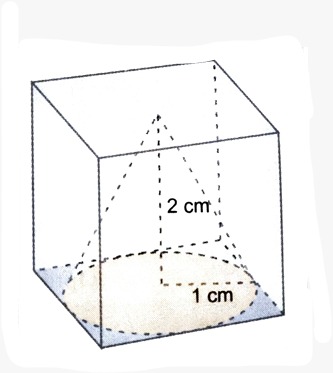
The largest cone that can be carved out from solid cube of edge 2 cm will be the cone whose diameter of base and height both are equal to the edge of the cube.

From the figure, radius of cone = r = 1 cm and height of cone = h = 2 cm

∴ Volume of cone formed

=13πr2h

=13×π×12×2

=2π3 cm3


Q 19 :

A right circular hollow cylinder has an outer radius of R and inner radius of r. Which of the following statements hold true if h is the height of the cylinder?

(i) Curved surface area of the cylinder =2π(R+r)h

(ii) Total surface area of the cylinder =2π(R+r)(R+h-r)

(iii) Total volume of the cylinder =π(R2-r2)h

(iv) Total volume of the cylinder =π(R2+r2)h

Choose the correct option from the following:

  • Only (iv)


  • (i) and (iii)


  • (i), (ii) and (iii)


  • (i), (ii) and (iv)


(3)

Curved surface area = External curved surface area + Internal curved surface area

=2πRh+2πrh=2π(R+r)h

(ii) Total surface area =2πRh+2πrh+2(πR2-πr2)

=2π(R+r)h+2π(R+r)(R-r)

=2π(R+r)(R+h-r)

(iii) Total volume=πR2h-πr2h=πh(R2-r2)

 Option (c) is correct.


Q 20 :

There is a cylinder circumscribing the hemisphere such that their bases are common and their height is same. The respective ratio (hemisphere : cylinder) of volume and curved surface area are:

(i) Ratio of volume = 1 : 3    (ii) Ratio of CSA = 1 : 2

(iii) Ratio of volume = 2 : 3   (iv) Ratio of CSA = 1 : 1

Choose the correct option from the following:

  • (i) and (iv)


  • (ii) and (iii)  


  • (i) and (iii)  


  • (iii) and (iv)


(4)

Height of cylinder = r
Radius of sphere = r

Volume of cylinder=V1=π(r2)(r)=πr3

Volume of hemisphere=V2=23πr3

V1V2=πr323πr3=32V2:V1=2:3

Ratio of CSA =CSA of hemisphereCSA of cylinder=2πr22πr(r)=1:1